

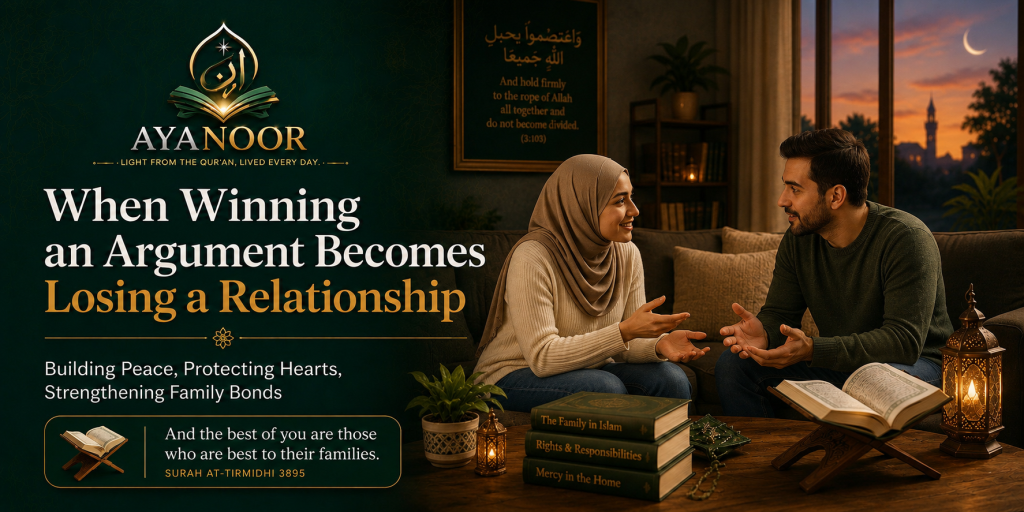
A Family Learning Guide Through Qur’anic Wisdom
Every family experiences disagreements. Parents and children may disagree. Husbands and wives may see situations differently. Siblings may argue over words, behavior, fairness, or misunderstandings.
But many times, the real damage does not come from the original issue. It comes from the way the argument continues long after hearts have stopped listening.
People begin trying to “win” the conversation instead of protecting the relationship.
Voices rise. Hurtful words are spoken. Old mistakes are brought back. Pride takes control. And slowly, love and respect begin to weaken.
The Qur’an teaches us that wisdom is not found in overpowering others with words. Real wisdom is found in patience, mercy, self-control, and protecting the dignity of one another.
1. Not Every Argument Needs to Continue
Allah says in the Qur’an:
“And when the ignorant address them harshly, they say words of peace.”
— Surah Al-Furqan 25:63
Sometimes the strongest response is not continuing the fight.
A person may feel:
- “I need to prove my point.”
- “I cannot stay quiet.”
- “They must understand I am right.”
But if continuing the argument only increases anger and distance, then silence, calmness, or delaying the discussion may be the wiser path.
Protecting peace is often more valuable than winning the debate.
2. Hurtful Words Leave Long Memories
Allah says:
“And speak to people good words.”
— Surah Al-Baqarah 2:83
During arguments, people often say things they later regret:
- insulting each other
- mocking
- embarrassing
- bringing up past failures
- attacking personalities instead of solving problems
The issue may eventually pass, but painful words can remain in hearts for years.
A family should become a place of emotional safety, not emotional fear.
Before speaking during anger, ask:
- Will these words heal or wound?
- Will this solve the issue or deepen it?
- If someone spoke to me this way, how would I feel?
3. Pride Often Keeps Arguments Alive
Allah says:
“Do not turn your cheek away from people in arrogance.”
— Surah Luqman 31:18
Many family conflicts continue because nobody wants to step back first.
People may know the conversation is becoming harmful, yet pride prevents apology, softness, or compromise.
But in reality:
- apologizing does not reduce dignity
- kindness is not weakness
- calming a conflict is strength
The Prophet ﷺ taught that the strong person is not the one who defeats others physically, but the one who controls themselves when angry.
4. Listen to Understand, Not Only to Respond
Many arguments become painful because people stop listening.
Instead of understanding feelings, people prepare counterarguments while the other person is still speaking.
Allah says:
“And lower to them the wing of humility and mercy.”
— Surah Al-Isra 17:24
Families need:
- patient listening
- emotional understanding
- gentleness in disagreement
- respect even during conflict
Sometimes a person is not seeking victory. They simply want to feel heard and understood.
5. Shaytan Loves Division Inside Families
Allah warns:
“Indeed, Shaytan seeks to sow hatred and division among you.”
— Surah Al-Ma’idah 5:91
Small disagreements can slowly become:
- resentment
- emotional distance
- broken trust
- damaged marriages
- divided families
This is why families must protect unity intentionally.
When arguments begin:
- pause before reacting
- lower the voice
- avoid public humiliation
- avoid arguing in front of children
- return later when emotions settle
Children especially learn conflict behavior from what they observe at home.
6. A Peaceful Home Is a Great Blessing
A beautiful home is not built only with furniture, money, or comfort.
A true home is built with:
- mercy
- patience
- forgiveness
- respectful speech
- emotional safety
- gentle hearts
Allah describes marriage as a relationship of tranquility and mercy:
“And He placed between you affection and mercy.”
— Surah Ar-Rum 30:21
Families should ask themselves:
- Are we protecting each other’s hearts?
- Are we speaking with mercy?
- Are we solving problems or feeding anger?
- Is our home becoming peaceful or emotionally exhausting?
Reflection Questions
- Do I continue arguments even when they stop benefiting anyone?
- Have my words hurt someone I love?
- Do I listen with patience or only wait to respond?
- Is pride preventing reconciliation?
- How can I bring more mercy and calmness into my home?
Final Reflection
Every family will face disagreements.
But successful families are not the ones without conflict.
They are the families who learn:
- how to calm anger,
- protect relationships,
- apologize sincerely,
- forgive generously,
- and choose mercy over ego.
Sometimes the greatest victory is not winning the argument.
It is saving the relationship.Here is a family learning guide written in the Ayanoor style:
When Winning an Argument Becomes Losing a Relationship
A Family Learning Guide Through Qur’anic Wisdom
Every family experiences disagreements. Parents and children may disagree. Husbands and wives may see situations differently. Siblings may argue over words, behavior, fairness, or misunderstandings.
But many times, the real damage does not come from the original issue. It comes from the way the argument continues long after hearts have stopped listening.
People begin trying to “win” the conversation instead of protecting the relationship.
Voices rise. Hurtful words are spoken. Old mistakes are brought back. Pride takes control. And slowly, love and respect begin to weaken.
The Qur’an teaches us that wisdom is not found in overpowering others with words. Real wisdom is found in patience, mercy, self-control, and protecting the dignity of one another.
1. Not Every Argument Needs to Continue
Allah says in the Qur’an:
“And when the ignorant address them harshly, they say words of peace.”
— Surah Al-Furqan 25:63
Sometimes the strongest response is not continuing the fight.
A person may feel:
- “I need to prove my point.”
- “I cannot stay quiet.”
- “They must understand I am right.”
But if continuing the argument only increases anger and distance, then silence, calmness, or delaying the discussion may be the wiser path.
Protecting peace is often more valuable than winning the debate.
2. Hurtful Words Leave Long Memories
Allah says:
“And speak to people good words.”
— Surah Al-Baqarah 2:83
During arguments, people often say things they later regret:
- insulting each other
- mocking
- embarrassing
- bringing up past failures
- attacking personalities instead of solving problems
The issue may eventually pass, but painful words can remain in hearts for years.
A family should become a place of emotional safety, not emotional fear.
Before speaking during anger, ask:
- Will these words heal or wound?
- Will this solve the issue or deepen it?
- If someone spoke to me this way, how would I feel?
3. Pride Often Keeps Arguments Alive
Allah says:
“Do not turn your cheek away from people in arrogance.”
— Surah Luqman 31:18
Many family conflicts continue because nobody wants to step back first.
People may know the conversation is becoming harmful, yet pride prevents apology, softness, or compromise.
But in reality:
- apologizing does not reduce dignity
- kindness is not weakness
- calming a conflict is strength
The Prophet ﷺ taught that the strong person is not the one who defeats others physically, but the one who controls themselves when angry.
4. Listen to Understand, Not Only to Respond
Many arguments become painful because people stop listening.
Instead of understanding feelings, people prepare counterarguments while the other person is still speaking.
Allah says:
“And lower to them the wing of humility and mercy.”
— Surah Al-Isra 17:24
Families need:
- patient listening
- emotional understanding
- gentleness in disagreement
- respect even during conflict
Sometimes a person is not seeking victory. They simply want to feel heard and understood.
5. Shaytan Loves Division Inside Families
Allah warns:
“Indeed, Shaytan seeks to sow hatred and division among you.”
— Surah Al-Ma’idah 5:91
Small disagreements can slowly become:
- resentment
- emotional distance
- broken trust
- damaged marriages
- divided families
This is why families must protect unity intentionally.
When arguments begin:
- pause before reacting
- lower the voice
- avoid public humiliation
- avoid arguing in front of children
- return later when emotions settle
Children especially learn conflict behavior from what they observe at home.
6. A Peaceful Home Is a Great Blessing
A beautiful home is not built only with furniture, money, or comfort.
A true home is built with:
- mercy
- patience
- forgiveness
- respectful speech
- emotional safety
- gentle hearts
Allah describes marriage as a relationship of tranquility and mercy:
“And He placed between you affection and mercy.”
— Surah Ar-Rum 30:21
Families should ask themselves:
- Are we protecting each other’s hearts?
- Are we speaking with mercy?
- Are we solving problems or feeding anger?
- Is our home becoming peaceful or emotionally exhausting?
Reflection Questions
- Do I continue arguments even when they stop benefiting anyone?
- Have my words hurt someone I love?
- Do I listen with patience or only wait to respond?
- Is pride preventing reconciliation?
- How can I bring more mercy and calmness into my home?
Final Reflection
Every family will face disagreements.
But successful families are not the ones without conflict.
They are the families who learn:
- how to calm anger,
- protect relationships,
- apologize sincerely,
- forgive generously,
- and choose mercy over ego.
Sometimes the greatest victory is not winning the argument.
It is saving the relationship.
Leave a Reply