

Understanding the Qur’an With Humility, Wisdom, and Unity
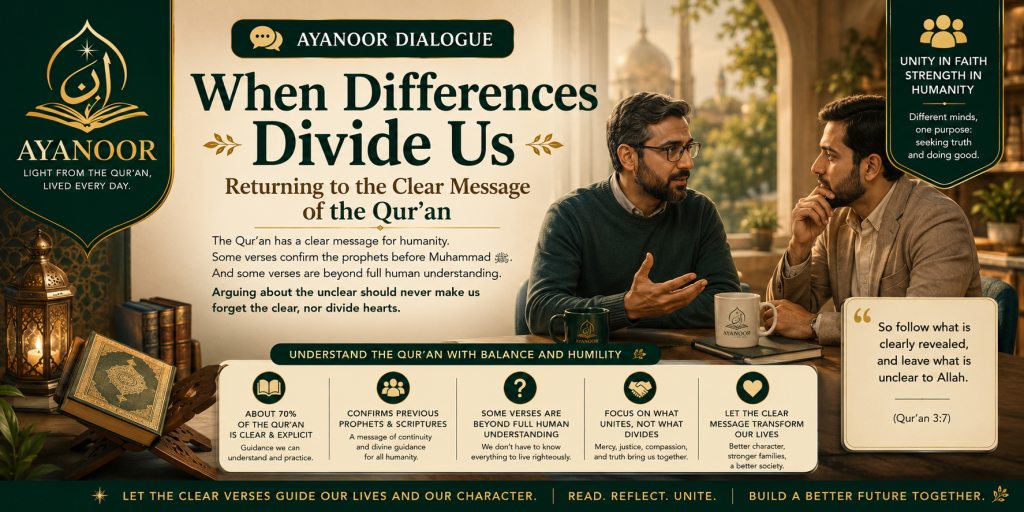
One of the most important realities about the Qur’an is that much of its message is beautifully clear and direct for humanity to understand and follow.
The Qur’an repeatedly speaks about:
- worshipping one God
- justice
- honesty
- mercy
- patience
- charity
- humility
- family values
- caring for humanity
- accountability
- respecting prophets
- avoiding oppression and corruption
It also confirms many prophets and stories already known from earlier scriptures, including:
- Adam
- Nuh (Noah)
- Ibrahim (Abraham)
- Musa (Moses)
- Dawud (David)
- Sulaiman (Solomon)
- Zakariyya
- Yahya (John)
- Isa (Jesus)
and many others, peace be upon them all.
This shared foundation creates an important bridge between people of faith and reminds humanity that divine guidance did not begin with one nation or one community alone.
But alongside the clear verses, the Qur’an also contains verses whose complete meaning and deeper realities may not be fully known to human beings.
Allah Himself tells us in the Qur’an that some verses are:
- clear and foundational
- while others require humility, reflection, and caution
The problem begins when people ignore the vast clear message of the Qur’an and become consumed with arguing over matters that human beings may never fully comprehend.
Instead of building unity, character, compassion, and justice, some become trapped in endless debates:
- trying to prove superiority
- attacking one another
- dividing communities
- turning religion into conflict instead of guidance
This is a dangerous drift for society.
The Qur’an was sent to guide hearts closer to Allah and closer to one another — not to create arrogance, hatred, and division.
A person may spend years debating unclear matters while neglecting:
- kindness to parents
- honesty in business
- mercy toward others
- care for the poor
- humility
- patience
- forgiveness
- unity of humanity
These are the very teachings repeatedly emphasized throughout the Qur’an.
A Lesson in Humility
Human knowledge will always remain limited.
Part of wisdom is knowing:
- what Allah has made clear
- and what requires humility and restraint
Not every mystery was meant to become a battlefield of arguments.
Sometimes the greatest sign of faith is not claiming certainty over everything, but accepting our limitations while remaining united in goodness.
Reflection Questions
- Are we focusing more on arguments than character?
- Do our discussions bring hearts together or push them apart?
- Are we practicing the clear teachings of mercy, honesty, justice, and humility?
- Do we approach differences with wisdom and respect?
Ayanoor Reflection
The Qur’an calls humanity toward reflection, balance, humility, and unity.
Its clear message is strong enough to transform families, communities, and societies if sincerely practiced.
And where knowledge becomes uncertain, humility becomes part of faith.
Leave a Reply