

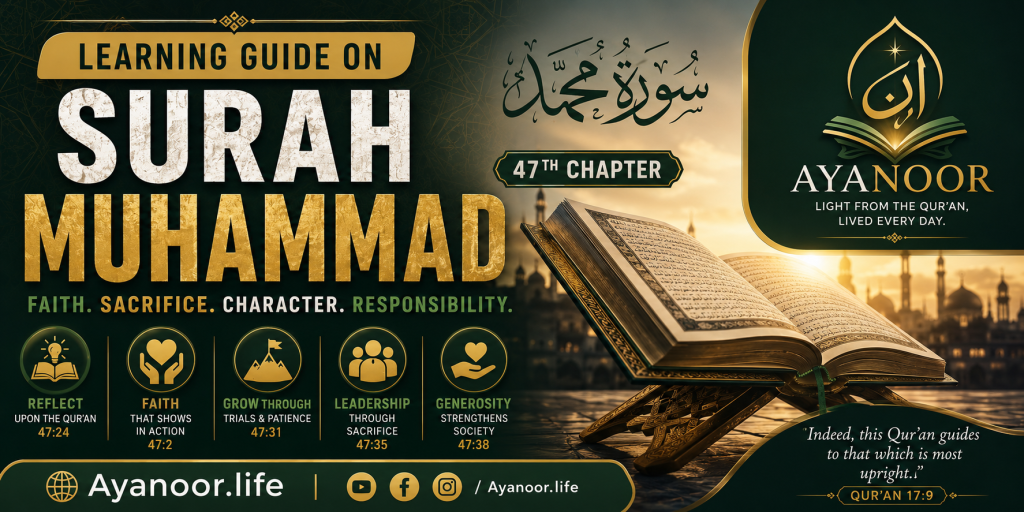
A Learning Guide on Faith, Sacrifice, Character, and Responsibility
Surah Muhammad is the 47th chapter of the Qur’an, revealed in Madinah during a period when the Muslim community faced conflict, hypocrisy, and the challenge of building a principled society. The Surah teaches that faith is not simply belief in the heart or words on the tongue — it must appear in action, sacrifice, honesty, patience, and moral responsibility.
Allah repeatedly contrasts:
- sincere believers who uphold truth,
- and those who reject faith, act hypocritically, or pursue selfish interests.
1. Faith Must Be Reflected Through Action
The Surah begins by distinguishing between those who reject truth and those who believe and do righteous deeds.
“And those who believe and do righteous deeds and believe in what has been sent down upon Muhammad — and it is the truth from their Lord — He will remove from them their misdeeds and amend their condition.”
— Qur’an 47:2
This verse establishes an important principle:
Faith is not complete without righteous action.
The Qur’an repeatedly joins:
- belief (iman)
- with righteous deeds (amal salih)
because genuine faith transforms behavior, character, and priorities.
Reflection
Today many people identify with religion culturally, yet struggle with:
- dishonesty,
- injustice,
- arrogance,
- selfishness,
- or neglect of responsibility.
Surah Muhammad asks believers to measure faith not merely by identity, but by conduct.
2. Truth and Falsehood Lead to Different Destinies
Allah explains why believers and deniers ultimately walk different paths:
“That is because those who disbelieve follow falsehood, while those who believe follow the truth from their Lord.”
— Qur’an 47:3
This verse teaches that every human being follows something:
- truth,
- desires,
- ego,
- social pressure,
- materialism,
- or divine guidance.
Reflection
Modern society often normalizes:
- manipulation,
- moral compromise,
- and image-building over sincerity.
The Qur’an reminds believers that truth must remain the foundation even when it is difficult.
3. Hardship Reveals Sincerity
The Surah explains that tests expose what lies inside people’s hearts.
“And We will surely test you until We make evident those who strive among you and the patient.”
— Qur’an 47:31
Difficulties are not always punishments. Sometimes they:
- strengthen character,
- purify intentions,
- develop patience,
- and reveal sincerity.
Reflection
People often wish for growth without struggle, but Allah teaches that maturity emerges through challenge.
Just as physical muscles grow through resistance, spiritual and emotional strength also develop through hardship.
4. The Danger of Hypocrisy
The Surah warns strongly about hypocrisy and insincerity.
“Indeed, those who turned back after guidance had become clear to them — Satan enticed them and prolonged hope for them.”
— Qur’an 47:25
Hypocrisy appears when:
- people speak about truth but avoid sacrifice,
- claim values but abandon them during difficulty,
- or place worldly comfort above moral principles.
Reflection
A major lesson of the Surah is that sincerity becomes visible during moments of pressure, not comfort.
5. Reflect Deeply Upon the Qur’an
One of the most powerful verses in the Surah states:
“Then do they not reflect upon the Qur’an, or are there locks upon their hearts?”
— Qur’an 47:24
The Qur’an was not revealed only for ritual recitation. It was revealed for:
- reflection,
- understanding,
- transformation,
- and guidance.
Reflection
A person may recite the Qur’an beautifully yet still fail to apply:
- justice,
- mercy,
- honesty,
- patience,
- and humility.
This verse encourages believers to think deeply and honestly about themselves and society.
6. Leadership Requires Sacrifice
The Surah teaches that communities survive only when people are willing to sacrifice for truth and justice.
“So do not weaken and call for peace while you are superior; and Allah is with you and will never deprive you of your deeds.”
— Qur’an 47:35
This verse was revealed during a time of conflict and pressure upon the Muslim community. It teaches resilience, courage, and moral strength.
Modern Reflection
Communities decline when:
- responsibility is avoided,
- comfort becomes the highest goal,
- and nobody wants to sacrifice for the common good.
Strong societies require:
- sincerity,
- discipline,
- service,
- and responsibility.
7. Wealth Is a Test, Not the Purpose of Life
Allah warns believers not to become consumed by worldly life.
“The worldly life is only play and amusement. But if you believe and fear Allah, He will grant you your rewards.”
— Qur’an 47:36
The Qur’an does not condemn wealth itself. Instead, it warns against:
- greed,
- obsession with status,
- selfishness,
- and forgetting spiritual purpose.
Reflection
When material success becomes the center of life, societies often lose:
- compassion,
- family strength,
- gratitude,
- and moral direction.
8. Generosity Benefits the Believer
Allah encourages believers to spend for good causes and help others.
“Here you are — those invited to spend in the cause of Allah — but among you are those who withhold.”
— Qur’an 47:38
The verse continues by reminding believers that Allah is not dependent upon human charity; rather, people benefit spiritually from generosity themselves.
Reflection
Giving develops:
- empathy,
- humility,
- gratitude,
- and social responsibility.
A healthy society depends upon people who are willing to contribute beyond personal interest.
9. Allah Can Replace Any Nation
The Surah ends with a powerful warning:
“And if you turn away, He will replace you with another people; then they will not be the likes of you.”
— Qur’an 47:38
No nation or community is guaranteed honor forever.
Civilizations decline when they:
- abandon justice,
- normalize corruption,
- weaken morally,
- and lose sincerity.
Historical Reflection
History repeatedly shows that societies often collapse internally before collapsing externally.
The Qur’an teaches humility and constant self-correction.
Description of Paradise
Surah Muhammad beautifully describes Paradise as a reward for sincere believers:
“A description of the Paradise promised to the righteous: wherein are rivers of water unaltered, rivers of milk whose taste never changes, rivers of wine delicious to those who drink, and rivers of purified honey…”
— Qur’an 47:15
This imagery symbolizes:
- purity,
- peace,
- satisfaction,
- and eternal reward.
Paradise is connected with:
- faith,
- righteous action,
- patience,
- and sincerity.
Practical Lessons from Surah Muhammad
Personal Lessons
- Build sincerity over appearances
- Stay patient during hardship
- Reflect deeply on the Qur’an
- Avoid arrogance and hypocrisy
- Let faith shape your behavior
Family Lessons
- Teach courage and honesty
- Encourage responsibility in children
- Build homes upon truth and mercy
- Avoid double standards in parenting
Community Lessons
- Societies survive through sacrifice
- Justice requires courage
- Leadership means service
- Moral decline weakens nations
Spiritual Lessons
- Faith must produce action
- Tests reveal sincerity
- Reflection softens the heart
- Allah values honesty and effort
Questions for Reflection
- Is my faith visible in my daily conduct?
- Do I reflect deeply upon the Qur’an?
- How do I behave during hardship?
- Am I driven more by comfort or responsibility?
- What sacrifices am I making for truth and goodness?
- Am I strengthening my community or weakening it?
Conclusion
Surah Muhammad is a powerful reminder that believers are meant to become people of:
- integrity,
- courage,
- reflection,
- discipline,
- compassion,
- and service.
The Surah teaches that true faith is not merely spoken — it is lived through character, sacrifice, and sincerity.
It reminds humanity that societies rise through truth and justice, and decline through hypocrisy, arrogance, and selfishness.
Above all, Surah Muhammad calls believers to transform faith into meaningful action and to live with responsibility before Allah and humanity.
Leave a Reply