

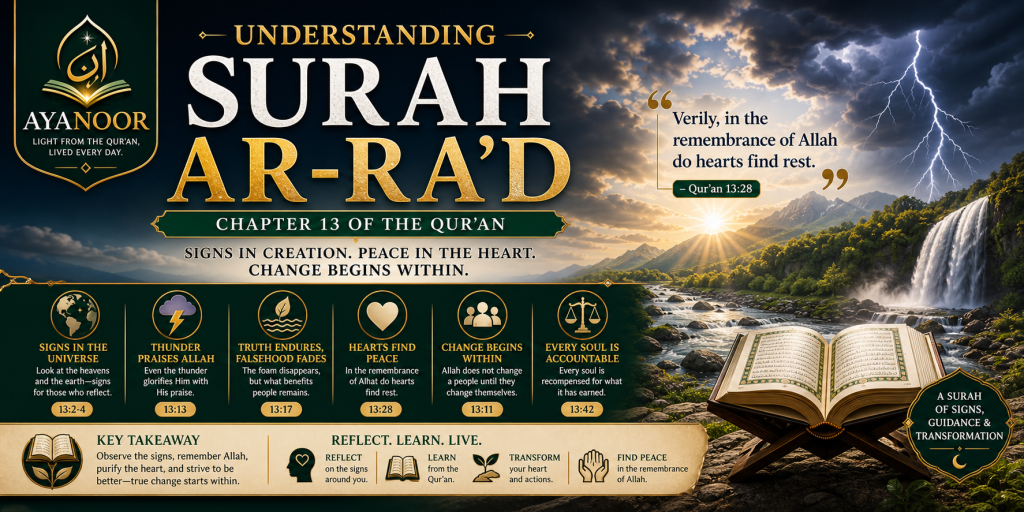
Power, Signs, and the Transformation of the Heart
Introduction
Surah Ar-Ra’d is the 13th chapter of the Qur’an. Its name means “The Thunder,” symbolizing the power of Allah and the awe-inspiring signs found in nature.
This surah invites us to reflect on:
- The visible and invisible signs of God
- The reality of guidance and misguidance
- The inner state of the human heart
- The principle that change begins within
1. Signs in the Universe
The surah begins by pointing to creation:
“It is Allah who raised the heavens without pillars that you see…”
(Qur’an 13:2)
“And in the earth are neighboring tracts… and gardens of grapevines…”
(Qur’an 13:4)
Reflection
The natural world is not random—it is filled with signs of purpose and design.
What we see outwardly is meant to awaken something inwardly.
2. Thunder as a Sign of Divine Power
The surah’s name comes from this powerful image:
“And the thunder exalts [Allah] with praise of Him…”
(Qur’an 13:13)
Reflection
Even forces of nature—like thunder—are portrayed as part of a greater order.
Moments of awe remind us of our place within creation.
3. Truth vs. Falsehood
A striking parable is given:
“As for the foam, it vanishes… but what benefits the people remains…”
(Qur’an 13:17)
Reflection
Falsehood may rise and appear strong, like foam on water—but it does not last.
Truth is steady, beneficial, and enduring.
4. The Hearts That Find Peace
One of the most well-known verses:
“Verily, in the remembrance of Allah do hearts find rest.”
(Qur’an 13:28)
Reflection
True peace is not found in wealth, success, or status—it is found in connection with God.
The heart is restless until it finds its source.
5. The Principle of Inner Change
A central message of the surah:
“Indeed, Allah does not change the condition of a people until they change what is within themselves.”
(Qur’an 13:11)
Reflection
Transformation begins from within:
- Attitudes
- Intentions
- Actions
Societies change when individuals change.
6. The Reality of Guidance
“Allah leaves astray whom He wills and guides to Himself whoever turns back [to Him].”
(Qur’an 13:27)
Reflection
Guidance is not forced—it is connected to a person’s willingness to seek truth.
Turning toward God opens the door to guidance.
7. The Weight of Accountability
“Every soul will be recompensed for what it has earned…”
(Qur’an 13:42)
Reflection
Nothing is lost.
Every action, intention, and choice carries weight.
8. The Temporary Nature of the World
“Allah extends provision for whom He wills and restricts it…”
(Qur’an 13:26)
Reflection
Wealth and provision are not always signs of success or failure.
They are part of a test—how we respond is what matters.
9. The Role of Revelation
“Thus We have sent it down as an Arabic Qur’an…”
(Qur’an 13:37)
Reflection
Revelation is guidance meant to be understood, lived, and followed—not just recited.
10. The Final Outcome
“For them is the home of peace with their Lord…”
(Qur’an 13:24)
Reflection
The ultimate reward is not temporary comfort—it is lasting peace in the presence of Allah.
Key Lessons from Surah Ar-Ra’d
- The universe is filled with signs of God’s power
- Truth endures; falsehood fades
- Inner peace comes from remembrance of Allah
- Change begins within the self
- Guidance is linked to sincere seeking
- Life is a test of response, not just circumstance
Conclusion
Surah Ar-Ra’d is a surah of awakening.
It calls us to:
- Observe deeply
- Reflect honestly
- Transform sincerely
It reminds us that while the world around us is full of signs,
the most important change happens within the heart.
Ayanoor Reflection
Light from the Qur’an transforms the heart before it transforms the world.
Surah Ar-Ra’d teaches that:
- The path to peace begins with remembrance
- The path to change begins within
- And the path to truth requires reflection
Leave a Reply