

Introduction
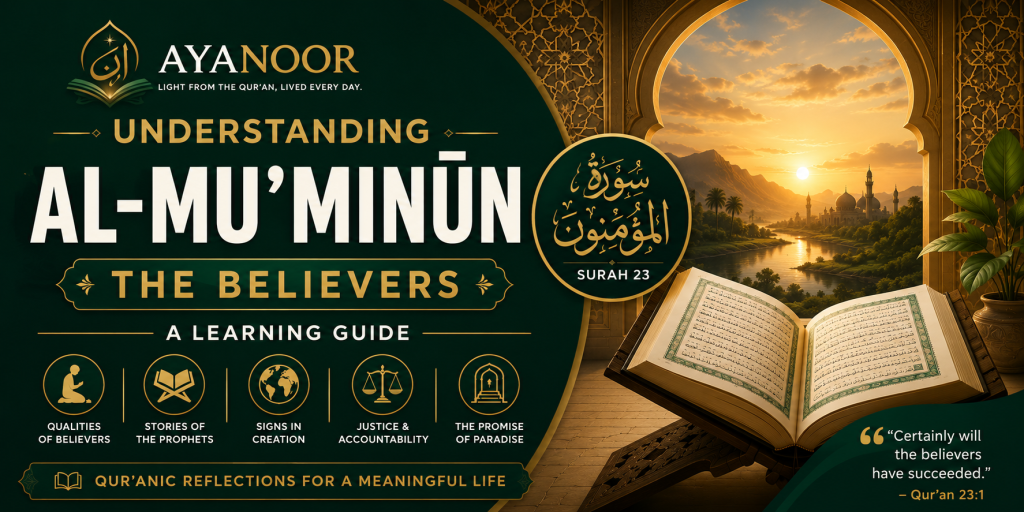
The Quran is the 23rd chapter of the Qur’an and is known as “The Believers.” This Surah focuses on the qualities of true believers, the purpose of human life, the signs of Allah in creation, and the ultimate reality of accountability before God.
The Surah presents a complete spiritual picture of what successful faith looks like — not merely belief in words, but belief reflected through character, worship, humility, honesty, and compassion.
It also connects humanity to the long chain of prophets including:
- Noah,
- Moses,
- Jesus,
- and other messengers who called humanity toward truth and righteousness.
1. The Characteristics of Successful Believers
The Surah begins with one of the Qur’an’s clearest descriptions of successful believers.
Allah says:
“Certainly will the believers have succeeded.”
— Qur’an 23:1
The Surah then lists their qualities.
a) Humility in Prayer
“Those who are humble in their prayers.”
— Qur’an 23:2
Prayer in Islam is not meant to be an empty ritual. The believer is called to stand before Allah with sincerity, reflection, and humility.
b) Avoiding Meaningless Behavior
“And those who turn away from idle talk.”
— Qur’an 23:3
The Qur’an encourages believers to avoid:
- harmful speech,
- gossip,
- mockery,
- pointless distractions,
- and behavior that damages the soul.
This teaches discipline over one’s words and attention.
c) Caring for Others
“And those who are observant of zakah.”
— Qur’an 23:4
Faith is connected to social responsibility. A believer is expected to care for the poor, needy, and vulnerable members of society.
d) Moral Purity and Self-Control
“And those who guard their chastity.”
— Qur’an 23:5
The Surah teaches dignity, modesty, and respect in relationships. Islam encourages responsible conduct and protection of families and communities.
e) Honesty and Trustworthiness
“And those who are to their trusts and promises attentive.”
— Qur’an 23:8
A true believer fulfills commitments and protects trust. Integrity is a central part of Islamic character.
f) Consistency in Worship
“And those who carefully maintain their prayers.”
— Qur’an 23:9
Faith requires consistency, not occasional spirituality.
2. The Promise of Paradise
After describing believers, Allah promises:
“Those are the inheritors. Who will inherit Al-Firdaws. They will abide therein eternally.”
— Qur’an 23:10–11
The Qur’an describes Paradise not merely as reward, but as the fulfillment of a life lived with sincerity and righteousness.
3. Human Creation as a Sign of Allah
Surah Al-Mu’minūn contains powerful verses about human development and creation.
Allah says:
“And certainly did We create man from an extract of clay.”
— Qur’an 23:12
Then Allah describes stages of development in the womb:
“Then We made the sperm-drop into a clinging clot, and We made the clot into a lump…”
— Qur’an 23:14
These verses invite humanity to reflect on:
- the miracle of life,
- human dependence on Allah,
- and the wisdom behind creation.
The Surah repeatedly asks people to recognize that human beings are not self-created or purposeless.
4. Life Has Purpose
One of the central messages of the Surah is that human life is meaningful and accountable.
Allah says:
“Did you think that We created you uselessly and that to Us you would not be returned?”
— Qur’an 23:115
This verse rejects the idea that life is random or without moral consequence.
The Qur’an teaches:
- human beings were created with purpose,
- actions matter,
- and every person will ultimately return to Allah.
5. Lessons from Earlier Prophets
The Surah revisits the stories of several prophets to show that the message of truth has always been consistent.
Prophet Nūḥ (Noah)
Noah warned his people against arrogance and denial.
“So We inspired him, ‘Construct the ship under Our observation and Our inspiration…’”
— Qur’an 23:27
The story emphasizes:
- patience,
- perseverance,
- and trust in Allah during rejection.
Prophet Mūsā (Moses) and Hārūn (Aaron)
Allah says:
“Then We sent Moses and his brother Aaron with Our signs…”
— Qur’an 23:45
Their mission challenged oppression and tyranny, especially under Pharaoh.
The Qur’an repeatedly highlights the struggle between truth and arrogance.
Jesus (‘Īsā) and Maryam (Mary)
Allah says:
“And We made the son of Mary and his mother a sign…”
— Qur’an 23:50
Jesus and Mary are honored in the Qur’an as signs of Allah’s mercy and power.
This reflects the Qur’an’s deep connection with earlier prophetic traditions shared with Christianity and Judaism.
6. The Danger of Arrogance
A repeated warning throughout the Surah is arrogance.
Many past nations rejected prophets because they:
- became proud,
- worshipped power and wealth,
- and refused moral accountability.
Allah says:
“But their hearts are covered with confusion over this…”
— Qur’an 23:63
The Surah teaches that spiritual blindness often begins when pride replaces humility.
7. Mercy and Repentance
Despite its warnings, the Surah repeatedly reminds believers of Allah’s mercy.
Allah teaches believers to pray:
“My Lord, forgive and have mercy, and You are the best of the merciful.”
— Qur’an 23:118
Repentance remains open for those who sincerely turn back to Allah.
8. Unity of the Message
The Surah strongly emphasizes that all prophets shared one essential message.
Allah says:
“And indeed this, your religion, is one religion, and I am your Lord, so fear Me.”
— Qur’an 23:52
This verse highlights the unity of divine guidance throughout history.
The Qur’an teaches that:
- revelation did not begin with one community,
- prophets were sent to many peoples,
- and the core message was always worship of Allah and righteous living.
Key Lessons from Surah Al-Mu’minūn
Spiritual Lessons
- Success begins with sincere faith
- Humility strengthens worship
- Prayer should transform character
- Human life has divine purpose
Moral Lessons
- Honor trusts and promises
- Avoid harmful speech
- Practice modesty and self-control
- Care for the vulnerable
Intellectual Lessons
- Reflect on human creation
- Observe the signs of Allah in life
- Learn from earlier civilizations and prophets
Interfaith Lessons
- The prophets shared one message
- Moses, Jesus, and Mary are honored in the Qur’an
- Revelation connects humanity through shared guidance
Conclusion
The Quran is a profound chapter about the meaning of true faith. It defines success not through wealth or status, but through humility, honesty, prayer, compassion, and awareness of Allah.
The Surah reminds humanity that:
- life is purposeful,
- creation itself is full of signs,
- and every soul will return to its Creator.
Its opening declaration remains one of the Qur’an’s most hopeful promises:
“Certainly will the believers have succeeded.”
— Qur’an 23:1
Leave a Reply