
Faith, Trials, Knowledge, and the Illusion of the World
Introduction
Surah Al-Kahf is one of the most powerful and widely recited chapters of the Qur’an. It is often read on Fridays due to its deep reminders about faith, trials, and protection from deception.
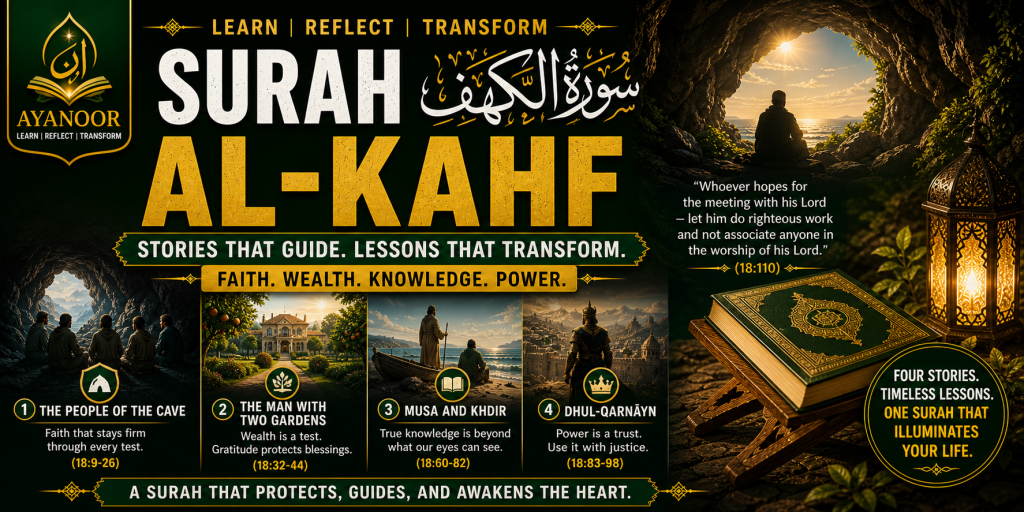
The Surah presents four major stories, each representing a different type of trial:
- Faith
- Wealth
- Knowledge
- Power
Together, they form a complete guide for navigating life with clarity and purpose.
1. The People of the Cave: Trial of Faith
“They were youths who believed in their Lord, and We increased them in guidance.” (18:13)
The young believers fled persecution to protect their faith. Allah caused them to sleep for many years, preserving them as a sign.
“And We made their hearts firm when they stood up…” (18:14)
Key Learning
- True faith may require sacrifice.
- Allah protects those who stand firm for truth.
- Youth can lead in courage and conviction.
2. The Man with Two Gardens: Trial of Wealth
“And present to them an example of two men…” (18:32)
One man was blessed with gardens and wealth but became arrogant and ungrateful:
“I do not think this will ever perish…” (18:35)
His companion reminded him:
“Why did you not say, ‘What Allah willed; there is no power except with Allah’?” (18:39)
Eventually, his wealth was destroyed.
Key Learning
- Wealth is a test, not a guarantee of success.
- Gratitude protects blessings; arrogance destroys them.
- True success is spiritual, not material.
3. Musa and Khidr: Trial of Knowledge
“And they found a servant from among Our servants…” (18:65)
Prophet Musa (Moses) seeks knowledge from Khidr, who performs actions that seem unjust:
- Damaging a boat (18:71)
- Killing a boy (18:74)
- Repairing a wall (18:77)
Later, Khidr explains the wisdom behind each action.
Key Learning
- Human knowledge is limited.
- What seems wrong may have hidden wisdom.
- Patience is essential in seeking understanding.
4. Dhul-Qarnayn: Trial of Power
“Indeed, We established him upon the earth…” (18:84)
Dhul-Qarnayn was given authority and power, yet he used it justly:
“As for one who does wrong, we will punish him…” (18:87)
He built a barrier to protect people from corruption.
Key Learning
- Power is a responsibility, not a privilege.
- Justice defines true leadership.
- Authority should be used to protect, not exploit.
5. The Reality of This World
The Surah repeatedly reminds us that worldly life is temporary:
“And present to them the example of the life of this world…” (18:45)
Like rain that brings growth, then fades away.
Key Learning
- The world is temporary and ever-changing.
- Attachment without awareness leads to loss.
- Focus on what lasts beyond this life.
6. The Greatest Trial: Deception and the Dajjal
Although not explicitly named in the Surah, its themes are strongly connected to protection from deception (as taught in hadith).
“Shall We inform you of the greatest losers in their deeds?” (18:103)
“Those whose effort is lost in worldly life while they think they are doing good.” (18:104)
Key Learning
- The greatest loss is being misguided while thinking you are right.
- Constant reflection and humility are essential.
7. The Power of Remembrance and Intention
“And remember your Lord when you forget…” (18:24)
Key Learning
- Staying connected to Allah prevents misguidance.
- Intentions shape the value of actions.
8. The Ultimate Success
The Surah concludes with a powerful principle:
“Whoever hopes for the meeting with his Lord – let him do righteous work and not associate anyone in the worship of his Lord.” (18:110)
Key Learning
- Faith + sincere action = success
- Purity of intention is essential
Conclusion
Surah Al-Kahf teaches that life is a series of tests:
- Faith (People of the Cave)
- Wealth (Two Gardens)
- Knowledge (Musa & Khidr)
- Power (Dhul-Qarnayn)
And above all, it reminds us:
- The world is temporary
- Truth requires humility
- Success lies in sincerity and guidance
Reflection Questions
- Which of the four trials is most relevant in your life today?
- How can you strengthen your faith like the People of the Cave?
- Do you view your blessings as gifts or entitlements?
- How do you react when things don’t make sense—like Musa did with Khidr?
- If given power, how would you use it?
Closing Thought
Surah Al-Kahf is not just a story—it is a map for navigating life’s most difficult tests. It reminds us that clarity comes from faith, patience, humility, and constant remembrance of Allah.
Leave a Reply