

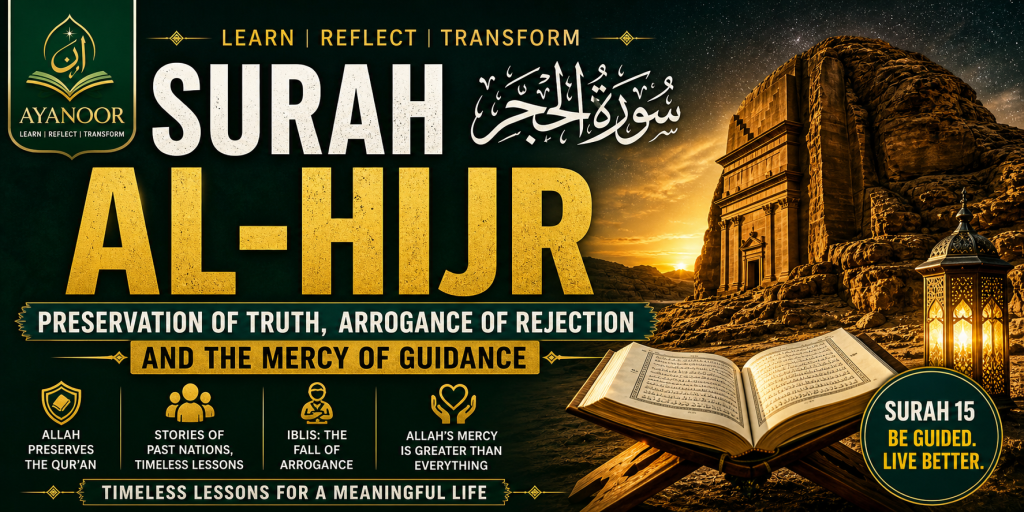
Preservation of Truth, Arrogance of Rejection, and the Mercy of Guidance
Introduction
Surah Al-Hijr is the 15th chapter of the Qur’an, revealed in Makkah during a time when the message of the Prophet ﷺ was strongly resisted. The Surah addresses denial, mockery, and arrogance, while offering reassurance that truth is divinely protected and falsehood is temporary.
The name Al-Hijr refers to a region inhabited by the people of Thamud, whose story is used as a powerful reminder of the consequences of rejecting divine guidance.
1. The Qur’an is Divinely Protected
One of the most profound declarations in this Surah is the divine guarantee of preservation:
“Indeed, it is We who sent down the Reminder, and indeed, We will be its guardian.” (15:9)
This verse establishes that the message of the Qur’an is not dependent on human protection. Unlike earlier scriptures that were altered or lost over time, the Qur’an is preserved in its original form.
Key Learning
- Truth, when rooted in divine origin, cannot be erased.
- Human opposition cannot diminish divine guidance.
2. The Pattern of Human Rejection
The Surah highlights a recurring human tendency—to reject truth when it challenges ego or tradition:
“And no messenger would come to them except that they ridiculed him.” (15:11)
This pattern is not unique to one people or one time. It reflects a deeper issue: resistance to change, arrogance, and fear of accountability.
Key Learning
- Rejection of truth is often emotional, not intellectual.
- History repeats when lessons are ignored.
3. The Story of Adam and Iblis: Arrogance vs Obedience
The Surah recounts the creation of Adam and the refusal of Iblis to bow:
“Iblis refused to be with those who prostrated.” (15:31)
“He said, ‘I am better than him…’” (15:33)
Iblis’ downfall was not ignorance—it was arrogance.
Key Learning
- Pride blinds a person to truth.
- Disobedience often begins with self-righteousness.
4. Shaytan’s Strategy and Human Vulnerability
Iblis declares his intention:
“I will surely make [evil] attractive to them on earth…” (15:39)
However, Allah sets a boundary:
“Indeed, My servants – you will have no authority over them…” (15:42)
Key Learning
- Evil works through deception, not force.
- Awareness and sincerity protect a believer.
5. Signs in Creation: A Universe with Purpose
The Surah repeatedly invites reflection on the natural world:
“And We have placed within the heaven great stars…” (15:16)
“And the earth – We have spread it…” (15:19)
These signs are reminders of order, balance, and intentional design.
Key Learning
- The universe is not random—it points to a Creator.
- Reflection leads to recognition of truth.
6. The Stories of Past Nations: Lessons from History
The Surah revisits earlier communities:
- People of Lut (Lot) – destroyed for moral corruption (15:61–77)
- People of Thamud (Al-Hijr) – destroyed for rejecting clear signs (15:80–84)
These are not just historical accounts—they are warnings.
Key Learning
- Moral decline leads to societal collapse.
- Ignoring repeated warnings has consequences.
7. Mercy Alongside Justice
Despite the warnings, Allah reminds:
“Inform My servants that I am the Forgiving, the Merciful.” (15:49)
“And that My punishment is the painful punishment.” (15:50)
This balance is central: hope and accountability coexist.
Key Learning
- Divine mercy is always accessible.
- Accountability ensures justice.
8. The Role of the Prophet: Patience and Perseverance
The Prophet ﷺ is comforted and guided:
“So be patient over what they say…” (15:97)
“And worship your Lord until there comes to you the certainty.” (15:99)
Key Learning
- Truth requires patience.
- Perseverance is part of faith.
Conclusion
Surah Al-Hijr is a powerful reminder that:
- Truth is preserved by divine will.
- Arrogance leads to downfall.
- History offers clear lessons for those who reflect.
- Mercy remains open, but accountability is certain.
It calls every reader—regardless of background—to reflect deeply on their relationship with truth, humility, and purpose.
Reflection Questions
- What prevents people from accepting truth even when it is clear?
- How can arrogance subtly appear in our own lives?
- What signs in nature strengthen your belief in purpose and design?
- How can we balance hope in mercy with awareness of accountability?
Closing Thought
Surah Al-Hijr teaches that while falsehood may appear strong for a time, it is ultimately fragile. Truth, preserved and guided by the Creator, endures across generations.
Leave a Reply