

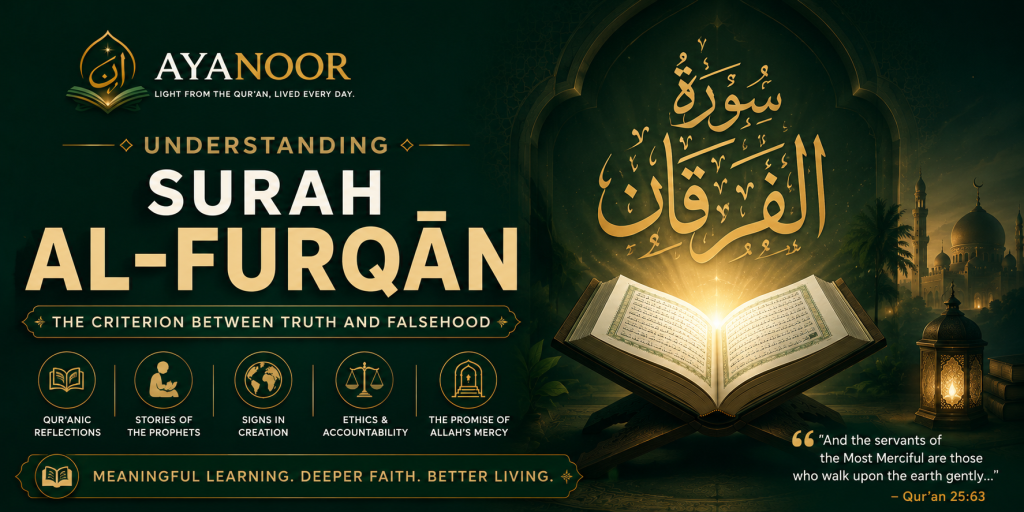
The word “Al-Furqān” means “The Criterion” — that which distinguishes truth from falsehood, guidance from misguidance, and light from darkness.
This Surah is deeply spiritual and intellectual. It addresses:
- the purpose of revelation,
- the rejection faced by prophets,
- the signs of Allah in creation,
- human arrogance,
- and the qualities of the true servants of the Most Merciful.
Surah Al-Furqān teaches believers how to live with wisdom, humility, patience, and moral clarity in a world often filled with confusion and distraction.
1. The Qur’an as a Criterion Between Truth and Falsehood
The Surah begins by honoring the Qur’an itself.
Allah says:
“Blessed is He who sent down the Criterion upon His servant that he may be to the worlds a warner.”
— Qur’an 25:1
The Qur’an is called Al-Furqān because it helps humanity:
- distinguish right from wrong,
- recognize justice,
- understand morality,
- and reconnect with divine guidance.
The message is not limited to one tribe or nation.
Allah says the message is:
“for the worlds”
— Qur’an 25:1
This reflects the universal nature of Qur’anic guidance.
2. Allah Alone Holds Ultimate Authority
The Surah repeatedly reminds humanity that all power belongs to Allah.
“To whom belongs the dominion of the heavens and the earth…”
— Qur’an 25:2
Human beings may possess wealth, influence, or status temporarily, but ultimate control belongs only to the Creator.
This develops humility and dependence upon Allah rather than worldly arrogance.
3. The Rejection Faced by Prophets
Like many Qur’anic chapters, Surah Al-Furqān addresses the resistance faced by prophets.
The disbelievers questioned:
- why revelation came gradually,
- why prophets were human,
- and why miracles were not constantly displayed.
Allah says:
“And those who disbelieve say, ‘Why was the Qur’an not revealed to him all at once?’”
— Qur’an 25:32
Allah explains that revelation came gradually:
- to strengthen hearts,
- guide people step by step,
- and establish understanding over time.
This teaches believers patience in learning and spiritual growth.
4. Signs of Allah in Creation
Surah Al-Furqān repeatedly calls people to reflect on nature and creation.
Allah says:
“And it is He who sends the winds as good tidings before His mercy, and We send down from the sky pure water.”
— Qur’an 25:48
The Surah points to:
- rain,
- oceans,
- shadows,
- night and day,
- stars,
- and human life
as signs of Allah’s wisdom and mercy.
Another beautiful verse says:
“And He is the One who made the night and the day in succession for whoever desires to remember or desires gratitude.”
— Qur’an 25:62
The universe becomes a classroom for reflection and remembrance.
5. Human Arrogance and Forgetfulness
One major warning in the Surah concerns arrogance.
Some people reject truth not because of lack of evidence, but because of pride and attachment to worldly desires.
Allah says:
“Have you seen the one who takes as his god his own desire?”
— Qur’an 25:43
This verse warns against making:
- ego,
- greed,
- status,
- or personal desires
the center of one’s life instead of Allah.
The Qur’an teaches that spiritual corruption begins when human beings worship themselves rather than the Creator.
6. The Day of Accountability
Surah Al-Furqān repeatedly reminds humanity about the Hereafter.
Allah says:
“The Day the wrongdoer will bite on his hands saying, ‘Oh, I wish I had taken with the Messenger a way.’”
— Qur’an 25:27
The Surah emphasizes:
- personal accountability,
- consequences of choices,
- and regret for ignoring guidance.
The Qur’an calls people to awaken spiritually before that Day arrives.
7. The Qualities of the Servants of the Most Merciful
The final section of Surah Al-Furqān is among the most beloved passages in the Qur’an.
Allah describes ʿIbād al-Raḥmān — “The Servants of the Most Merciful.”
These verses define true spiritual character.
a) Humility
“And the servants of the Most Merciful are those who walk upon the earth gently…”
— Qur’an 25:63
True believers are not arrogant or harsh. They carry themselves with dignity and humility.
b) Responding Peacefully
“And when the ignorant address them harshly, they say words of peace.”
— Qur’an 25:63
The Qur’an teaches emotional restraint and mature conduct.
Believers are encouraged to:
- avoid unnecessary conflict,
- respond calmly,
- and preserve dignity.
c) Night Prayer and Reflection
“And those who spend part of the night to their Lord prostrating and standing.”
— Qur’an 25:64
Spiritual strength is developed through private worship and sincere connection with Allah.
d) Balance and Moderation
“And those who, when they spend, are neither extravagant nor stingy…”
— Qur’an 25:67
Islam encourages balance:
- generosity without waste,
- discipline without harshness,
- and moderation in worldly life.
e) Avoiding Major Sins
The Surah warns against:
- injustice,
- murder,
- immorality,
- false testimony,
- and corruption.
Allah says:
“And those who do not testify to falsehood…”
— Qur’an 25:72
Truthfulness becomes a defining characteristic of believers.
f) Concern for Family and Future Generations
One of the most beautiful prayers in the Qur’an appears here:
“Our Lord, grant us from our spouses and offspring comfort to our eyes and make us leaders for the righteous.”
— Qur’an 25:74
The Qur’an encourages believers to build families rooted in faith, mercy, and moral leadership.
8. Mercy and Repentance
Even after warning against major sins, Allah opens the door to repentance.
Allah says:
“Except for those who repent, believe and do righteous work. For them Allah will replace their evil deeds with good.”
— Qur’an 25:70
This verse reflects one of the Qur’an’s greatest themes:
- Allah’s mercy is always greater than despair.
No person is beyond forgiveness if they sincerely return to Allah.
Key Lessons from Surah Al-Furqān
Spiritual Lessons
- The Qur’an is a guide distinguishing truth from falsehood
- Reflection strengthens faith
- Worship develops humility
- Allah’s mercy remains open through repentance
Moral Lessons
- Speak peacefully
- Avoid arrogance
- Live with honesty and moderation
- Control desires and ego
Intellectual Lessons
- Observe creation thoughtfully
- Recognize patterns and signs in nature
- Understand that revelation develops hearts gradually
Social Lessons
- Build righteous families
- Treat others with dignity
- Stand for truth without cruelty
Conclusion
The Quran is a Surah of moral clarity, spiritual refinement, and deep reflection. It teaches humanity how to distinguish truth from falsehood while living with humility and compassion.
The final portrait of the Servants of the Most Merciful offers one of the Qur’an’s clearest models of ethical and spiritual excellence:
- gentle in conduct,
- sincere in worship,
- truthful in speech,
- balanced in life,
- and deeply aware of Allah.
Surah Al-Furqān reminds believers that true success lies not in pride or power, but in walking through life with wisdom, mercy, and devotion to the Creator.
Leave a Reply