

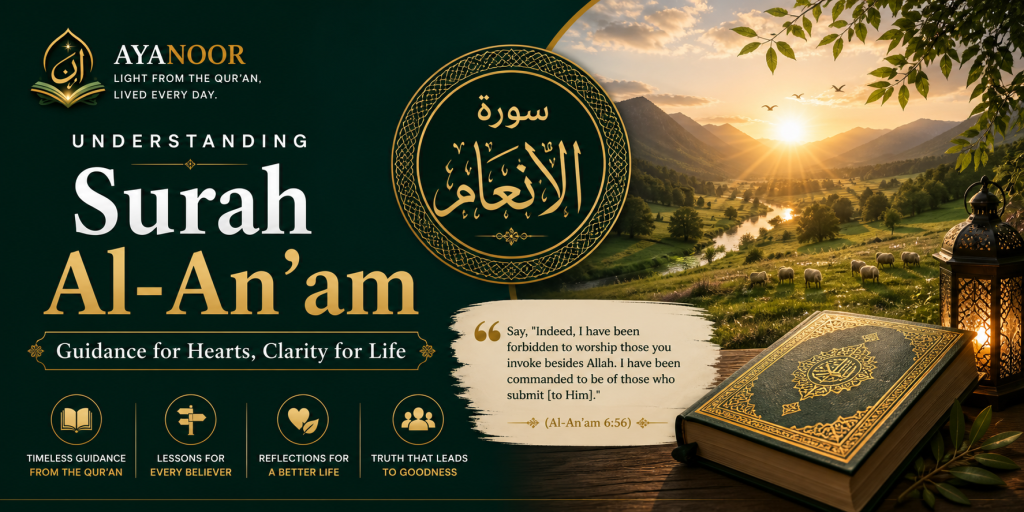
- Meaning: “The Cattle”
- Position: 6th chapter of the Quran
- Revelation: Mostly Makkan
- Main focus: Pure monotheism (Tawheed), belief, and rejecting false practices
👉 Unlike the previous legal-focused surahs, this one centers on faith, belief, and correcting misconceptions about God.
Core Themes & Explanation
☝️ 1. Absolute Oneness of God (Tawheed)
- Repeated emphasis that:
- God is the only creator and sustainer
- No partners, no intermediaries
👉 Strong rejection of:
- Idolatry
- Polytheism
2. Signs in Creation
- Encourages reflection on:
- Sky, earth, animals, plants
- Life and death
👉 Message:
- Nature itself is evidence of God’s existence and power
3. Correction of False Practices
- Criticizes pre-Islamic customs related to:
- Animals (cattle, sacrifice rules)
- Superstitions
👉 Explains:
- People invented religious rules without divine authority
4. Story & Argument of Abraham
- Shows how Abraham:
- Reflected on stars, moon, sun
- Rejected them as gods
👉 Lesson:
- Use reason and observation to find truth
5. Accountability & Judgment
- Every person is responsible for:
- Their own actions
- No one bears another’s burden
👉 Strong emphasis on individual responsibility
6. Role of Prophets
- Prophets are:
- Messengers of guidance
- Not divine beings
👉 Their duty:
- Deliver the message clearly
7. Warning Against Denial
- Warns those who:
- Reject truth despite clear signs
- Uses examples of past nations destroyed due to disbelief
8. Freedom & Choice
- People are free to believe or reject
- Guidance cannot be forced
👉 Emphasizes:
- Personal choice + accountability
9. Ethical Commands (Key Verses)
Near the end, the surah gives powerful moral instructions:
- Do not associate partners with God
- Be good to parents
- Do not kill unjustly
- Avoid immoral acts
- Be just in dealings
👉 These are often seen as core ethical principles of Islam
Key Themes (Simple)
- ✔ Believe in one God
- ✔ Reflect on creation
- ✔ Reject superstition
- ✔ Take personal responsibility
- ✔ Follow ethical living
How It Differs from Previous Surahs
- Surah An-Nisa & Surah Al-Ma’idah
👉 Focus on law and society - Surah Al-An’am
👉 Focus on belief and worldview
Final Insight
Surah Al-An’am is a powerful call to faith and reflection. It teaches that:
- True belief comes from:
- Thinking
- Observing
- Understanding
👉 It builds the foundation of faith, upon which laws and actions stand.
Here are some of the most powerful and commonly highlighted verses from Surah Al-An’am that are especially meaningful for memorization, reflection, and daily guidance:
1. Ayah 162–163 (Purpose of Life)
👉 One of the most جامع (comprehensive) statements of faith:
Meaning (summary):
- My prayer, sacrifice, life, and death are for Allah alone
- He has no partner
✔ Why memorize:
- Defines complete submission and purpose of life
2. Ayah 95–99 (Signs in Creation)
👉 Describes how God:
- Brings life from the dead
- Controls nature and growth
✔ Why memorize:
- Strengthens faith through reflection on nature
3. Ayah 164 (Individual Responsibility)
Key idea:
- No soul bears the burden of another
✔ Why memorize:
- Emphasizes personal accountability and justice
4. Ayah 50 (Limits of the Prophet)
👉 The Prophet Muhammad is told to say:
- I do not possess treasures of God
- I only follow what is revealed
✔ Why memorize:
- Reinforces humility and role of revelation
5. Ayah 68–70 (Avoiding Falsehood)
👉 Guidance to:
- Avoid gatherings where truth is mocked
- Stay mindful of accountability
✔ Why memorize:
- Teaches protecting your faith environment
6. Ayah 103 (Nature of God)
👉 A deeply profound verse:
Meaning (summary):
- Vision cannot fully grasp Him
- But He grasps all vision
✔ Why memorize:
- Powerful understanding of God’s transcendence
7. Ayah 75–79 (Faith of Abraham)
👉 Abraham’s journey:
- Rejecting stars, moon, and sun as gods
- Turning to the Creator
✔ Why memorize:
- Teaches reasoning and pure monotheism
8. Ayah 151–153 (Core Ethical Commandments)
👉 Among the most important verses in the surah
Includes commands:
- Do not associate partners with God
- Be good to parents
- Do not kill unjustly
- Avoid immoral acts
- Be just in dealings
✔ Why memorize:
- A complete moral code in a few verses
Simple Memorization Set (Recommended)
If you want a focused start, memorize:
- 6:162–163 → Purpose of life
- 6:151–153 → Ethical commandments
- 6:103 → Understanding God
- 6:164 → Accountability
👉 These alone give a powerful foundation of belief + ethics
Leave a Reply