

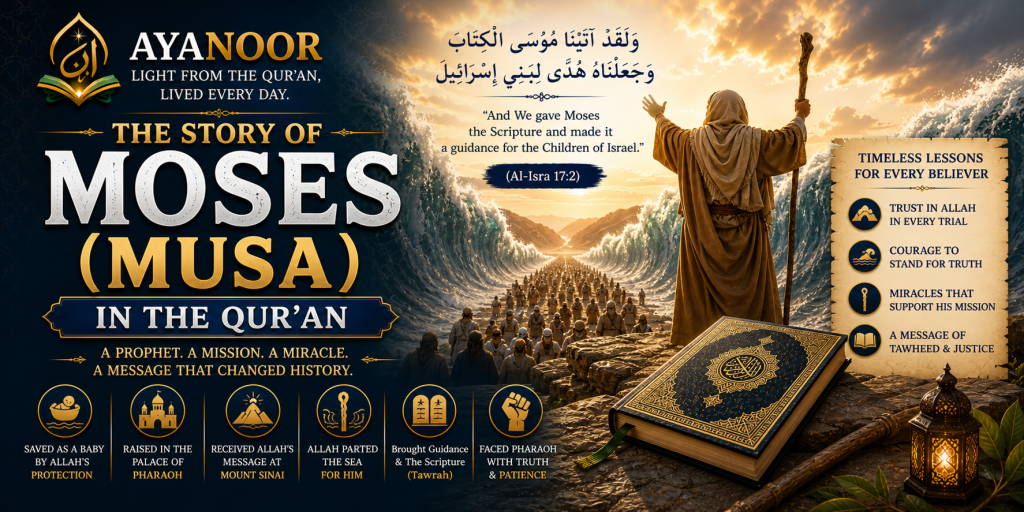
The Story of Musa (Moses) and His Encounter at Mount Sinai (Koh Toor)
A Journey of Divine Calling, Struggle, and Transformation
The story of Musa (peace be upon him) is among the most frequently mentioned narratives in the Qur’an. His life is not presented as a simple historical account, but as a profound lesson in faith, leadership, struggle, and direct connection with Allah.
Among the most powerful moments in his journey is his encounter with Allah at Mount Sinai (Koh Toor)—a moment that transformed him from a man in search of direction into one of the greatest prophets.
1. A Man in Search of Direction
Before prophethood, Musa (AS) found himself in a state of uncertainty. After leaving Egypt due to an unintended killing, he lived in Madyan for years. Eventually, while traveling back toward Egypt with his family, he experienced a moment that would change everything.
The Qur’an describes:
“Indeed, I have perceived a fire. Perhaps I can bring you from it a torch or find at the fire some guidance.”
— Surah Taha (20:10)
This moment is symbolic. Musa (AS) was seeking physical light—but Allah was about to grant him spiritual illumination.
2. The Divine Call at Mount Sinai
As Musa (AS) approached the fire near Mount Sinai, he was called directly by Allah:
“Indeed, I am your Lord, so remove your sandals. Indeed, you are in the sacred valley of Tuwa.”
— Surah Taha (20:12)
This was not just an introduction—it was a declaration of sacred presence.
Then came the core of revelation:
“Indeed, I am Allah. There is no deity except Me, so worship Me and establish prayer for My remembrance.”
— Surah Taha (20:14)
This moment establishes:
- The foundation of Tawheed (Oneness of God)
- The purpose of human life: worship and remembrance
- The beginning of Musa’s prophetic mission
3. Signs Given to Strengthen Faith
Understanding the weight of the mission ahead, Allah granted Musa (AS) signs:
“And what is that in your right hand, O Musa?”
— Surah Taha (20:17)
His staff transformed into a serpent:
“He threw it down, and thereupon it was a snake, moving swiftly.”
— Surah Taha (20:20)
And his hand became radiant:
“And draw your hand to your side; it will come out white without disease…”
— Surah Taha (20:22)
These were not just miracles—they were:
- Reassurance for Musa
- Proof for Pharaoh
- Signs for humanity
4. The Weight of Responsibility
Despite witnessing divine signs, Musa (AS) did not respond with arrogance. Instead, he responded with humility and awareness of his limitations:
“My Lord, expand for me my chest, ease for me my task, and untie the knot from my tongue…”
— Surah Taha (20:25–27)
This dua is deeply powerful. It shows:
- Even prophets seek strength and clarity
- True leadership begins with self-awareness
- Reliance on Allah is essential for any mission
He also requested support:
“And appoint for me a minister from my family—Harun (Aaron), my brother.”
— Surah Taha (20:29–30)
This reflects an important principle:
Great missions are not carried alone.
5. The Mission Against Tyranny
Allah then commanded Musa (AS) to confront Pharaoh:
“Go to Pharaoh. Indeed, he has transgressed.”
— Surah Taha (20:24)
This moment defines Musa’s role:
- From a seeker → to a messenger
- From uncertainty → to courage
- From isolation → to divine support
It also shows that:
Faith is not passive—it requires standing for truth, even against power.
6. The Deeper Spiritual Encounter
Later, Musa (AS) returned to Mount Sinai for a deeper spiritual experience:
“And when Musa came at Our appointed time and his Lord spoke to him…”
— Surah Al-A‘raf (7:143)
In this moment, Musa (AS) asked to see Allah:
“My Lord, show me Yourself that I may look at You.”
— Surah Al-A‘raf (7:143)
Allah responded by demonstrating His power through the mountain:
“…When his Lord appeared to the mountain, He made it crumble…”
— Surah Al-A‘raf (7:143)
Musa (AS) fell unconscious, realizing the limits of human capacity.
This moment teaches:
- The majesty of Allah
- The limits of human perception
- The depth of spiritual humility
7. Lessons for Us Today
The encounter at Mount Sinai is not just a historical event—it is a template for personal transformation.
1. Guidance begins when we seek it
Musa (AS) went looking for fire—but found revelation.
2. Faith requires courage
He was commanded to face one of the most powerful tyrants.
3. Leadership requires humility
He asked for help, clarity, and strength.
4. Connection with Allah is central
The command to establish prayer came at the very beginning.
5. Spiritual growth requires surrender
Even Musa (AS) realized his limits before Allah’s greatness.
Conclusion
The story of Musa (AS) at Mount Sinai is a powerful reminder that:
- Allah guides those who seek Him
- Every great mission begins with a moment of divine connection
- True strength lies in reliance on Allah
For Ayanoor’s vision—“Light from the Qur’an, lived every day”—this story is central.
It teaches us that the Qur’an is not just to be read, but to be experienced, trusted, and lived, just as Musa (AS) lived his mission after that defining moment at Koh Toor.
Leave a Reply