

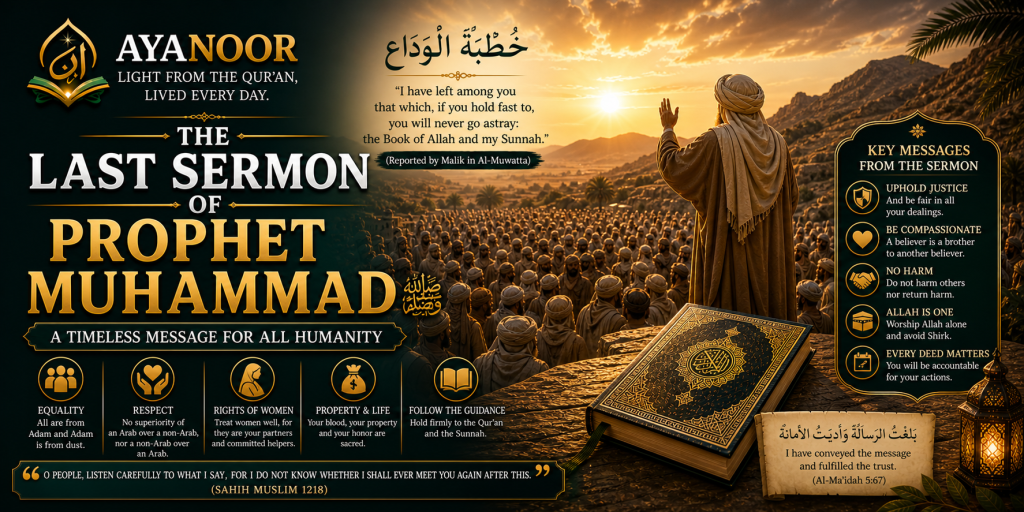
The Last Sermon (Khutbat al-Wada‘) was delivered during the Farewell Pilgrimage in 632 CE, near Mount Arafat. It is considered one of the most important summaries of Islamic teachings—covering human rights, justice, equality, and moral conduct.
O people, lend me an attentive ear, for I do not know whether after this year I shall ever be amongst you again.
Therefore listen carefully to what I am saying and take these words to those who could not be present here today.
O people, just as you regard this month, this day, this city as sacred, so regard the life and property of every Muslim as a sacred trust.
Return the goods entrusted to you to their rightful owners.
Hurt no one so that no one may hurt you.
Remember that you will indeed meet your Lord, and that He will indeed reckon your deeds.
Allah has forbidden you to take interest (riba), therefore all interest obligations shall henceforth be waived.
Beware of Satan, for the safety of your religion.
He has lost all hope that he will ever be able to lead you astray in big things, so beware of following him in small things. O people, it is true that you have certain rights with regard to your women, but they also have rights over you.
Treat women kindly and be good to them, for they are your partners and committed helpers.
O people, listen to me in earnest.
Worship Allah, say your five daily prayers, fast during the month of Ramadan, and give your wealth in zakat.
All mankind is from Adam and Eve.
An Arab has no superiority over a non-Arab, nor a non-Arab over an Arab; also a white has no superiority over a black, nor a black over a white—except by piety and good action.
Learn that every Muslim is a brother to every Muslim and that the Muslims constitute one brotherhood.
Nothing shall be legitimate to a Muslim which belongs to a fellow Muslim unless it was given freely and willingly.
Do not therefore do injustice to yourselves.
Remember, one day you will appear before Allah and answer for your deeds.
Behold! All practices of the Days of Ignorance are now under my feet.
All blood feuds are abolished.
I leave behind me two things, the Quran and my example (Sunnah), and if you follow these, you will never go astray.
Let those who are present convey this message to those who are absent, for many people to whom the message is conveyed may understand it better than those who heard it directly.
O Allah, have I conveyed Your message?
Here is a clear tabular comparison between the Last Sermon of Muhammad and modern human rights frameworks like the Universal Declaration of Human Rights (UDHR) by the United Nations:
| Aspect | Last Sermon of Prophet Muhammad | Modern Human Rights Charters (UDHR) |
| Source of Authority | Divine guidance (Quran and Sunnah) | Human consensus and international law |
| Core Principle | Justice, morality, and accountability before God | Universal rights, freedom, and equality |
| Human Dignity | Life, property, and honor are sacred | Right to life, liberty, and security |
| Equality | No superiority by race, color, or ethnicity; based on piety | All humans equal regardless of race, gender, religion |
| Women’s Rights | Rights + responsibilities within family structure | Full legal equality in all areas |
| Economic Justice | Prohibits exploitation (e.g., interest/usury), promotes fairness | Right to property, fair wages, and economic security |
| Justice System | Moral + spiritual accountability; end of revenge | Legal systems, courts, and rule of law |
| Violence & Conflict | Abolishes blood feuds and injustice | Protection from violence and arbitrary harm |
| Accountability | Accountability before God (afterlife focus) | Legal accountability through institutions |
| Rights vs Duties | Strong emphasis on both rights and responsibilities | Primarily focused on individual rights |
| Freedom of Religion | Emphasized within a moral framework | Explicit protection of freedom of belief and expression |
| Social Structure | Brotherhood and community unity | Individual rights within society |
| Implementation | Based on personal faith and moral adherence | Enforced through legal and political systems |
Leave a Reply