

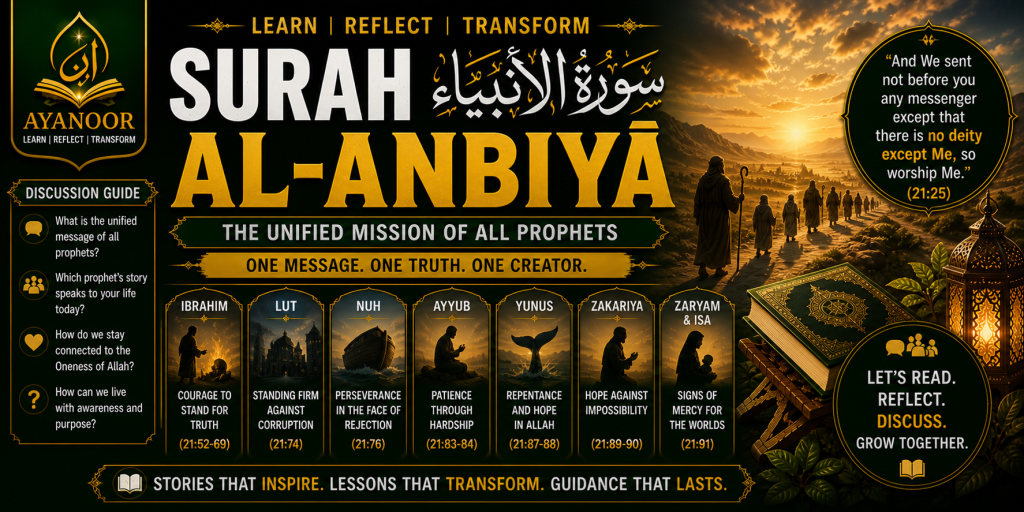
The Unified Mission of All Prophets
Introduction
Surah Al-Anbiya brings together powerful glimpses of many prophets, not to tell full stories, but to highlight a single unifying truth:
“And We sent not before you any messenger except that We revealed to him that there is no deity except Me, so worship Me.” (21:25)
This Surah is not just about history—it is about a continuous message across time, calling humanity to:
- Recognize One Creator
- Live with accountability
- Return to truth and sincerity
1. Opening Reflection: Are We Awake?
“[The time of] their account has approached for the people, while they are in heedlessness turning away.” (21:1)
Discussion Insight
The Surah begins with urgency. Life continues as usual, yet accountability is near.
Reflect:
- What are the “distractions” that keep us in heedlessness today?
- Are we living consciously or just reacting to life?
2. One Message, Many Messengers
“And We certainly sent into every nation a messenger…” (16:36 – supporting theme)
“There is no deity except Me, so worship Me.” (21:25)
All prophets—across cultures and centuries—delivered the same core message.
Discussion Insight
- Truth is not fragmented; it is consistent.
- Differences are in context, not in core belief.
Reflect:
- Why do humans divide what was sent as a unified message?
- How can we reconnect with this unity today?
3. Ibrahim: Challenging False Narratives
Ibrahim
“What are these statues to which you are devoted?” (21:52)
Ibrahim challenged inherited beliefs and exposed falsehood.
Discussion Insight
- Truth requires questioning what is blindly followed.
- Courage is needed to stand against societal norms.
Reflect:
- What “idols” exist today (not just physical, but mental or social)?
- Do we question our assumptions enough?
4. Prophets in Different Trials, Same Response
The Surah highlights multiple prophets:
- Nuh (Noah) – perseverance (21:76)
- Lut (Lot) – moral courage (21:74)
- Ayyub (Job) – patience (21:83)
- Yunus (Jonah) – repentance (21:87)
- Zakariya (Zechariah) – hope (21:89)
Each faced different circumstances—but all turned to Allah.
Discussion Insight
- Trials vary, but the response remains constant: faith + patience + reliance on Allah
Reflect:
- Which prophet’s trial mirrors your life right now?
- How can their response guide your actions?
5. The Power of Turning Back to Allah
“There is no deity except You; exalted are You. Indeed, I have been of the wrongdoers.” (21:87)
Yunus shows that even in mistakes, return is always possible.
Discussion Insight
- Faith is not about perfection—it is about returning.
Reflect:
- What holds people back from sincere repentance?
- How can we make “returning to Allah” a regular practice?
6. The Universe as a Sign of Unity
“Have those who disbelieved not considered that the heavens and the earth were a joined entity…” (21:30)
Creation itself reflects unity and order.
Discussion Insight
- The message of Tawḥīd is visible not only in scripture but in nature.
Reflect:
- How often do we reflect on creation as a sign of truth?
- What does the order of the universe teach us about purpose?
7. Truth vs Falsehood: An Ongoing Reality
“Rather, We dash the truth upon falsehood, and it destroys it…” (21:18)
Discussion Insight
- Falsehood may dominate temporarily—but it is fragile.
- Truth has a natural strength.
Reflect:
- Where do we see this struggle today (personally or globally)?
- How can we align ourselves with truth consistently?
8. The Prophet ﷺ: Mercy as the Final Message
“And We have not sent you except as a mercy to the worlds.” (21:107)
The mission of all prophets culminates in mercy.
Discussion Insight
- Islam is not just about belief—it is about how that belief impacts others.
Reflect:
- Does our behavior reflect mercy?
- How can we embody this in daily life?
9. Accountability and Responsibility
“Every soul will taste death…” (21:35)
“And We test you with evil and with good as trial…” (21:35)
Discussion Insight
- Life itself is a test—both ease and hardship.
Reflect:
- Do we recognize both success and difficulty as tests?
- How does this perspective change our reactions?
10. Unity of the Ummah and Humanity
“Indeed this, your religion, is one religion, and I am your Lord, so worship Me.” (21:92)
Discussion Insight
- The message is unified—but humanity often divides.
Reflect:
- What causes division in faith communities?
- How can unity be restored through shared principles?
Conclusion
Surah Al-Anbiyā teaches that:
- All prophets carried one message: worship Allah alone
- Life is a test of faith, patience, and sincerity
- Truth will always overcome falsehood
- Mercy is at the heart of divine guidance
It invites us to move from:
- Heedlessness → Awareness
- Division → Unity
- Ritual → Meaningful faith
Group Discussion Questions
- What does “one message across all prophets” mean in practical life today?
- Which prophetic story resonates most with modern challenges?
- How can we balance truth and mercy in our interactions?
- What steps can we take to live more consciously and less distracted?
Closing Thought
Surah Al-Anbiyā reminds us that history is not just something to read—it is something to learn from and live by. The prophets were not just messengers of the past; they are guides for every generation seeking truth, purpose, and closeness to Allah.
Leave a Reply