

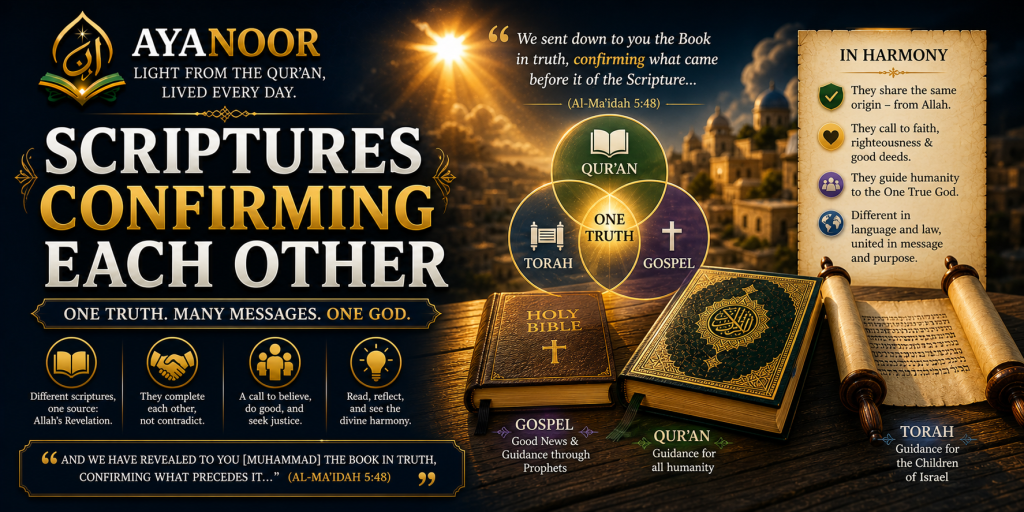
One Truth, Many Messages, One God
One of the most profound teachings of the Qur’an is that divine guidance did not begin with one people or one time—it has been sent repeatedly throughout history.
The Qur’an teaches that earlier revelations such as the Tawrah (Torah), Zabur (Psalms), and Injeel (Gospel) were all part of the same divine message—calling humanity to worship One God and live righteously.
1. A Continuation, Not a Beginning
The Qur’an does not present itself as a new religion, but as a continuation and confirmation of previous scriptures:
“And We have revealed to you the Book in truth, confirming what came before it of the Scripture and as a criterion over it…”
— Surah Al-Ma’idah (5:48)
This establishes:
- A single source of revelation
- A consistent message across time
- The Qur’an as both confirmation and clarification
2. The Same Core Message: Tawheed
All prophets brought the same essential call:
“And We certainly sent into every nation a messenger, [saying], ‘Worship Allah and avoid false gods.’”
— Surah An-Nahl (16:36)
Whether it was:
- Musa (AS) with the Tawrah
- Dawud (AS) with the Zabur
- Isa (AS) with the Injeel
The message remained:
Worship Allah alone.
3. The Qur’an Confirms Previous Scriptures
The Qur’an repeatedly emphasizes its role as a confirmer:
“This Qur’an is not such as could ever be produced by other than Allah… but it is a confirmation of what was before it…”
— Surah Yunus (10:37)
And:
“He has sent down upon you the Book in truth, confirming what was before it. And He revealed the Torah and the Gospel…”
— Surah Aal-Imran (3:3)
This teaches:
- Revelation is continuous, not isolated
- Truth does not contradict itself—it aligns
4. Respect for All Prophets and Books
A believer is required to accept all divine messengers:
“We make no distinction between any of His messengers…”
— Surah Al-Baqarah (2:285)
This principle builds:
- Respect across traditions
- A foundation for interfaith understanding
- Recognition that guidance came to all humanity
5. Differences in Law, Unity in Purpose
While core beliefs remain the same, certain laws differed:
“For each [community] We have appointed a law and a way…”
— Surah Al-Ma’idah (5:48)
However, the purpose remains unified:
- To guide humanity
- To establish justice
- To cultivate righteousness
This shows:
Diversity in practice, unity in truth.
6. The Qur’an as a Final Criterion
While confirming earlier scriptures, the Qur’an also serves as a final reference point:
“…and as a criterion (Furqan) over it…”
— Surah Al-Ma’idah (5:48)
This means:
- It clarifies what may have been altered or misunderstood
- It preserves the message in its final, protected form
7. A Call to Reflection and Unity
The Qur’an invites people of all scriptures to common ground:
“Say, O People of the Scripture, come to a word that is equitable between us and you—that we will not worship except Allah…”
— Surah Aal-Imran (3:64)
This verse is powerful:
- It encourages dialogue, not division
- It centers on shared belief in One God
Key Lessons
1. Revelation is one continuous message
Different prophets, same truth.
2. Tawheed is the foundation
All scriptures call to the Oneness of Allah.
3. Respect is essential
Believers honor all prophets and revelations.
4. Unity over division
Differences should not erase shared truth.
5. The Qur’an completes and preserves guidance
It serves as the final, clear reference.
Conclusion
The concept of “Scriptures Confirming Each Other” is a powerful reminder that:
- Truth is consistent
- Guidance is universal
- And Allah’s message has always been one
For Ayanoor’s vision—“Light from the Qur’an, lived every day”—this teaching encourages us to:
- Learn with humility
- Engage with wisdom
- And recognize the unity of divine guidance across time
Because in the end:
There is one truth, revealed in many moments, leading back to One God.
Leave a Reply