
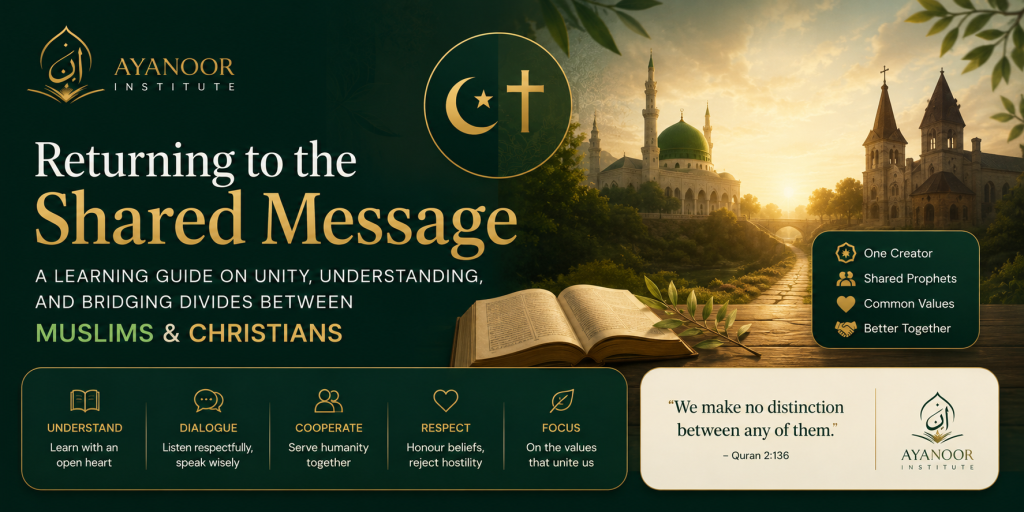
A Learning Guide on Unity, Understanding, and Bridging Divides Between Muslims and Christians
Throughout history, human beings have often divided themselves into groups, schools, denominations, and sects. While diversity in understanding can sometimes enrich learning, it can also slowly create distance, suspicion, pride, and hostility between people who were originally guided toward the same Creator.
Today, both Muslims and Christians face a growing challenge: internal divisions are increasing, while mutual understanding between the two faiths is often weakening. Yet when we step back and reflect deeply, we find something remarkable — both communities trace themselves back to the worship of One God, reverence for revelation, moral living, prayer, compassion, accountability, and the hope of eternal life.
The Qur’an repeatedly reminds humanity that Allah sent messengers to every people and that the core message was always centered on worshiping the Creator and living righteously.
“And We certainly sent into every nation a messenger, saying: Worship Allah and avoid false gods.”
(Qur’an 16:36)
Christians believe in the teachings of Prophet Isa (Jesus, peace be upon him), while Muslims honor him as one of the greatest prophets of Allah, born miraculously to Maryam (Mary), performing signs by Allah’s permission, and calling people toward righteousness and devotion to God.
The Qur’an says:
“Say: We believe in Allah and what was revealed to us and what was revealed to Ibrahim, Ismail, Ishaq, Yaqub, and the Tribes, and what Musa and Isa received… We make no distinction between any of them.”
(Qur’an 2:136)
This shared spiritual heritage should encourage humility, dialogue, and cooperation — not hatred or separation.
Why Are Divisions Increasing?
1. Identity Over Spirituality
Many people begin to identify more strongly with their sect, denomination, culture, or group than with the actual teachings of revelation itself.
Sometimes labels become more important than character:
- Sunni vs Shia
- Catholic vs Protestant
- Conservative vs Liberal
- Traditional vs Reformist
Instead of asking:
“How can we become better servants of God?”
people often ask:
“How can we prove our group is superior?”
This creates emotional walls.
2. Lack of Knowledge
A large number of conflicts arise not from deep understanding, but from shallow understanding.
Many people:
- inherit opinions without study,
- hear stereotypes,
- consume divisive media,
- or only learn from one-sided sources.
The Qur’an warns against blindly following assumptions:
“Do not pursue that of which you have no knowledge.”
(Qur’an 17:36)
Real learning creates humility. Ignorance often creates arrogance.
3. Politics and Power
History shows that religious divisions are often intensified by political struggles, leadership rivalries, nationalism, and worldly interests.
Faith becomes manipulated for influence and control.
This has happened:
- among Muslims,
- among Christians,
- and between nations claiming religious identity.
Yet the prophets themselves called people toward sincerity, justice, mercy, and truth — not tribal pride.
4. Loss of Human Connection
When communities stop eating together, visiting one another, helping each other, and listening sincerely, misunderstandings grow rapidly.
Human beings naturally fear what they no longer understand.
Dialogue disappears.
Suspicion grows.
The Shared Foundations That Still Exist
Despite theological differences, Muslims and Christians still share many profound values:
Belief in One Creator
Both believe the universe was created with purpose and wisdom.
Respect for Revelation
Both believe God guided humanity through prophets and scripture.
Love of Morality
Both traditions emphasize:
- charity,
- mercy,
- honesty,
- family,
- modesty,
- justice,
- forgiveness,
- caring for the weak.
Accountability
Both believe human beings are morally responsible for their actions.
Prayer and Worship
Both traditions preserve prayer, remembrance, fasting, and devotion to God.
What Can Be Done to Bridge the Gap?
1. Return to Sincere Dialogue
Dialogue does not mean abandoning beliefs.
It means:
- listening respectfully,
- understanding sincerely,
- and speaking with wisdom.
The Qur’an teaches:
“And do not argue with the People of the Scripture except in the best manner…”
(Qur’an 29:46)
Conversations should seek understanding, not victory.
2. Focus on Shared Moral Challenges
Today the world faces:
- loneliness,
- family breakdown,
- materialism,
- addiction,
- violence,
- loss of spirituality,
- weakening compassion.
Muslims and Christians can cooperate in restoring:
- family values,
- kindness,
- community care,
- service to humanity,
- ethical living.
3. Encourage Education Instead of Stereotypes
People should learn:
- what others actually believe,
- not merely what opponents claim they believe.
This reduces fear and misinformation.
Children especially should grow up learning:
- respect,
- curiosity,
- and the dignity of others.
4. Strengthen Shared Humanity
The prophets taught mercy toward all people.
Simple actions matter:
- visiting neighbors,
- serving communities together,
- helping the poor,
- disaster relief,
- protecting families,
- supporting the elderly,
- caring for creation.
Shared service softens hearts.
5. Avoid Mockery and Hostility
Mocking sacred beliefs only deepens wounds.
The Qur’an teaches believers to avoid insulting others:
“And do not insult those they invoke besides Allah…”
(Qur’an 6:108)
Respectful disagreement is possible without hatred.
A Deeper Reflection
Humanity did not create itself.
The universe did not appear without wisdom.
The prophets did not come to divide humanity into hostile camps.
The Creator sent guidance so people could:
- recognize Him,
- improve themselves,
- establish justice,
- care for one another,
- and live with purpose.
Differences will always exist. But hatred, arrogance, and dehumanization do not have to exist.
Muslims and Christians may continue to hold different theological understandings, yet they can still choose:
- respect over hostility,
- dialogue over division,
- compassion over suspicion,
- and cooperation over hatred.
Final Reflection
The world is becoming increasingly polarized. In such a time, sincere believers must become bridges instead of walls.
The more humanity reconnects with:
- humility,
- revelation,
- mercy,
- reflection,
- and sincere worship of the Creator,
the more hearts can move closer together again.
Perhaps one of the greatest acts of faith today is not merely defending our own group, but learning how to uphold truth while still honoring the dignity of others.
Because the Creator of humanity is One — and every human being ultimately returns to Him.
Leave a Reply