

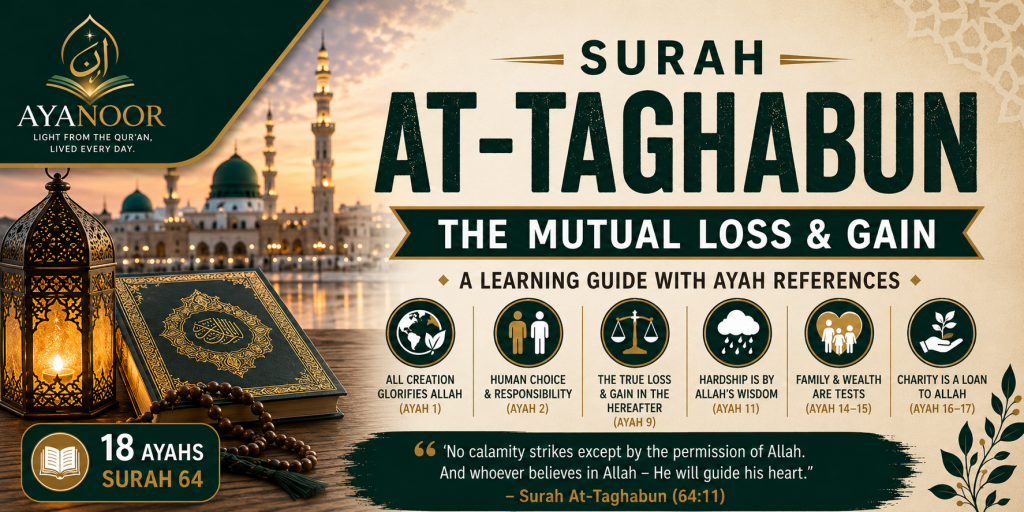
Surah At-Taghabun is the 64th chapter of the Qur’an, consisting of 18 ayahs. The word Taghabun refers to the ultimate realization of loss and gain on the Day of Judgment, when people will clearly see the consequences of their choices, beliefs, and actions.
The Surah focuses on Allah’s absolute knowledge and power, human accountability, the temporary nature of worldly life, patience during hardship, and the importance of faith, charity, and trust in Allah.
1. Everything in Creation Glorifies Allah
The Surah opens by reminding believers that all creation glorifies Allah.
“Whatever is in the heavens and whatever is on the earth glorifies Allah…”
— Ayah 1
Lessons
- The entire universe exists in submission to Allah.
- Human beings are part of a much larger creation constantly praising Him.
- Reflection on nature strengthens faith and humility.
Reflection
From the stars and oceans to birds and mountains, creation reflects divine order and wisdom. Believers are encouraged to live consciously and spiritually within this universe.
2. Allah Created Humanity With Choice
“He created you, and among you is the disbeliever, and among you is the believer…”
— Ayah 2
Lessons
- Human beings are given free will and responsibility.
- Every person chooses their path.
- Allah fully sees every action and intention.
Reflection
Faith is not inherited merely by name or culture. It requires conscious belief, sincerity, and righteous action.
3. The Hereafter Reveals the True Winners and Losers
The central theme of the Surah appears in the description of the Day of Gathering.
“That is the Day of Mutual Loss and Gain…”
— Ayah 9
Lessons
- Temporary worldly success may not reflect true success.
- The real outcome of life becomes clear in the Hereafter.
- Those who sacrificed faith for worldly gain may realize their loss too late.
Reflection
People often compete for:
- Wealth
- Fame
- Power
- Status
But the Surah reminds believers that eternal success is far greater than temporary worldly achievements.
4. Hardships Occur by Allah’s Permission
“No calamity strikes except by the permission of Allah…”
— Ayah 11
Lessons
- Trials are part of life.
- Allah’s wisdom exists even in difficulty.
- Faith helps believers navigate hardship with patience and trust.
Reflection
Challenges may include:
- Financial struggles
- Illness
- Loss
- Emotional pain
The Surah teaches believers to respond with patience, reflection, and reliance on Allah rather than despair.
5. Obey Allah and the Messenger
“Obey Allah and obey the Messenger…”
— Ayah 12
Lessons
- Guidance comes through revelation and prophetic example.
- Obedience protects believers spiritually and morally.
- Islam is meant to shape daily life, not remain theoretical.
Reflection
True faith appears through:
- Character
- Honesty
- Compassion
- Ethical choices
- Consistency in worship
6. Family and Wealth Can Become Tests
One of the most powerful sections of the Surah discusses how loved ones and wealth can sometimes distract believers from faith.
“O believers! Indeed, among your spouses and your children are enemies to you, so beware of them…”
— Ayah 14
This does not mean family itself is bad, but that emotional attachments can sometimes pull people away from truth and obedience.
Lessons
- Every blessing can also become a test.
- Love should never replace obedience to Allah.
- Balance is essential in family life.
Reflection
Modern distractions may include:
- Obsession with financial success
- Social pressure
- Fear of pleasing people over pleasing Allah
- Neglecting spirituality due to worldly responsibilities
7. Allah Encourages Forgiveness and Mercy
The Surah immediately balances the warning with compassion.
“But if you pardon, overlook, and forgive — then indeed, Allah is Forgiving and Merciful.”
— Ayah 14
Lessons
- Families require patience and forgiveness.
- Mercy strengthens relationships.
- Believers should reflect Allah’s qualities of compassion and forgiveness.
Reflection
Strong families are built through:
- Communication
- Patience
- Mercy
- Understanding
- Spiritual growth together
8. Charity Is an Investment With Allah
“So fear Allah as much as you are able, listen and obey, and spend in charity…”
— Ayah 16
And Allah says:
“Whoever lends to Allah a good loan — He will multiply it for him…”
— Ayah 17
Lessons
- Charity benefits both society and the soul.
- Allah rewards generosity abundantly.
- Giving purifies the heart from greed.
Reflection
Charity is not limited to money. It includes:
- Time
- Knowledge
- Kindness
- Emotional support
- Helping others sincerely
9. Allah Knows the Seen and the Unseen
The Surah ends with a reminder of Allah’s complete knowledge.
“Knower of the unseen and the seen, the Almighty, the Most Wise.”
— Ayah 18
Lessons
- Nothing escapes Allah’s knowledge.
- Allah knows hidden struggles, intentions, and sacrifices.
- Believers can trust His wisdom completely.
Reflection
Even when people misunderstand or overlook our efforts, Allah sees every sincere act.
Major Themes of Surah At-Taghabun
| Theme | Ayah Reference |
| Creation glorifies Allah | 1 |
| Human responsibility and choice | 2 |
| True loss and gain in the Hereafter | 9 |
| Patience during hardship | 11 |
| Obedience to Allah and His Messenger | 12 |
| Family and wealth as tests | 14–15 |
| Forgiveness and mercy | 14 |
| Charity and generosity | 16–17 |
| Allah’s complete knowledge | 18 |
Practical Lessons for Daily Life
Personal Life
- Focus on eternal success, not temporary status.
- Respond to hardship with patience and faith.
- Practice sincerity and self-accountability.
Family & Relationships
- Maintain balance between family love and spiritual priorities.
- Forgive often and nurture mercy within the home.
- Raise families with faith and character.
Spiritual Growth
- Increase remembrance of Allah.
- Give charity regularly.
- Trust Allah during uncertainty and hardship.
Self-Reflection Questions
- What does true success mean to me?
- Do worldly pursuits distract me from Allah?
- How do I respond during hardship?
- Am I generous with my time, wealth, and kindness?
- Am I preparing for the Day when real loss and gain will become clear?
Final Reflection
The Quran reminds believers that life is a temporary test and that the true reality of success and failure will only become fully clear in the Hereafter. Wealth, status, and comfort may disappear, but faith, sincerity, patience, and righteous deeds remain valuable forever.
The Surah calls believers to:
- Trust Allah
- Stay patient during trials
- Balance worldly life with spirituality
- Strengthen family relationships through mercy
- Prepare for the eternal life to come
True success is not what people celebrate in this world — it is what brings closeness to Allah in the next.
Leave a Reply