

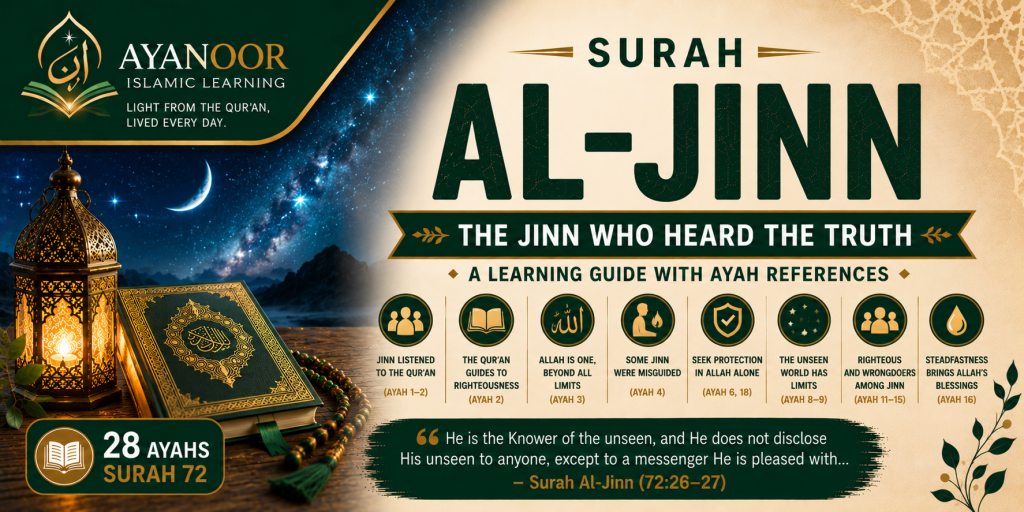
Surah Al-Jinn is the 72nd chapter of the Qur’an, consisting of 28 ayahs. The Surah discusses a group of jinn who listened to the Qur’an and immediately recognized its truth, leading them toward faith and submission to Allah.
The Surah teaches about the unseen world, the universality of the Qur’an, sincere worship of Allah alone, human accountability, and the limits of knowledge possessed by both humans and jinn.
1. A Group of Jinn Listened to the Qur’an
The Surah begins:
“Say, it has been revealed to me that a group of the jinn listened and said, ‘Indeed, we have heard an amazing Qur’an.’”
— Ayah 1
Lessons
- The Qur’an is guidance for all creation, not only humans.
- Truth naturally affects sincere hearts.
- The message of Islam reaches both the seen and unseen worlds.
Reflection
The jinn immediately recognized the beauty and truth of the Qur’an, while many humans rejected it despite repeated reminders.
2. The Qur’an Guides Toward Righteousness
The jinn said:
“It guides to right conduct, so we have believed in it…”
— Ayah 2
Lessons
- The Qur’an provides moral, spiritual, and practical guidance.
- Guidance transforms hearts and behavior.
- Sincere listeners respond with humility and faith.
Reflection
The Qur’an is not merely for recitation — it is meant to:
- Change character
- Strengthen faith
- Build justice
- Bring people closer to Allah
3. Allah Has No Partner or Child
The believing jinn declared:
“And exalted is the majesty of our Lord; He has not taken a wife or a son.”
— Ayah 3
Lessons
- Tawheed (Oneness of Allah) is the central message of Islam.
- Allah is unique and beyond human limitations.
- Pure worship belongs to Allah alone.
Reflection
The Surah emphasizes correcting false beliefs and returning to sincere worship of the Creator.
4. Some Jinn Were Misguided
The jinn admitted:
“And that our foolish one used to say excessive falsehood about Allah.”
— Ayah 4
Lessons
- Jinn, like humans, have free will.
- Some choose guidance while others choose misguidance.
- Every creation is accountable before Allah.
Reflection
Islam teaches balance regarding the unseen world:
- Avoid denial
- Avoid exaggeration
- Focus on Allah’s guidance and protection
5. Humans and Jinn Should Not Seek Power Through Each Other
The Surah warns against unhealthy spiritual dependence.
“And there were men from mankind who sought refuge in men from the jinn, so they increased them in burden.”
— Ayah 6
Lessons
- Seeking supernatural protection from jinn is discouraged.
- Dependence should be placed upon Allah alone.
- Fear and superstition can mislead people.
Reflection
Believers are encouraged to seek protection through:
- Prayer
- Qur’an recitation
- Trust in Allah
- Authentic remembrance (dhikr)
6. The Jinn Could Not Access the Heavens as Before
The jinn describe changes after the coming of revelation.
“And we used to sit there in positions for hearing, but whoever listens now will find a flaming fire waiting for him.”
— Ayah 9
Lessons
- Divine revelation is protected by Allah.
- The unseen world has limits set by Allah.
- Humans should not chase hidden knowledge or superstition.
Reflection
Islam discourages:
- Fortune telling
- Sorcery
- Obsession with hidden matters
Believers should focus on revealed guidance instead.
7. Among the Jinn Are Believers and Wrongdoers
The jinn said:
“And among us are the righteous, and among us are otherwise…”
— Ayah 11
And:
“And among us are Muslims, and among us are deviators…”
— Ayah 14
Lessons
- Jinn are morally accountable like humans.
- Every individual chooses their path.
- Allah’s justice applies universally.
Reflection
The Surah reminds believers that guidance is based on sincerity and submission to Allah, not species, race, or status.
8. Steadfastness Brings Blessings
Allah says:
“And if they had remained straight on the path, We would have given them abundant water.”
— Ayah 16
Lessons
- Obedience and righteousness bring blessings.
- Spiritual stability strengthens both individuals and societies.
- Allah provides for those who remain sincere.
Reflection
Blessings may include:
- Peace
- Stability
- Guidance
- Provision
- Emotional well-being
9. Worship Belongs to Allah Alone
One of the major teachings of the Surah is:
“And the places of worship are for Allah, so do not call upon anyone along with Allah.”
— Ayah 18
Lessons
- Worship must remain pure and sincere.
- Du‘a (supplication) should be directed only to Allah.
- Islam protects believers from spiritual confusion and idolatry.
Reflection
True worship includes:
- Prayer
- Gratitude
- Trust
- Dependence
- Love and fear of Allah
10. The Prophet ﷺ Only Conveyed the Message
Allah instructed the Prophet ﷺ to say:
“Indeed, I do not possess for you harm or guidance.”
— Ayah 21
Lessons
- Guidance ultimately comes from Allah.
- Prophets conveyed revelation faithfully.
- Human beings should not exaggerate human powers.
Reflection
Islam teaches believers to maintain direct connection with Allah without turning people into objects of worship.
11. Knowledge of the Unseen Belongs to Allah
The Surah concludes:
“He is the Knower of the unseen, and He does not disclose His unseen to anyone…”
— Ayah 26
Lessons
- Ultimate knowledge belongs to Allah alone.
- Humans should remain humble regarding unseen matters.
- Revelation provides sufficient guidance.
Reflection
The Surah encourages believers to avoid unhealthy obsession with the unseen and instead focus on worship, character, and preparation for the Hereafter.
Major Themes of Surah Al-Jinn
| Theme | Ayah Reference |
| Jinn listening to the Qur’an | 1 |
| Qur’an as guidance | 2 |
| Tawheed and Allah’s uniqueness | 3 |
| Misguided beliefs among jinn | 4 |
| Warning against seeking refuge in jinn | 6 |
| Protection of revelation | 8–9 |
| Believers and wrongdoers among jinn | 11–15 |
| Steadfastness brings blessings | 16 |
| Worship belongs only to Allah | 18 |
| Prophetic mission | 21–23 |
| Knowledge of the unseen belongs to Allah | 26–27 |
Practical Lessons for Daily Life
Spiritual Growth
- Strengthen connection with the Qur’an.
- Place trust and dependence upon Allah alone.
- Avoid superstition and fear-based beliefs.
Personal Development
- Stay humble regarding unseen matters.
- Focus on sincerity and righteous action.
- Build faith through worship and reflection.
Family & Society
- Teach balanced Islamic understanding about the unseen.
- Protect communities from harmful spiritual practices.
- Encourage Tawheed and authentic worship.
Self-Reflection Questions
- How deeply do I engage with the Qur’an?
- Do I place my trust fully in Allah?
- Am I influenced by superstition or fear?
- How can I strengthen sincerity in worship?
- Do I focus more on hidden mysteries or on improving my character and faith?
Final Reflection
The Quran reminds believers that the Qur’an is guidance for all creation and that true honor comes through sincere faith and submission to Allah. The Surah clarifies the reality of the unseen world while protecting believers from fear, superstition, and spiritual confusion.
It teaches humanity that:
- Allah alone deserves worship
- The Qur’an transforms sincere hearts
- Guidance is available to all who seek truth
- Knowledge of the unseen belongs to Allah
- True protection comes through faith and remembrance of Allah
The Surah encourages believers to strengthen Tawheed, trust Allah fully, and remain grounded in revelation rather than speculation.
Leave a Reply