

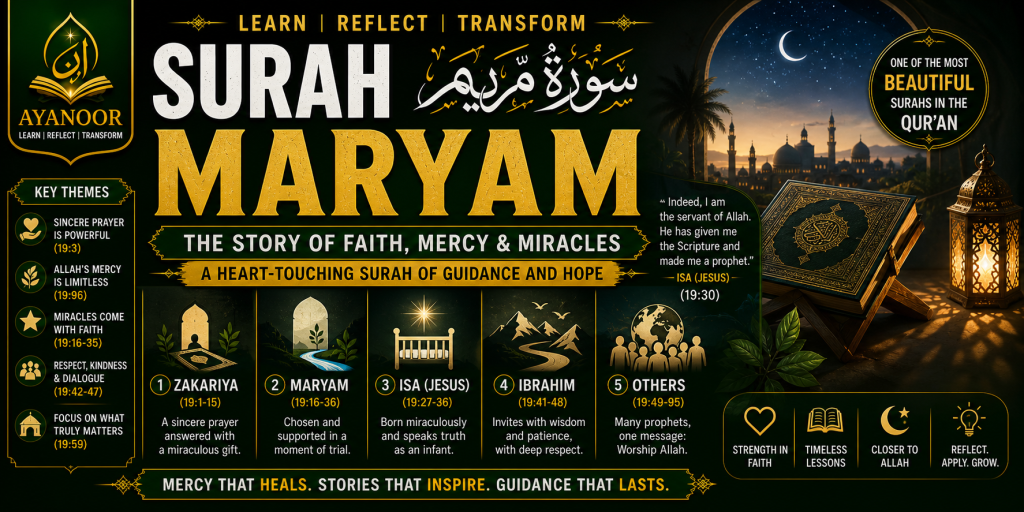
Mercy, Miracles, and the Power of Sincere Faith
Introduction
Surah Maryam is one of the most emotionally powerful chapters of the Qur’an. It beautifully weaves together stories of prophets and righteous individuals, highlighting Allah’s mercy, the acceptance of sincere prayers, and the miracles that come with unwavering faith.
The Surah is named after Maryam (Mary)—one of the most honored women in the Qur’an—and emphasizes purity, devotion, and trust in Allah.
1. The Power of Private, Sincere Prayer (Zakariya)
“[This is] a mention of the mercy of your Lord to His servant Zakariya.” (19:2)
Prophet Zakariya makes a quiet, heartfelt dua:
“When he called to his Lord a private supplication…” (19:3)
Despite old age and apparent impossibility, Allah grants him a son, Yahya (John).
Key Learning
- Sincere, private prayers are deeply valued.
- No situation is beyond Allah’s power.
- Hope should never fade.
2. Maryam: Faith in the Face of Judgment
Maryam
Maryam withdraws for worship and is given a miraculous test—the birth of Isa (Jesus) without a father.
“Indeed, I am the messenger of your Lord to give you [news of] a pure boy.” (19:19)
Her reaction shows human vulnerability:
“I wish I had died before this…” (19:23)
Yet Allah comforts her:
“Do not grieve; your Lord has provided beneath you a stream.” (19:24)
Key Learning
- Even the strongest believers feel fear and pain.
- Allah provides support in the most difficult moments.
- Honor comes through patience and trust.
3. Isa (Jesus): Truth from the Beginning
Isa
As an infant, Isa speaks miraculously:
“Indeed, I am the servant of Allah…” (19:30)
He clarifies his mission:
“And He has made me blessed wherever I am…” (19:31)
Key Learning
- Truth stands firm even in extraordinary circumstances.
- Prophethood is a mission of guidance and humility.
4. Ibrahim: Gentle Dialogue in Faith
Ibrahim
Ibrahim respectfully invites his father away from idol worship:
“O my father, why do you worship that which does not hear or see?” (19:42)
Despite rejection, he responds with kindness:
“Peace will be upon you; I will ask forgiveness for you…” (19:47)
Key Learning
- Truth should be conveyed with gentleness.
- Respect does not mean compromising belief.
- Patience is essential in family matters.
5. Other Prophets: A Chain of Guidance
The Surah mentions several prophets:
- Musa (Moses) (19:51)
- Harun (Aaron) (19:53)
- Ismail (Ishmael) (19:54)
- Idris (Enoch) (19:56)
“Those were the ones upon whom Allah bestowed favor…” (19:58)
Key Learning
- All prophets share one message: worship Allah.
- Guidance is consistent across generations.
6. The Contrast: Faith vs Neglect
The Surah warns about those who neglected prayer and followed desires:
“But there came after them successors who neglected prayer…” (19:59)
Key Learning
- Spiritual neglect leads to moral decline.
- Discipline in worship is essential.
7. Allah’s Mercy: A Central Theme
Mercy appears throughout the Surah:
- Zakariya’s prayer answered
- Maryam supported in hardship
- Isa protected and honored
- Ibrahim guided and forgiven
“Indeed, those who have believed and done righteous deeds – the Most Merciful will appoint for them affection.” (19:96)
Key Learning
- Allah’s mercy is constant and accessible.
- Faith attracts love—both divine and human.
8. The Reality of Accountability
The Surah ends with a reminder:
“There is no one in the heavens and earth but that he comes to the Most Merciful as a servant.” (19:93)
Key Learning
- All will return to Allah.
- Status, wealth, and lineage do not matter—only faith and actions.
Conclusion
Surah Maryam teaches that:
- Sincere prayer brings miracles
- Faith is tested but supported by Allah
- Mercy surrounds those who believe
- Truth should be spoken with wisdom and compassion
It is a Surah of hope—reminding us that even in our most vulnerable moments, Allah’s care is near.
Reflection Questions
- How can you make your prayers more sincere like Zakariya?
- What can Maryam’s story teach us about handling judgment and hardship?
- How can we communicate truth with the gentleness of Ibrahim?
- Are there areas in life where spiritual discipline needs strengthening?
Closing Thought
Surah Maryam reminds us that miracles are not just events—they are moments where faith meets divine mercy. When the heart turns sincerely to Allah, even the impossible becomes possible.
Leave a Reply