

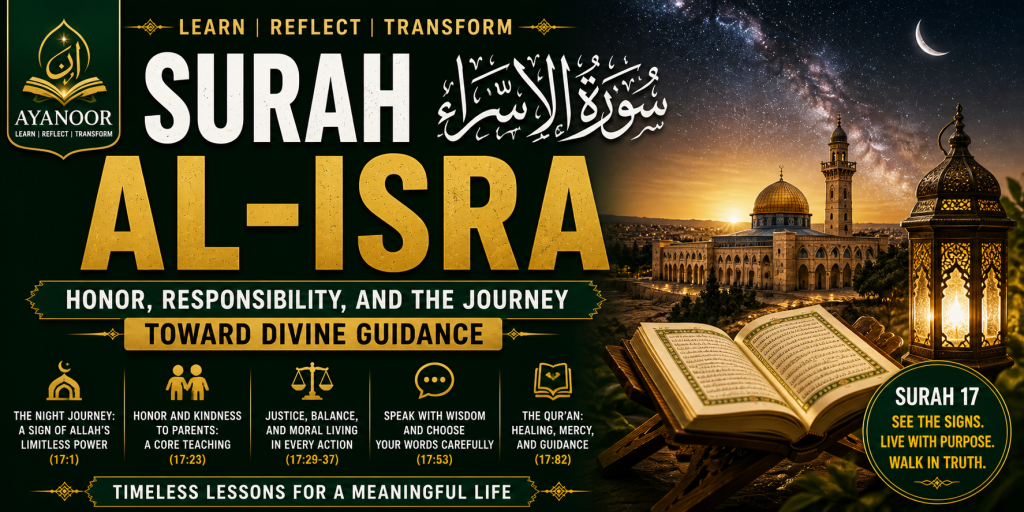
Honor, Responsibility, and the Journey Toward Divine Guidance
Introduction
Surah Al-Isra, also known as Banī Isrā’īl, is a Makkan Surah that begins with the miraculous Night Journey of the Prophet ﷺ. It then expands into a comprehensive guide for personal conduct, social justice, and spiritual awareness.
This Surah connects faith with responsibility, reminding humanity that honor comes with accountability.
1. The Night Journey: A Sign Beyond Limits
The Surah opens with one of the most remarkable events:
“Exalted is He who took His servant by night from Al-Masjid al-Ḥarām to Al-Masjid al-Aqṣā…” (17:1)
This journey symbolizes:
- The connection between sacred spaces
- The elevation of the Prophet ﷺ
- The limitless power of Allah
Key Learning
- Divine power is beyond human limitations.
- Spiritual elevation comes through closeness to Allah.
2. Honor of Human Beings
A powerful declaration of human dignity:
“And We have certainly honored the children of Adam…” (17:70)
This honor is universal—given to all humanity.
Key Learning
- Every human being has inherent dignity.
- With honor comes moral responsibility.
3. Individual Accountability
The Surah emphasizes personal responsibility:
“Whoever is guided is only guided for [the benefit of] himself…” (17:15)
“And no bearer of burdens will bear the burden of another.”
Key Learning
- Each person is accountable for their choices.
- Guidance benefits the individual first.
4. The Qur’an as Guidance and Healing
The Surah highlights the transformative power of revelation:
“And We send down of the Qur’an that which is healing and mercy for the believers…” (17:82)
Key Learning
- The Qur’an heals hearts, minds, and societies.
- True guidance brings inner peace.
5. Core Ethical Teachings (A Moral Framework)
Surah Al-Isrā contains one of the most comprehensive ethical passages in the Qur’an:
“Do not associate anything with Allah…” (17:22)
“And your Lord has decreed that you not worship except Him, and to parents, good treatment…” (17:23)
“Do not kill your children out of poverty…” (17:31)
“Do not approach unlawful sexual relations…” (17:32)
“Do not take a life which Allah has forbidden…” (17:33)
“Give full measure and weight with justice…” (17:35)
“Do not walk upon the earth arrogantly…” (17:37)
Key Learning
- Faith must reflect in ethical living.
- Justice, humility, and compassion define a believer.
6. Balance in Spending and Lifestyle
The Surah teaches moderation:
“Do not make your hand [as] chained to your neck or extend it completely…” (17:29)
Key Learning
- Avoid both stinginess and extravagance.
- Balance leads to stability.
7. The Danger of Arrogance and Pride
Arrogance is strongly condemned:
“Indeed, you will never tear the earth apart, nor reach the mountains in height.” (17:37)
Key Learning
- Pride disconnects a person from truth.
- Humility brings clarity and growth.
8. The Power of Speech and Communication
The Surah emphasizes speaking wisely:
“Tell My servants to say that which is best…” (17:53)
Key Learning
- Words can build or destroy.
- Kind speech is a form of worship.
9. The Limits of Human Knowledge
A profound reminder:
“And you have not been given of knowledge except a little.” (17:85)
Key Learning
- Human knowledge is limited.
- Humility in learning is essential.
10. Truth Will Always Prevail
A powerful closing principle:
“Truth has come, and falsehood has vanished…” (17:81)
Key Learning
- Falsehood is temporary.
- Truth is enduring.
Conclusion
Surah Al-Isrā teaches that:
- Humanity is honored—but accountable.
- Faith must translate into ethical behavior.
- The Qur’an is a living guide for healing and direction.
- Truth, humility, and justice form the foundation of a meaningful life.
It calls every reader to align their actions with their purpose.
Reflection Questions
- How can we honor the dignity given to us by Allah?
- Which ethical teaching from this Surah resonates most with your life today?
- How can we improve our speech and communication?
- What does it mean to live responsibly with the knowledge we have?
Closing Thought
Surah Al-Isrā reminds us that life itself is a journey—like the Night Journey—moving from darkness toward light, guided by faith, responsibility, and truth.
Leave a Reply