

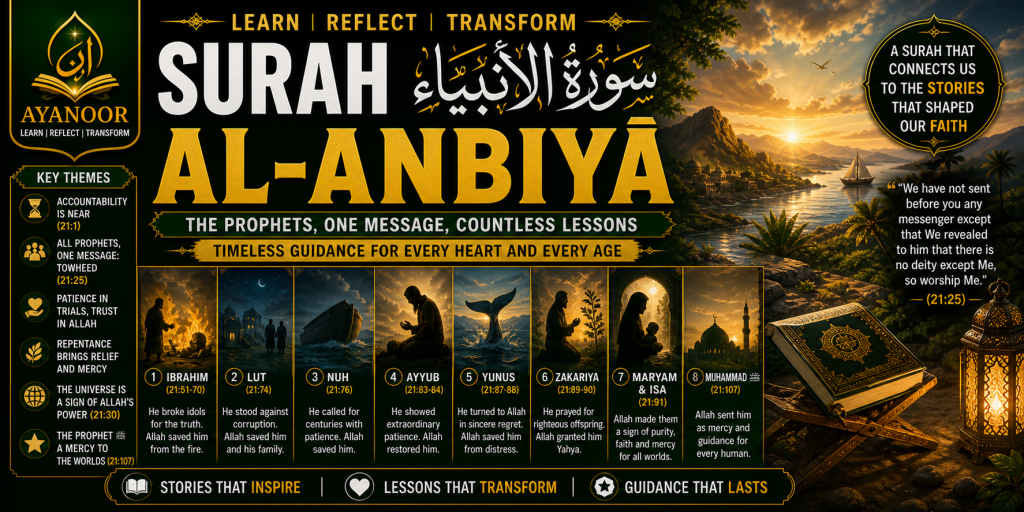
Urgency of Accountability, Unity of Prophethood, and Allah’s Overarching Mercy
Introduction
Surah Al-Anbiya (The Prophets) is a Makkan Surah that calls humanity to awaken from heedlessness. It highlights the nearness of accountability, the shared mission of all prophets, and the mercy of Allah that surrounds guidance.
Through brief but powerful snapshots of many prophets, the Surah shows that truth is consistent across time—and that those who hold onto it are ultimately supported.
1. The Nearness of Accountability
“[The time of] their account has approached for the people, while they are in heedlessness turning away.” (21:1)
“No mention comes to them anew from their Lord except that they listen to it while they are at play.” (21:2)
Key Learning
- Life moves quickly toward accountability.
- Distraction can prevent us from recognizing truth.
- Awareness must replace heedlessness.
2. The Human Response to Revelation
People often respond with doubt or mockery:
“Is this but a human being like you?” (21:3)
Yet Allah clarifies:
“We did not send before you except men to whom We revealed…” (21:7)
Key Learning
- Prophets were human—relatable and real.
- Rejection often comes from arrogance, not lack of evidence.
3. The Mission of All Prophets: One Message
A central verse of the Surah:
“And We sent not before you any messenger except that We revealed to him that there is no deity except Me, so worship Me.” (21:25)
Key Learning
- All prophets brought the same core message: Tawḥīd (Oneness of Allah)
- Differences in time and place do not change the truth.
4. Ibrahim: Challenging Falsehood with Clarity
Ibrahim
Ibrahim questions idol worship:
“What are these statues to which you are devoted?” (21:52)
He breaks the idols to awaken reflection:
“Rather, this—the largest of them—did it…” (21:63)
Despite being thrown into the fire:
“We said, ‘O fire, be coolness and safety upon Ibrahim.’” (21:69)
Key Learning
- Truth requires courage.
- Questioning false beliefs is part of guidance.
- Allah protects those who stand firm.
5. Lut: Standing Firm Against Corruption
Lut
“And Lot—We gave him judgment and knowledge…” (21:74)
“And We saved him from the city that was committing wicked deeds.” (21:74)
Key Learning
- Moral courage is essential in corrupt environments.
- Standing alone for truth is still victory.
6. Nuh: Perseverance Over Time
Nuh
“And [mention] Nuh, when he called [to Allah] before…” (21:76)
“So We responded to him and saved him…” (21:76)
Key Learning
- Long-term perseverance is honored by Allah.
- Sincere الدعاء (supplication) is always heard.
7. Ayyub: Patience Through Hardship
Ayyub
“Indeed, adversity has touched me, and You are the Most Merciful of the merciful.” (21:83)
“So We responded to him and removed what afflicted him…” (21:84)
Key Learning
- Patience does not mean silence—it includes turning to Allah.
- Relief comes with trust and perseverance.
8. Yunus: Returning to Allah After Mistake
Yunus
“There is no deity except You; exalted are You. Indeed, I have been of the wrongdoers.” (21:87)
“So We responded to him and saved him from distress…” (21:88)
Key Learning
- Mistakes do not define us—returning to Allah does.
- Sincere repentance brings relief.
9. Zakariya: Hope Against Impossibility
Zakariya
“My Lord, do not leave me alone [without an heir]…” (21:89)
“So We responded to him and gave him Yahya…” (21:90)
Key Learning
- Never lose hope in Allah’s mercy.
- What seems impossible is easy for Allah.
10. Maryam and Isa: Signs of Mercy
Maryam
Isa
“And the one who guarded her chastity… We made her and her son a sign for the worlds.” (21:91)
Key Learning
- Purity and faith lead to honor.
- Miracles are signs pointing toward truth.
11. The Universe as a Sign of Truth
“Do not those who disbelieve see that the heavens and the earth were a joined entity, and We separated them…” (21:30)
“And We made from water every living thing…” (21:30)
Key Learning
- Creation itself points to a Creator.
- Reflection leads to belief.
12. The Victory of Truth Over Falsehood
“Rather, We dash the truth upon falsehood, and it destroys it…” (21:18)
Key Learning
- Falsehood may appear strong, but it is fragile.
- Truth is enduring and ultimately prevails.
13. The Prophet ﷺ as Mercy to the Worlds
A defining verse:
“And We have not sent you except as a mercy to the worlds.” (21:107)
Key Learning
- Islam is rooted in mercy.
- The Prophet ﷺ embodies compassion, guidance, and balance.
Conclusion
Surah Al-Anbiyā teaches that:
- Accountability is near—live consciously
- All prophets brought one unified message
- Patience, repentance, and trust lead to success
- Truth will always overcome falsehood
- Mercy is at the heart of divine guidance
Reflection Questions
- What distractions keep us from recognizing truth today?
- Which prophet’s story reflects your current life situation?
- How can we strengthen our connection with Allah in times of difficulty?
- Do we view life with awareness of accountability?
Closing Thought
Surah Al-Anbiyā reminds us that history is not just a record—it is a mirror. The stories of the prophets are reflections of our own struggles, choices, and opportunities to return to Allah.
Leave a Reply