

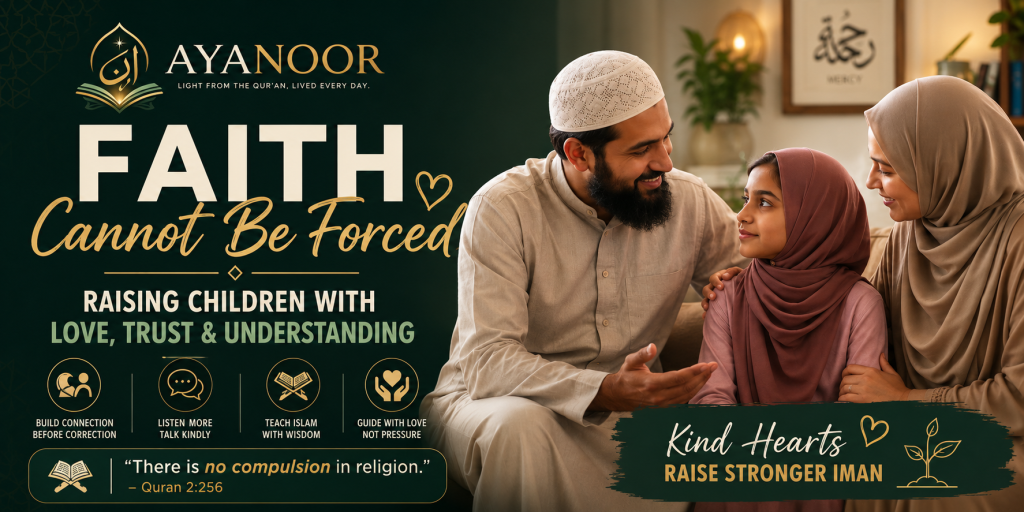
In many Muslim families, especially across the subcontinent, religion is deeply respected and cherished. Parents naturally want their children to grow up with modesty, good character, Islamic values, and protection from harmful influences. Their intentions are often sincere and rooted in love.
However, sometimes the way faith is communicated inside the home can unintentionally create fear, emotional distance, secrecy, or resentment instead of understanding, confidence, and spiritual connection.
Many young girls grow up hearing constant pressure about hijab, behavior, friendships, appearance, or interaction with boys, while meaningful emotional connection with parents remains limited. At the same time, boys may also grow up emotionally disconnected, unable to openly discuss their struggles, confusion, or questions.
Islam does not call parents to merely control behavior. Islam calls families to nurture hearts.
Allah says in the Quran:
“There is no compulsion in religion.”
— Quran 2:256
This verse is not simply about accepting Islam formally. It also teaches a timeless principle: faith grows strongest when hearts willingly embrace truth through understanding, reflection, trust, and love.
The Difference Between Guidance and Pressure
There is a major difference between:
- guiding a child with wisdom, and
- constantly controlling them through fear, shame, or emotional pressure.
A child who obeys only because they are afraid of parents may appear religious outwardly, but internally they may feel distant, confused, or emotionally exhausted.
On the other hand, when children feel emotionally safe, heard, respected, and loved, they are far more likely to embrace Islamic values sincerely and naturally.
The Prophet ﷺ transformed hearts through mercy, patience, companionship, and wisdom — not through humiliation or emotional force.
Allah described him beautifully:
“It is by the mercy of Allah that you were gentle with them. Had you been harsh or hard-hearted, they would have dispersed from around you.”
— Quran 3:159
This principle applies inside our homes as well.
Children Need Friendship Before Correction
One of the biggest challenges in many households is the lack of meaningful interaction between parents and children.
Some parents provide food, education, clothing, and protection, yet rarely sit with their children as companions. Conversations become limited to:
- studies,
- rules,
- criticism,
- warnings,
- comparisons,
- or instructions.
As a result, children may obey externally while emotionally drifting away internally.
Children naturally admire people they emotionally connect with. If parents become approachable, compassionate, and involved in their children’s lives, many Islamic values will be adopted organically without constant enforcement.
A daughter who deeply respects and trusts her mother may naturally want to resemble her modesty and character.
A son who admires his father’s honesty, mercy, discipline, and kindness may naturally imitate him.
Real influence comes through connection.
Hijab Should Be Taught With Wisdom and Dignity
Hijab is part of Islamic teachings and modesty is a beautiful value in Islam for both men and women. But how we teach it matters greatly.
If hijab is presented only as:
- fear of society,
- fear of dishonor,
- family pressure,
- or endless restrictions,
then some girls may begin associating religion with stress and emotional burden rather than spirituality and dignity.
Parents should help daughters understand:
- their worth is not based on appearance,
- modesty protects dignity and self-respect,
- beauty in Islam includes character and intellect,
- and hijab can be an act of love and devotion to Allah.
These conversations require patience, maturity, and emotional intelligence.
Faith cannot simply be installed through commands. It must be nurtured over time.
The Prophet ﷺ Listened to Young People
The Prophet ﷺ never treated young people as problems to be controlled. He listened to them, guided them gently, and understood their emotions.
Even when people made mistakes, he corrected them with wisdom instead of public humiliation.
Today, many children are growing up in a world filled with:
- social media influence,
- identity confusion,
- loneliness,
- unrealistic beauty standards,
- peer pressure,
- and emotional struggles.
This generation does not only need rules. They need emotionally available parents.
Sometimes a calm conversation at night can protect a child more than years of strictness.
Fear May Produce Secrecy, Not Faith
When children are unable to speak openly at home, they often begin hiding things instead.
Fear-based environments can sometimes produce:
- double lives,
- emotional isolation,
- dishonesty,
- anxiety,
- rebellion,
- or silent resentment.
Parents may think strict control guarantees protection, but true protection comes when children trust their parents enough to seek guidance willingly.
A home should feel like the safest place for difficult conversations.
Children should feel they can say:
- “I’m confused.”
- “I made a mistake.”
- “I’m struggling.”
- “I need help.”
Without immediately fearing humiliation or rejection.
Parents Must Become Role Models
Children observe far more than they listen.
If parents constantly speak about Islam but display:
- anger,
- disrespect,
- hypocrisy,
- emotional neglect,
- harshness,
- or dishonesty,
children may struggle to connect faith with beauty.
But when they witness:
- mercy,
- patience,
- prayer,
- humility,
- honesty,
- kindness,
- generosity,
- and emotional balance,
Islam becomes alive before their eyes.
The strongest dawah inside a home is character.
Building Homes Filled With Mercy
Strong Muslim families are not built merely through restrictions. They are built through:
- trust,
- communication,
- companionship,
- emotional safety,
- shared time,
- and sincere dua.
Parents should spend meaningful time with their children:
- eating together,
- traveling together,
- discussing life,
- listening without immediate judgment,
- reading Quran together,
- sharing reflections,
- laughing,
- and building memories.
These moments strengthen hearts.
Children who feel loved and emotionally secure are often far more capable of handling the pressures of the modern world.
A Balanced Islamic Approach
Islam does not ask parents to abandon guidance or ignore moral boundaries. Parents still have the responsibility to teach values, encourage modesty, and protect their families.
But Islam also teaches wisdom, gentleness, patience, and understanding.
The goal is not to raise children who merely appear religious in front of society.
The goal is to raise human beings who genuinely love Allah, trust their parents, possess strong character, and willingly carry faith in their hearts even when nobody is watching.
That journey begins not with force, but with mercy.
Leave a Reply