

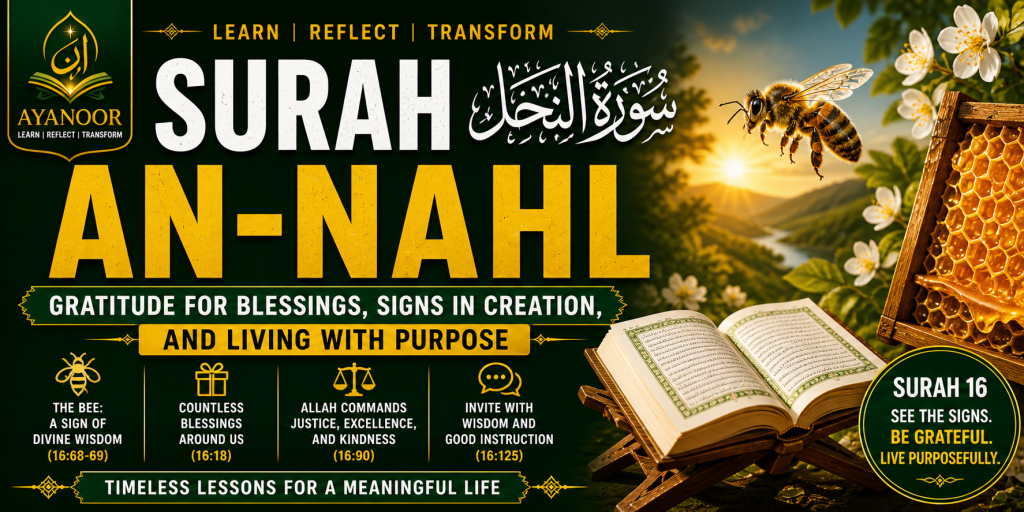
Gratitude, Divine Signs, and Living with Purpose
Introduction
Surah An-Nahl is a Makkan Surah often called “The Surah of the Bee.” It invites us to reflect on the countless blessings around us—from the natural world to revelation—and reminds us that gratitude is not just a feeling, but a way of life.
The Surah speaks to humanity at large, calling people to recognize truth through observation, reflection, and humility.
1. Recognizing Allah’s Blessings Everywhere
The Surah opens with a powerful reminder that divine command is certain:
“The command of Allah is coming, so do not seek to hasten it.” (16:1)
It then unfolds a wide canvas of blessings:
“He created the heavens and the earth in truth…” (16:3)
“And He created the cattle for you…” (16:5)
“And He subjected for you the night and day…” (16:12)
Key Learning
- Blessings are not random—they are intentional signs.
- Awareness of blessings leads to gratitude.
2. The Bee as a Sign of Divine Wisdom
The Surah highlights one of the most fascinating creations:
“And your Lord inspired the bee…” (16:68–69)
“…from their bellies comes a drink of varying colors, in which there is healing for people.”
The bee operates with precision, purpose, and harmony.
Key Learning
- Even the smallest creatures reflect divine design.
- Nature teaches discipline, cooperation, and purpose.
3. Gratitude vs Ingratitude
A central theme is the contrast between those who recognize blessings and those who deny them:
“And if you count the favors of Allah, you cannot enumerate them…” (16:18)
Yet many still turn away:
“They recognize the favor of Allah; then they deny it…” (16:83)
Key Learning
- Gratitude is acknowledgment + obedience.
- Ingratitude leads to spiritual blindness.
4. The Consequences of Denial
The Surah warns through historical patterns:
“We certainly sent into every nation a messenger…” (16:36)
Those who rejected guidance faced consequences—not arbitrarily, but as a result of persistent denial.
Key Learning
- Guidance has always been sent to humanity.
- Accountability is universal.
5. Justice, Excellence, and Moral Living
One of the most comprehensive ethical verses in the Qur’an:
“Indeed, Allah commands justice, excellence, and giving to relatives…” (16:90)
“…and forbids immorality, wrongdoing, and oppression.”
This verse is often recited in sermons because it summarizes a complete moral framework.
Key Learning
- Faith must translate into ethical conduct.
- Justice and kindness are inseparable in Islam.
6. Integrity in Words and Promises
The Surah emphasizes honesty and accountability:
“And fulfill the covenant of Allah when you have taken it…” (16:91)
“Do not break oaths after confirming them…”
Key Learning
- Trustworthiness is a core value.
- Words carry moral weight.
7. Responding to Opposition with Wisdom
The Surah gives a timeless principle for dialogue:
“Invite to the way of your Lord with wisdom and good instruction…” (16:125)
“…and argue with them in a way that is best.”
Key Learning
- Truth should be conveyed with wisdom, not aggression.
- Respectful dialogue opens hearts.
8. Patience and Reliance on Allah
The Prophet ﷺ is guided to remain patient:
“Be patient, and your patience is not but through Allah…” (16:127)
Key Learning
- Patience is strength, not weakness.
- Reliance on Allah brings inner stability.
9. The Dangers of Following Desire Without Guidance
The Surah warns against blindly following assumptions:
“They follow nothing but conjecture…” (16:116)
Key Learning
- Truth requires knowledge, not guesswork.
- Moral clarity comes from divine guidance.
Conclusion
Surah An-Nahl teaches that:
- Life is surrounded by signs of divine mercy.
- Gratitude is the foundation of faith.
- Justice, integrity, and wisdom define a believer’s character.
- Nature itself is a classroom for reflection.
It invites every reader—regardless of background—to pause, observe, and live consciously with purpose and gratitude.
Reflection Questions
- What blessings in your daily life do you often overlook?
- How can gratitude be practiced beyond words?
- What can we learn from the discipline and purpose of the bee?
- How can we communicate truth with wisdom in today’s world?
Closing Thought
Surah An-Nahl reminds us that guidance is not hidden—it is all around us. The real question is whether we choose to see it, appreciate it, and live by it.
Leave a Reply