

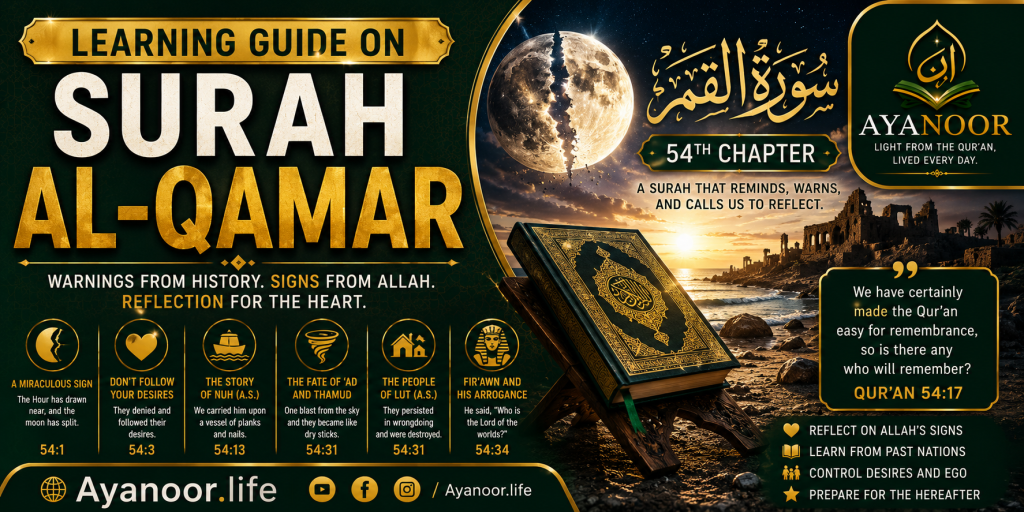
A Learning Guide on Accountability, Warnings, Reflection, and the Consequences of Arrogance
Surah Al-Qamar (“The Moon”) is the 54th chapter of the Qur’an and is one of the most powerful Makkan Surahs about:
- the certainty of the Day of Judgment,
- the rejection of truth,
- the destruction of arrogant nations,
- and the repeated call for humanity to reflect and learn.
The Surah opens with one of the miraculous signs shown during the life of Prophet Muhammad ﷺ:
“The Hour has drawn near, and the moon has split.”
— Qur’an 54:1
Despite witnessing signs, many people still denied the truth because of arrogance and stubbornness.
Throughout the Surah, Allah repeatedly narrates the stories of earlier nations and after each story asks:
“And We have certainly made the Qur’an easy for remembrance, so is there any who will remember?”
— Qur’an 54:17
This repeated verse becomes the central message of the Surah:
- reflect,
- learn,
- and do not repeat the mistakes of those before you.
1. The Signs of Allah Should Awaken the Heart
The Surah begins with the miracle of the splitting of the moon.
“The Hour has drawn near, and the moon has split.”
— Qur’an 54:1
Yet many still rejected what they saw.
“But if they see a sign, they turn away and say: continuing magic.”
— Qur’an 54:2
Reflection
The Qur’an teaches that guidance is not only about seeing signs — it also requires sincerity and humility.
People may witness:
- blessings,
- miracles of nature,
- moments of truth,
- and countless signs,
yet still refuse reflection because of pride or distraction.
Surah Al-Qamar calls humanity to awaken spiritually before it becomes too late.
2. Following Desires Can Blind Human Beings
Allah describes people who rejected guidance:
“They denied and followed their desires…”
— Qur’an 54:3
Reflection
Modern society often encourages people to:
- follow desires without limits,
- define truth according to feelings,
- and avoid accountability.
But Surah Al-Qamar teaches that when desires dominate:
- wisdom weakens,
- morality declines,
- and the heart becomes spiritually blind.
True freedom comes through guidance and self-control, not unrestricted desire.
3. The Story of Prophet Nuh عليه السلام
The Surah recalls the people of Nuh (Noah) عليه السلام who rejected repeated warnings.
“Before them, the people of Nuh denied…”
— Qur’an 54:9
Despite years of preaching, they mocked and rejected him.
Eventually Allah saved Nuh and the believers while the flood destroyed the arrogant rejecters.
“And We carried him upon a vessel of planks and nails.”
— Qur’an 54:13
Reflection
The story teaches:
- patience in delivering truth,
- the danger of arrogance,
- and that rejection of guidance eventually carries consequences.
4. The Destruction of ‘Ad and Thamud
Allah then reminds humanity of the nations of ‘Ad and Thamud.
These powerful civilizations were destroyed because they:
- became arrogant,
- rejected truth,
- and abused power.
Regarding Thamud, Allah says:
“Indeed, We sent upon them one blast from the sky, and they became like dry sticks used by a fence-builder.”
— Qur’an 54:31
Reflection
History repeatedly shows that civilizations decline morally before collapsing physically.
The Surah teaches that:
- strength without humility becomes dangerous,
- and societies built upon arrogance eventually weaken.
5. The Story of Prophet Lut عليه السلام
The people of Lut rejected morality and persisted in corruption despite warnings.
Allah saved Lut and his family except those who chose disbelief.
Reflection
The Qur’an repeatedly teaches that moral corruption damages societies deeply.
Surah Al-Qamar reminds believers that:
- truth should not be abandoned simply because wrongdoing becomes normalized.
6. Fir‘awn and Power Without Humility
Allah also mentions Fir‘awn (Pharaoh), who:
- possessed enormous power,
- controlled wealth and armies,
- yet rejected Allah arrogantly.
Reflection
Power without humility often leads to:
- oppression,
- injustice,
- and spiritual blindness.
The Surah teaches believers that no worldly power can stand against Allah’s justice.
7. The Qur’an Has Been Made Easy for Reflection
One of the most repeated and beautiful verses in the Surah states:
“And We have certainly made the Qur’an easy for remembrance, so is there any who will remember?”
— Qur’an 54:17
This verse appears multiple times throughout the Surah.
Reflection
The Qur’an is:
- accessible,
- understandable,
- and spiritually transformative for sincere hearts.
Allah did not reveal the Qur’an only for scholars — but for all people willing to reflect sincerely.
The real question is:
- Are people willing to listen and change?
8. The Hereafter Is Certain
Surah Al-Qamar repeatedly reminds humanity of the Day of Judgment.
“Indeed, the righteous will be among gardens and rivers.”
— Qur’an 54:54
The righteous are contrasted with those who rejected truth arrogantly.
Reflection
The Surah teaches believers not to become consumed by temporary worldly life.
Real success belongs to:
- faith,
- sincerity,
- humility,
- and righteous action.
9. Allah’s Power Is Absolute
The Surah repeatedly demonstrates Allah’s complete control over:
- nature,
- history,
- nations,
- and destiny.
“And Our command is but one, like a glance of the eye.”
— Qur’an 54:50
Reflection
Human beings often become arrogant because of:
- technology,
- wealth,
- influence,
- or worldly achievements.
But Surah Al-Qamar reminds humanity that all power remains under Allah’s control.
Practical Lessons from Surah Al-Qamar
Personal Lessons
- Reflect upon Allah’s signs
- Control desires and ego
- Learn from history
- Stay humble before Allah
- Prepare for accountability
Family Lessons
- Build homes upon faith and morality
- Teach children reflection and humility
- Encourage obedience to truth
- Protect families from spiritual neglect
Community Lessons
- Arrogance destroys societies
- Moral corruption weakens nations
- Truth must remain above desires
- Communities survive through humility and justice
Spiritual Lessons
- The Qur’an is a reminder for sincere hearts
- Allah’s signs surround humanity
- The Hereafter is certain
- Guidance requires humility
- Reflection awakens the soul
Important Ayahs for Reflection
The Splitting of the Moon
“The Hour has drawn near, and the moon has split.”
— Qur’an 54:1
Following Desires
“They denied and followed their desires…”
— Qur’an 54:3
The Qur’an Made Easy
“We have certainly made the Qur’an easy for remembrance…”
— Qur’an 54:17
Allah’s Absolute Power
“Our command is but one, like a glance of the eye.”
— Qur’an 54:50
Reward for the Righteous
“Indeed, the righteous will be among gardens and rivers.”
— Qur’an 54:54
Questions for Reflection
- Am I truly reflecting upon Allah’s signs?
- Are my desires controlling my decisions?
- What lessons can I learn from earlier nations?
- Do I approach the Qur’an with sincerity and humility?
- Am I preparing for the Hereafter or only worldly life?
- How often do I pause and reflect deeply?
Conclusion
Surah Al-Qamar is a powerful call toward:
- reflection,
- humility,
- accountability,
- and spiritual awakening.
The Surah teaches believers that:
- signs alone do not guide arrogant hearts,
- desires can blind people from truth,
- and civilizations collapse when they reject morality and humility.
It repeatedly reminds humanity that the Qur’an has been made accessible for those willing to remember and reflect.
Above all, Surah Al-Qamar calls believers to learn from history, recognize Allah’s signs, and return to Him with sincerity before the Day of Judgment arrives.