

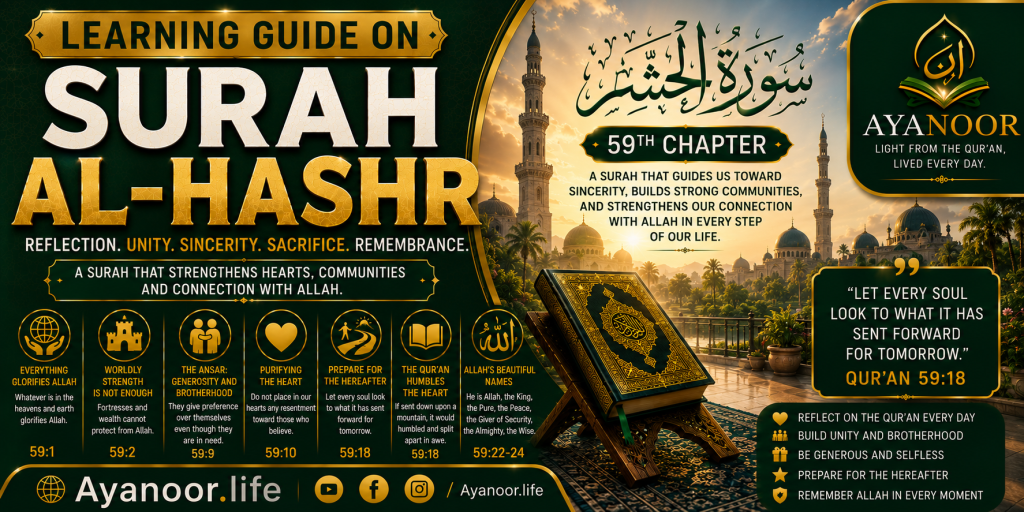
A Learning Guide on Reflection, Unity, Hypocrisy, Sacrifice, and the Beautiful Names of Allah
Surah Al-Hashr (“The Gathering”) is the 59th chapter of the Qur’an and is a deeply powerful Surah focused on:
- the consequences of hypocrisy,
- trust in Allah,
- unity among believers,
- sacrifice and generosity,
- reflection upon the Qur’an,
- and the magnificent Names and Attributes of Allah.
The Surah discusses the expulsion of the tribe of Banu Nadir from Madinah after betrayal and treachery, while also drawing broader spiritual lessons about:
- reliance upon Allah,
- sincerity,
- community ethics,
- and preparing for the Hereafter.
One of the most famous sections of the Qur’an appears at the end of Surah Al-Hashr, where Allah reveals several of His beautiful Names.
The Surah repeatedly calls believers to:
- reflect deeply,
- purify the heart,
- and build spiritually strong communities rooted in sincerity and compassion.
1. Everything in Creation Glorifies Allah
The Surah begins by declaring:
“Whatever is in the heavens and whatever is on the earth glorifies Allah…”
— Qur’an 59:1
Reflection
The Qur’an teaches that all creation exists in a state of submission and glorification of Allah:
- stars,
- oceans,
- mountains,
- animals,
- and every system within nature.
Human beings are invited to consciously join this universal remembrance through:
- worship,
- gratitude,
- and obedience.
2. Worldly Strength Cannot Protect Against Allah’s Decree
The Surah discusses the people of Banu Nadir, who believed their fortresses and resources would protect them.
“They thought their fortresses would protect them from Allah…”
— Qur’an 59:2
Yet Allah’s decree reached them unexpectedly.
Reflection
People often place ultimate trust in:
- wealth,
- technology,
- status,
- power,
- or security systems.
But Surah Al-Hashr reminds believers that:
- true protection comes from Allah,
- and worldly strength alone cannot guarantee safety.
This develops humility and dependence upon Allah.
3. Hypocrisy Weakens Individuals and Societies
The Surah exposes the behavior of hypocrites who:
- pretended loyalty,
- encouraged betrayal,
- and abandoned people when difficulties arose.
“Like Satan when he says to man, ‘Disbelieve,’ but when he disbelieves, he says, ‘Indeed, I am free from you.’”
— Qur’an 59:16
Reflection
Hypocrisy destroys:
- trust,
- unity,
- relationships,
- and moral integrity.
True believers strive for consistency between:
- words and actions,
- public image and private reality,
- promises and behavior.
4. The Ansar Represent Generosity and Brotherhood
One of the most beautiful passages in the Surah praises the Ansar (the Helpers of Madinah).
“They give preference over themselves even though they are in need…”
— Qur’an 59:9
Reflection
The Ansar welcomed the Muhajirun (migrants) with:
- generosity,
- love,
- sacrifice,
- and emotional support.
This verse teaches believers the importance of:
- selflessness,
- caring for others,
- and building communities rooted in compassion rather than selfishness.
5. Believers Should Purify Their Hearts from Hatred
Allah teaches believers to make this beautiful dua:
“Our Lord, forgive us and our brothers who preceded us in faith and do not place in our hearts any resentment toward those who believe…”
— Qur’an 59:10
Reflection
The Qur’an recognizes the danger of:
- jealousy,
- resentment,
- bitterness,
- and hatred.
Healthy communities require:
- forgiveness,
- emotional maturity,
- and sincere concern for one another.
Purifying the heart is part of spiritual growth.
6. Believers Must Prepare for the Hereafter
One of the most powerful verses in the Surah states:
“O you who believe, fear Allah. And let every soul look to what it has sent forward for tomorrow…”
— Qur’an 59:18
Reflection
The Surah teaches believers to live consciously and intentionally.
People often become consumed by:
- daily routines,
- worldly competition,
- entertainment,
- and temporary concerns,
while forgetting eternal accountability.
The verse encourages self-reflection:
- What am I preparing for my Hereafter?
- What legacy am I building?
7. Forgetting Allah Leads to Spiritual Loss
Allah warns:
“And do not be like those who forgot Allah, so He made them forget themselves.”
— Qur’an 59:19
Reflection
When people disconnect from Allah, they often:
- lose clarity,
- lose purpose,
- lose moral direction,
- and become spiritually empty.
True remembrance of Allah helps people:
- understand themselves,
- control desires,
- and live with purpose.
8. The Qur’an Has the Power to Humble Hearts
One of the most emotionally powerful verses in the Qur’an appears in this Surah:
“If We had sent down this Qur’an upon a mountain, you would have seen it humbled and split apart from fear of Allah…”
— Qur’an 59:21
Reflection
If mountains would humble themselves before Allah’s words, then human hearts should soften as well.
The Qur’an was not revealed merely for:
- recitation,
- decoration,
- or memorization alone,
but for:
- reflection,
- transformation,
- and spiritual awakening.
9. Allah’s Beautiful Names Reveal His Perfection
The Surah concludes with several Names of Allah:
“He is Allah, besides whom there is no deity…”
— Qur’an 59:22
Among His Names mentioned:
- Al-Malik (The King)
- Al-Quddus (The Most Pure)
- As-Salam (The Source of Peace)
- Al-Mu’min (The Granter of Security)
- Al-Aziz (The Almighty)
- Al-Hakim (The Most Wise)
Reflection
Learning Allah’s Names strengthens:
- faith,
- love for Allah,
- trust,
- worship,
- and spiritual connection.
Every Name reflects aspects of Allah’s perfection and mercy.
Practical Lessons from Surah Al-Hashr
Personal Lessons
- Reflect upon your Hereafter
- Purify the heart from resentment
- Stay sincere and avoid hypocrisy
- Depend upon Allah, not worldly strength
- Deepen connection with the Qur’an
Family Lessons
- Build homes rooted in generosity and trust
- Encourage forgiveness and emotional maturity
- Strengthen remembrance of Allah
- Teach children sincerity and compassion
Community Lessons
- Communities thrive through sacrifice and brotherhood
- Hypocrisy destroys trust
- Unity requires sincerity and forgiveness
- Generosity strengthens societies
Spiritual Lessons
- Everything glorifies Allah
- The Qur’an softens hearts
- Allah’s Names strengthen faith
- Remembering Allah brings clarity and purpose
Important Ayahs for Reflection
Everything Glorifies Allah
“Whatever is in the heavens and earth glorifies Allah…”
— Qur’an 59:1
Generosity of the Ansar
“They give preference over themselves…”
— Qur’an 59:9
Purifying the Heart
“Do not place in our hearts resentment…”
— Qur’an 59:10
Preparing for the Hereafter
“Let every soul look to what it has sent forward for tomorrow…”
— Qur’an 59:18
The Qur’an and the Mountain
“If We had sent down this Qur’an upon a mountain…”
— Qur’an 59:21
Beautiful Names of Allah
“He is Allah, besides whom there is no deity…”
— Qur’an 59:22
Questions for Reflection
- Am I relying more on worldly security or on Allah?
- Is there resentment or jealousy within my heart?
- What am I preparing for my Hereafter?
- Has the Qur’an softened and transformed my heart?
- How generous and selfless am I toward others?
- How well do I know and reflect upon Allah’s Names?
Conclusion
Surah Al-Hashr is a profound reminder about:
- sincerity,
- unity,
- reflection,
- sacrifice,
- and remembrance of Allah.
The Surah teaches believers that:
- worldly power is temporary,
- hypocrisy destroys trust,
- generosity strengthens communities,
- and hearts must remain connected to Allah and His guidance.
It calls believers to:
- prepare for the Hereafter,
- purify their hearts,
- reflect deeply upon the Qur’an,
- and strengthen their relationship with Allah through His beautiful Names.
Above all, Surah Al-Hashr reminds humanity that true success belongs to hearts that remain humble, sincere, compassionate, and connected to Allah.