

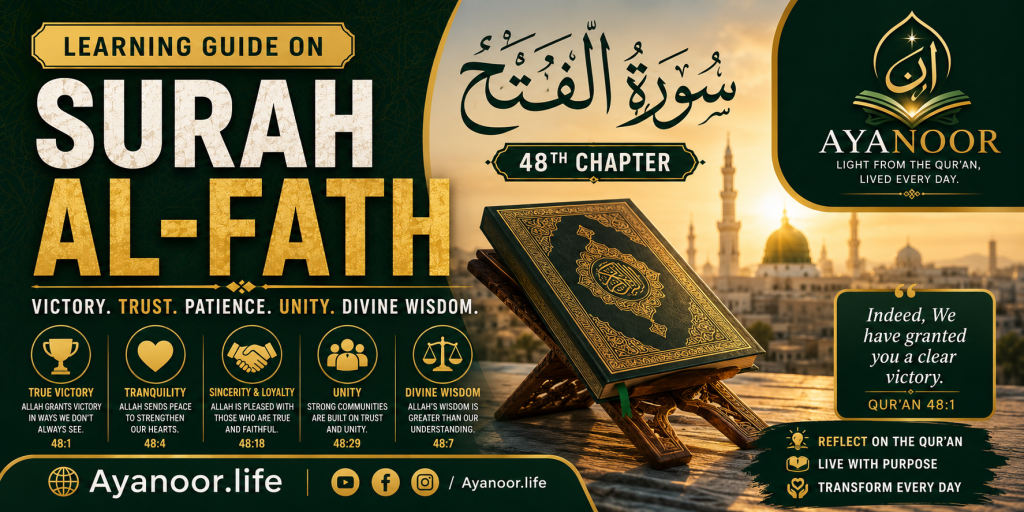
A Learning Guide on Victory, Trust, Patience, Unity, and Divine Wisdom
Surah Al-Fath (“The Victory”) is the 48th chapter of the Qur’an and was revealed after the Treaty of Hudaybiyyah — a moment that initially appeared disappointing to many Muslims, yet Allah described it as a clear victory.
The Surah teaches believers a profound lesson:
Sometimes what appears to be a setback is actually the beginning of a greater success.
Surah Al-Fath focuses on:
- trusting Allah’s wisdom,
- remaining patient during uncertainty,
- staying united,
- fulfilling commitments,
- and understanding that true victory is not always immediate or obvious.
Historical Context of Surah Al-Fath
The Surah was revealed when Prophet Muhammad ﷺ and his companions traveled toward Makkah intending to perform Umrah peacefully. However, the Quraysh stopped them outside the city, leading to the Treaty of Hudaybiyyah.
Many companions initially struggled to understand why the treaty seemed to favor the Quraysh. Yet Allah revealed:
“Indeed, We have granted you a clear victory.”
— Qur’an 48:1
This teaches one of the greatest spiritual lessons in the Qur’an:
Human beings see the present moment, while Allah sees the complete future.
Within a few years:
- Islam spread rapidly,
- tribes entered Islam in large numbers,
- and Makkah itself was peacefully opened.
What looked like compromise became a doorway to transformation.
1. True Victory Is Not Always Immediate
The Surah begins with a powerful declaration:
“Indeed, We have granted you a clear victory.”
— Qur’an 48:1
The companions did not initially perceive Hudaybiyyah as victory because they expected immediate success.
But Allah showed them that:
- wisdom can exist inside delay,
- growth can emerge through patience,
- and peace can achieve what conflict cannot.
Reflection
Modern people often measure success only through:
- quick results,
- wealth,
- popularity,
- or visible achievements.
But Surah Al-Fath teaches that true success may involve:
- restraint,
- patience,
- long-term thinking,
- and trust in Allah’s timing.
2. Allah Brings Peace to the Hearts of Believers
During uncertainty and emotional difficulty, Allah strengthened the believers internally.
“It is He who sent down tranquility into the hearts of the believers so that they would increase in faith along with their faith.”
— Qur’an 48:4
This tranquility (sakinah) is a deep spiritual calm granted by Allah during moments of anxiety and confusion.
Reflection
People today struggle with:
- stress,
- fear,
- uncertainty,
- emotional pressure,
- and instability.
The Surah reminds believers that true peace does not come only from external comfort, but from spiritual connection with Allah.
3. Trust Allah Even When You Don’t Understand the Process
Many companions questioned the terms of the treaty because they could not yet see its wisdom.
But Allah repeatedly emphasized His knowledge and wisdom.
“And Allah is Ever Knowing and Wise.”
— Qur’an 48:4
Reflection
There are moments in life when:
- doors close unexpectedly,
- plans fail,
- opportunities disappear,
- or delays become painful.
Surah Al-Fath teaches believers:
- not every delay is a loss,
- not every hardship is punishment,
- and not every closed door is failure.
Sometimes Allah protects people through postponement.
4. Sincerity and Loyalty Matter Greatly
Allah praised the companions who sincerely pledged loyalty to the Prophet ﷺ.
“Indeed, Allah was pleased with the believers when they pledged allegiance to you under the tree…”
— Qur’an 48:18
This pledge became known as Bay‘at al-Ridwan, one of the most honored moments in Islamic history.
Lessons from This Ayah
Allah values:
- sincerity,
- loyalty,
- courage,
- and commitment during difficult times.
Reflection
Strong communities are built upon:
- trust,
- unity,
- honesty,
- and reliability.
Societies weaken when people abandon one another during hardship.
5. Hypocrisy and Excuses Weaken Communities
The Surah also discusses people who stayed behind and made excuses instead of supporting the believers.
“Those who remained behind will say to you…”
— Qur’an 48:11
The Qur’an exposes how fear, selfishness, and attachment to comfort prevent people from contributing to greater causes.
Reflection
Many people:
- support truth verbally,
- but hesitate when sacrifice is required.
The Surah teaches that sincerity becomes visible through action, not slogans.
6. Good Character and Mercy Are Signs of Believers
Allah beautifully describes the companions of the Prophet ﷺ:
“Muhammad is the Messenger of Allah; and those with him are firm against oppression and merciful among themselves.”
— Qur’an 48:29
This verse highlights balance:
- strength against injustice,
- and mercy within the community.
Reflection
A healthy believer should combine:
- courage with compassion,
- discipline with mercy,
- and conviction with humility.
Modern societies often fall into extremes:
- either harshness without mercy,
- or weakness without principles.
The Qur’an teaches balance.
7. Islam Spread Through Wisdom and Character
Hudaybiyyah demonstrated that Islam’s growth was not dependent only upon military strength.
Peaceful interaction allowed people to:
- observe Muslim character,
- understand Islam properly,
- and embrace the message sincerely.
Reflection
People are often influenced more by:
- honesty,
- kindness,
- integrity,
- and consistency
than by arguments alone.
The Surah teaches believers to become living examples of their values.
8. Allah’s Promise Will Ultimately Prevail
Allah reassured the believers repeatedly throughout the Surah.
“And to Allah belong the soldiers of the heavens and the earth.”
— Qur’an 48:7
This reminds believers that:
- ultimate power belongs to Allah,
- human plans are limited,
- and justice ultimately belongs to Him.
Reflection
Believers should work responsibly and wisely, but never lose hope when circumstances seem difficult.
Practical Lessons from Surah Al-Fath
Personal Lessons
- Trust Allah’s timing
- Stay patient during uncertainty
- Avoid emotional reactions during hardship
- Build inner peace through faith
- Remain sincere and dependable
Family Lessons
- Solve conflicts with wisdom and patience
- Build trust and loyalty within families
- Teach emotional resilience to children
- Encourage calm decision-making
Community Lessons
- Unity strengthens societies
- Excuses weaken collective progress
- Strong leadership requires patience and wisdom
- Mercy and discipline must coexist
Spiritual Lessons
- Allah’s wisdom exceeds human understanding
- True victory may come gradually
- Tranquility is a gift from Allah
- Faith grows during difficult moments
Important Ayahs for Reflection
Victory Through Patience
“Indeed, We have granted you a clear victory.”
— Qur’an 48:1
Tranquility from Allah
“He sent down tranquility into the hearts of the believers…”
— Qur’an 48:4
Allah’s Pleasure with the Sincere
“Allah was pleased with the believers when they pledged allegiance to you under the tree…”
— Qur’an 48:18
Description of the Believers
“Firm against oppression and merciful among themselves.”
— Qur’an 48:29
Questions for Reflection
- Do I trust Allah during delays and uncertainty?
- How do I react when plans do not go my way?
- Am I strengthening unity or creating division?
- Do I remain loyal during difficult times?
- Is my faith producing inner peace and patience?
- Do I balance strength with mercy?
Conclusion
Surah Al-Fath is one of the Qur’an’s greatest lessons about:
- patience,
- trust,
- emotional resilience,
- unity,
- sincerity,
- and long-term vision.
The Surah teaches that believers should not judge events only by immediate appearances. What seems difficult today may become the foundation of tomorrow’s success.
Above all, Surah Al-Fath reminds humanity that:
- Allah’s wisdom is perfect,
- true victory belongs to truth and patience,
- and inner peace comes through trust in Him.
It calls believers to become people of calmness, loyalty, wisdom, mercy, and unwavering faith even during uncertain times.