

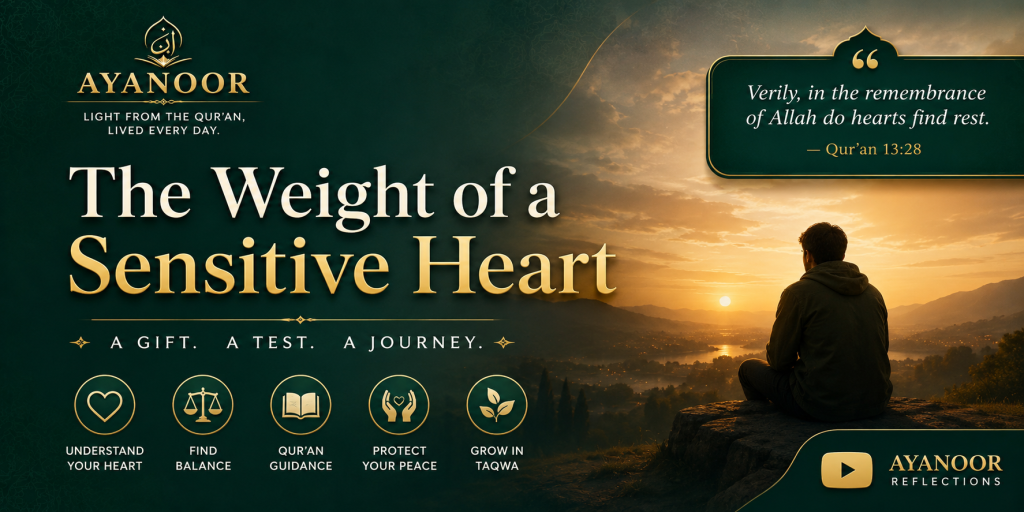
Some people move through life lightly. Others feel everything deeply.
A simple word stays in their mind for days.
Someone’s sadness affects them deeply.
Harshness hurts them more than people realize.
They notice the loneliness in others, the tension in a room, the pain hidden behind smiles, and even the silence that most people ignore.
To the outside world, emotionally sensitive people may appear “too emotional,” “too soft,” or “too serious.”
But perhaps Allah created some hearts to feel more deeply for a reason.
The real question is not whether sensitivity is a blessing or a burden.
The real question is:
How do we carry a sensitive heart without letting it break us?
A Sensitive Heart Can Be a Beautiful Gift
Not everyone notices what sensitive people notice.
A sensitive heart often:
- feels compassion quickly
- notices suffering
- values kindness deeply
- avoids hurting others
- reflects more
- appreciates beauty, mercy, and sincerity
- becomes emotionally connected to people and experiences
These people are often the first to help, comfort, encourage, forgive, or quietly make sacrifices for others.
Their softness is not weakness.
It is humanity.
In a world becoming increasingly harsh, emotionally aware people can become a source of mercy and healing for others.
Allah created hearts differently, and every heart carries its own test and responsibility.
But Feeling Everything Deeply Can Become Exhausting
A sensitive person may carry emotional burdens silently.
They may:
- replay conversations repeatedly
- overthink small interactions
- become emotionally drained by negativity
- struggle with criticism
- absorb the moods of others
- feel hurt by disrespect or harshness
- carry guilt for things beyond their control
Sometimes they become tired not because of physical work, but because their heart has been carrying too much for too long.
The danger is when sensitivity becomes emotional exhaustion.
A person begins to lose peace, overreact emotionally, withdraw from people, or carry pain that Allah never intended them to carry alone.
Even the Prophets Felt Deeply
The Qur’an teaches us that deep emotions are part of being human.
Prophet Yaqub (AS) cried deeply from the pain of losing Yusuf (AS).
Prophet Muhammad ﷺ was deeply affected by the suffering and rejection of people.
He cared so much for humanity that Allah comforted him repeatedly throughout the Qur’an.
Feeling deeply is not a flaw.
But the Prophets also teach us balance:
- patience without bitterness
- compassion without emotional collapse
- mercy without losing wisdom
- grief without losing hope in Allah
A believer’s heart feels deeply, but remains connected to Allah for strength.
Not Every Emotion Should Control Us
One of the greatest lessons in life is understanding that emotions are real, but they should not become our master.
A sensitive person may feel:
- anger
- sadness
- disappointment
- rejection
- loneliness
But wisdom lies in learning:
- when to speak
- when to stay silent
- when to forgive
- when to step away
- when to seek help
- and when to place our trust in Allah
Emotional maturity is not becoming emotionless.
It is learning how to feel without being destroyed by every feeling.
Sensitive Hearts Need Boundaries Too
Many emotionally sensitive people spend their lives caring for everyone except themselves.
They listen to everyone’s problems.
They absorb everyone’s stress.
They carry everyone’s pain.
Eventually, they become emotionally exhausted.
Islam teaches compassion, but it also teaches balance.
You can:
- care for people without carrying their entire burden
- help others without destroying your own peace
- love people without losing yourself
- protect your heart without becoming cold
Sometimes protecting your peace is not selfishness.
It is wisdom.
Parents Must Protect Emotionally Sensitive Children
Some children naturally feel things more deeply than others.
They may:
- cry easily
- become quiet after harsh words
- struggle with tension at home
- overthink rejection
- feel emotionally overwhelmed
These children should not be mocked, shamed, or constantly compared to others.
Parents and elders should:
- listen patiently
- avoid humiliating language
- teach emotional strength gently
- create emotional safety at home
- help children express feelings in healthy ways
A child whose emotions are respected grows into an adult who feels secure, valued, and emotionally balanced.
But a child constantly dismissed may grow up carrying silent emotional wounds for years.
A Sensitive Heart Needs a Strong Connection With Allah
The world can become emotionally heavy.
People disappoint us.
Relationships change.
Words hurt.
Life becomes overwhelming.
This is why sensitive hearts especially need:
- salah
- Qur’an
- dua
- reflection
- gratitude
- quiet moments with Allah
Because no human being can carry the emotional weight of life alone.
When the heart remains connected to Allah, sensitivity becomes softer, wiser, calmer, and more balanced.
Final Reflection
If you are someone who feels everything deeply, do not hate the softness Allah placed in your heart.
Your sensitivity may become:
- a source of mercy
- a source of wisdom
- a source of compassion
- a source of healing for others
But remember:
A sensitive heart must also learn strength.
Not every burden belongs on your shoulders.
Not every emotion deserves control over your peace.
Not every disappointment deserves a permanent place in your heart.
Feel deeply.
Care sincerely.
Love gently.
But always return your heart to Allah, because only He fully understands the weight you carry inside.