

Introduction
Surah An-Naba is the 78th chapter of the Qur’an and was revealed in Makkah. The word An-Naba means “The Great News” or “The Great Announcement.” The surah centers around the reality of the Day of Judgment, resurrection after death, and the signs of Allah visible throughout creation.
The “great news” discussed in the surah refers to the Hereafter — the truth that humanity will be resurrected and held accountable before Allah.
1. The Great News Humanity Disagrees About
The surah begins by asking:
“About what are they asking one another?”
— Qur’an 78:1
Allah answers:
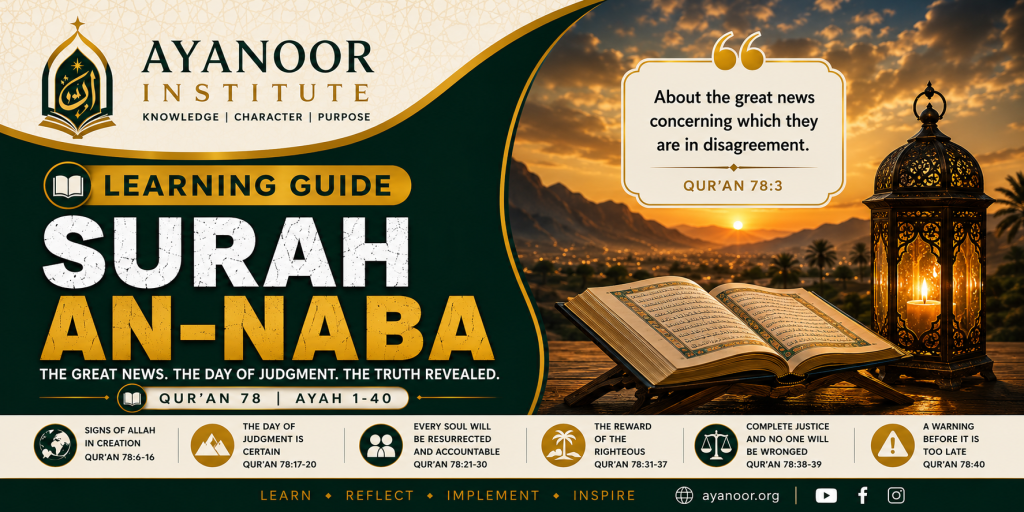
“About the great news concerning which they are in disagreement.”
— Qur’an 78:2-3
Many people questioned or denied resurrection and accountability.
Lessons
- Humanity has always debated the purpose of life and what happens after death.
- The Qur’an presents the Hereafter as absolute truth.
- Believers are encouraged to seek certainty through reflection and revelation.
Related Qur’anic References
- “And the Hour is surely coming, there is no doubt about it.” — Qur’an 22:7
- “Every soul shall taste death.” — Qur’an 3:185
2. Signs of Allah in Creation
Allah draws attention to the world around us:
“Have We not made the earth as a resting place?”
— Qur’an 78:6
The surah mentions:
- Mountains as stabilizers
- Human beings created in pairs
- Sleep as rest
- Night as covering
- Day for livelihood
- Rain bringing vegetation
Lessons
- Creation reflects balance, wisdom, and mercy.
- Nature itself is a sign pointing toward Allah.
- The One who created life can easily recreate it after death.
Related Qur’anic References
- “Indeed, in the creation of the heavens and earth are signs.” — Qur’an 3:190
- “And We made from water every living thing.” — Qur’an 21:30
3. The Certainty of Resurrection
Allah says:
“Indeed, the Day of Judgment is an appointed time.”
— Qur’an 78:17
The surah describes dramatic events of the Last Day:
- The trumpet being blown
- The sky opening
- Mountains moving away
- Humanity gathered for judgment
Lessons
- Resurrection is a certainty.
- This world is temporary.
- Every person will stand before Allah individually.
Related Qur’anic References
- “The Trumpet will be blown, and all who are in the heavens and earth will fall.” — Qur’an 39:68
- “As We began the first creation, We will repeat it.” — Qur’an 21:104
4. The Consequences of Arrogance and Rejection
The surah warns those who denied truth and lived carelessly:
“Indeed, Hell has been lying in wait.”
— Qur’an 78:21
These people mocked accountability and ignored Allah’s guidance.
Lessons
- Actions have consequences.
- Ignoring truth does not remove responsibility.
- Arrogance can blind the heart.
Related Qur’anic References
- “And who is more unjust than one reminded of the signs of his Lord then turns away?” — Qur’an 18:57
- “The worldly life is only enjoyment of delusion.” — Qur’an 57:20
5. The Reward of the Righteous
Allah contrasts the fate of the wicked with the reward of the righteous:
“Indeed, for the righteous is success.”
— Qur’an 78:31
Paradise is described with:
- Gardens and vineyards
- Peace and security
- Pure companionship
- Refreshing drinks
- Eternal comfort
Lessons
- Allah rewards sincerity, patience, and righteousness.
- Paradise is the true success.
- Eternal peace outweighs temporary hardship.
Related Qur’anic References
- “Indeed, the righteous will be in gardens and bliss.” — Qur’an 52:17
- “Peace be upon you for what you patiently endured.” — Qur’an 13:24
6. Accountability Before Allah
The surah emphasizes complete accountability:
“The Day the Spirit and the angels will stand in rows.”
— Qur’an 78:38
No one will speak except with Allah’s permission.
Lessons
- Human beings will answer for their words and actions.
- True authority belongs only to Allah.
- The Hereafter will reveal complete justice.
Related Qur’anic References
- “Whoever does an atom’s weight of good will see it.” — Qur’an 99:7
- “Your Lord wrongs no one.” — Qur’an 18:49
7. A Warning Before It is Too Late
The surah concludes with a serious warning:
“Indeed, We have warned you of a near punishment.”
— Qur’an 78:40
People will regret neglecting faith and righteous deeds.
Lessons
- Life is short and temporary.
- Delaying repentance is dangerous.
- The Qur’an warns humanity out of mercy.
Related Qur’anic References
- “Turn to your Lord in repentance before punishment comes to you.” — Qur’an 39:54
- “Allah invites to the Home of Peace.” — Qur’an 10:25
Key Themes of Surah An-Naba
1. The Reality of the Hereafter
The Day of Judgment is certain.
2. Signs in Creation
Nature reflects Allah’s wisdom and power.
3. Resurrection After Death
Allah can recreate humanity easily.
4. Accountability
Every action will be judged fairly.
5. Reward and Punishment
Paradise and Hell are realities.
6. Reflection and Preparation
Life is an opportunity to prepare for eternity.
Reflection Questions
- How often do we reflect on the Hereafter?
- Are we noticing Allah’s signs in creation?
- What distractions keep us from preparing for eternity?
- Are we living with awareness of accountability?
- How can we strengthen sincerity and repentance?
Practical Action Points
- Reflect daily on the blessings of creation.
- Increase Qur’an recitation and understanding.
- Prepare for the Hereafter through righteous deeds.
- Strengthen consistency in prayer and remembrance.
- Avoid arrogance and heedlessness.
- Repent sincerely and regularly.
Conclusion
Surah An-Naba is a profound reminder that life is not without purpose. The surah calls humanity to reflect on creation, recognize Allah’s power, and prepare for the inevitable Day of Judgment.
Through vivid descriptions of the Hereafter, the surah encourages believers toward faith, gratitude, humility, and righteous living while warning against denial, arrogance, and spiritual neglect.
Its message remains timeless: the “Great News” is real, and every soul must prepare for the eternal life to come.