

Introduction
Surah Al-Muddaththir is the 74th chapter of the Qur’an and one of the earliest revelations given to Prophet Muhammad ﷺ in Makkah. The name Al-Muddaththir means “The Cloaked One” or “The One Wrapped Up,” referring to the Prophet ﷺ when he was covered in his cloak after the first revelation.
This surah is a powerful call toward responsibility, purification, courage, sincerity, and warning humanity about accountability before Allah. It marks the beginning of the Prophet’s public mission.
1. The Call to Rise and Warn
Allah begins the surah with a direct command:
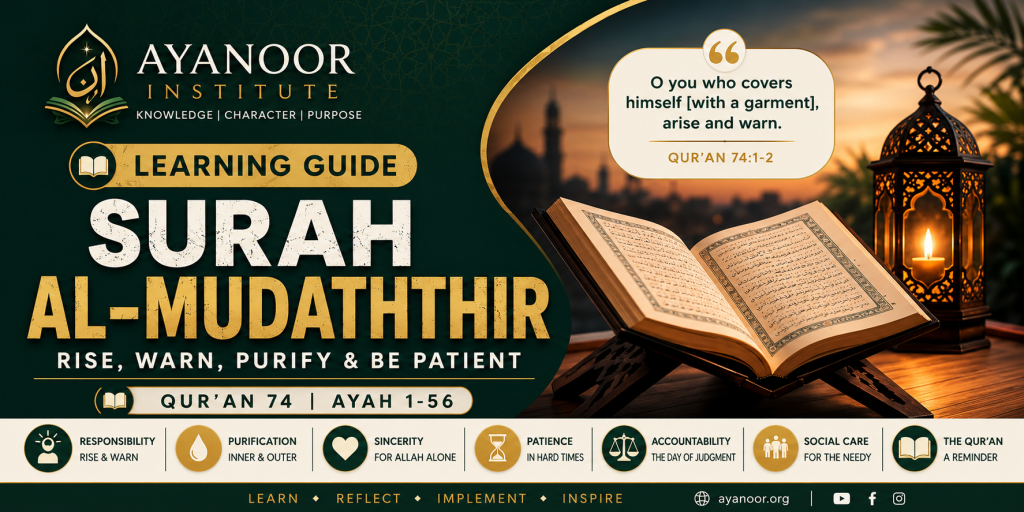
“O you who covers himself [with a garment], arise and warn.”
— Qur’an 74:1-2
The Prophet ﷺ had just experienced the awe of revelation in the Cave of Hira. Instead of remaining withdrawn, Allah instructed him to rise with purpose and deliver the message.
Lessons
- Faith is not meant to remain hidden.
- Every believer has a responsibility to spread goodness.
- True guidance requires courage and action.
Related Qur’anic References
- “Invite to the way of your Lord with wisdom and good instruction.” — Qur’an 16:125
- “And warn your closest relatives.” — Qur’an 26:214
2. Spiritual Purification Before Public Mission
Allah says:
“And your clothing purify.”
— Qur’an 74:4
This command includes both physical cleanliness and purification of the heart, intentions, and character.
Lessons
- Dawah (calling toward Allah) begins with self-purification.
- Cleanliness, sincerity, honesty, and humility are essential qualities of believers.
- A believer’s character is part of the message they carry.
Related Qur’anic References
- “Indeed Allah loves those who repent and those who purify themselves.” — Qur’an 2:222
- “He has succeeded who purifies it.” — Qur’an 91:9
3. Avoid Seeking Recognition for Good Deeds
Allah warns:
“And do not confer favor to acquire more.”
— Qur’an 74:6
Believers should not do good merely to gain praise, influence, or worldly rewards.
Lessons
- Sincerity is central in Islam.
- Good deeds lose value when done for pride or recognition.
- True believers work for Allah’s pleasure alone.
Related Qur’anic References
- “We feed you only for the countenance of Allah.” — Qur’an 76:9
- “They were not commanded except to worship Allah sincerely.” — Qur’an 98:5
4. Patience in the Path of Truth
Allah says:
“And for your Lord be patient.”
— Qur’an 74:7
The mission of truth is never easy. The Prophet ﷺ faced rejection, mockery, boycotts, and persecution.
Lessons
- Patience is a requirement for leadership and reform.
- Hardship does not mean Allah has abandoned a believer.
- Great missions require endurance.
Related Qur’anic References
- “Indeed, Allah is with the patient.” — Qur’an 2:153
- “So be patient as were those of determination among the messengers.” — Qur’an 46:35
5. The Reality of the Day of Judgment
The surah vividly describes the coming Judgment Day:
“For when the trumpet is blown, that Day will be a difficult day.”
— Qur’an 74:8-9
Allah reminds humanity that worldly power, wealth, and status will not benefit anyone on that Day.
Lessons
- Life is temporary.
- Accountability before Allah is certain.
- Preparing for the Hereafter should shape our priorities.
Related Qur’anic References
- “Every soul shall taste death.” — Qur’an 3:185
- “The weighing that Day will be the truth.” — Qur’an 7:8
6. The Example of Arrogance and Rejection
The surah discusses a man who recognized the truth internally but rejected it out of pride and worldly interests.
“Then he frowned and scowled.”
— Qur’an 74:22
This reflects how arrogance can blind people from accepting truth even when they recognize it.
Lessons
- Pride is one of the greatest spiritual diseases.
- Intelligence alone does not guide a person.
- Humility is necessary for faith.
Related Qur’anic References
- “I will turn away from My signs those who are arrogant upon the earth.” — Qur’an 7:146
- Story of Pharaoh’s arrogance — Qur’an 79:17-26
7. A Description of Hell and Accountability
The surah mentions Saqar, one of the names of Hellfire.
When asked what led people there, they respond:
“We were not of those who prayed, nor did we feed the poor.”
— Qur’an 74:43-44
Lessons
The surah highlights major causes of spiritual destruction:
- Neglecting prayer
- Ignoring the needy
- Engaging in falsehood
- Denying accountability
Related Qur’anic References
- “Have you seen the one who denies the religion? That is the one who repulses the orphan.” — Qur’an 107:1-3
- “Establish prayer and give zakah.” — Qur’an 2:43
8. The Qur’an as a Reminder for Humanity
Allah concludes by explaining that the Qur’an is a reminder for whoever sincerely seeks guidance.
“Indeed, it is a reminder.”
— Qur’an 74:54
Lessons
- Guidance is available to all sincere people.
- The Qur’an transforms hearts that are open and humble.
- Human beings still have free will and responsibility.
Related Qur’anic References
- “This is a blessed Book which We have revealed.” — Qur’an 38:29
- “Indeed this Qur’an guides to that which is most upright.” — Qur’an 17:9
Key Themes of Surah Al-Muddaththir
1. Responsibility After Guidance
Knowledge must lead to action.
2. Purification of the Self
Inner and outer cleanliness matter.
3. Sincerity
Good deeds should only seek Allah’s pleasure.
4. Patience and Courage
Truth requires perseverance.
5. Accountability
Every person will answer before Allah.
6. Warning Against Arrogance
Pride prevents spiritual growth.
7. Social Responsibility
Neglecting the poor is condemned.
Reflection Questions
- What responsibilities come with knowledge and faith?
- How can we purify our intentions in daily life?
- Are worldly distractions reducing our preparation for the Hereafter?
- How can we strengthen patience during hardships?
- What practical steps can we take to care for the needy?
Practical Action Points
- Strengthen consistency in prayer.
- Practice sincerity in acts of worship.
- Help those in need regularly.
- Read and reflect on the Qur’an daily.
- Develop patience and emotional discipline.
- Avoid arrogance and self-righteousness.
Conclusion
Surah Al-Muddaththir is a wake-up call for humanity. It teaches believers to rise with purpose, purify themselves, remain sincere, care for society, and prepare for the Day they will stand before Allah.
The surah reminds us that faith is not passive — it is a mission built on truth, patience, humility, and responsibility.