

Introduction
Surah Al-Insan, also known as Surah Ad-Dahr (“Time”), is the 76th chapter of the Qur’an. The surah reflects on the creation of human beings, the purpose of life, moral responsibility, patience, gratitude, and the eternal rewards awaiting the righteous.
It beautifully contrasts the temporary struggles of worldly life with the everlasting peace of Paradise, reminding believers that true success lies in sincere obedience to Allah.
1. The Humble Beginning of Human Beings
Allah begins the surah by reminding humanity of its origins:
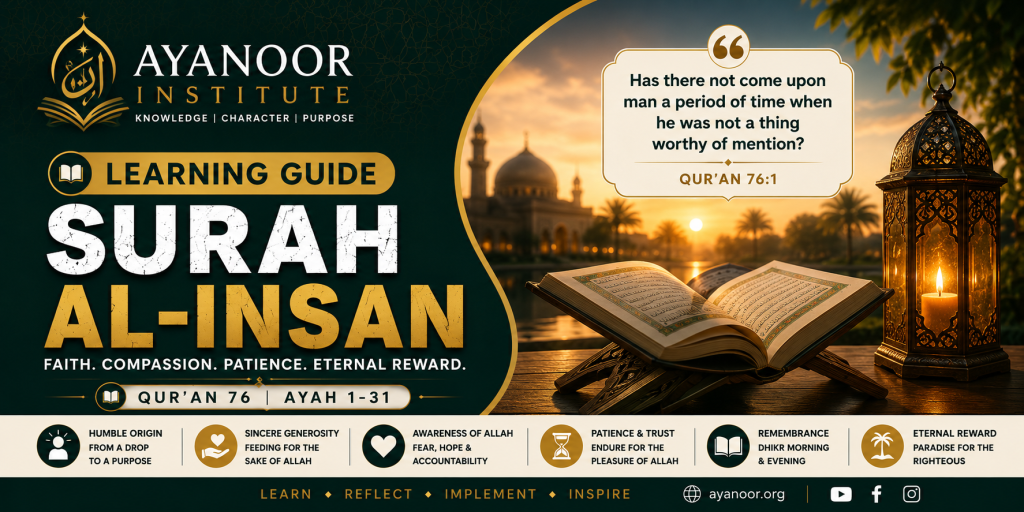
“Has there not come upon man a period of time when he was not a thing worthy of mention?”
— Qur’an 76:1
Allah then explains:
“Indeed, We created man from a mixed drop of fluid in order to test him.”
— Qur’an 76:2
Lessons
- Human beings were once unknown and insignificant.
- Life is a test, not an accident.
- Remembering our origins develops humility.
Related Qur’anic References
- “And among His signs is that He created you from dust.” — Qur’an 30:20
- “Did We not create you from a humble fluid?” — Qur’an 77:20
2. Guidance and Free Will
Allah says:
“Indeed, We guided him to the way, whether he be grateful or ungrateful.”
— Qur’an 76:3
Allah gave humanity intellect, conscience, revelation, and the ability to choose.
Lessons
- Human beings are responsible for their choices.
- Gratitude is not merely words; it is obedience.
- Guidance is a mercy from Allah.
Related Qur’anic References
- “There is no compulsion in religion.” — Qur’an 2:256
- “Whoever wills, let him believe; and whoever wills, let him disbelieve.” — Qur’an 18:29
3. The Reward of the Righteous
The surah describes the qualities of righteous believers and their eternal reward in Paradise.
“Indeed, the righteous will drink from a cup whose mixture is of Kafur.”
— Qur’an 76:5
Paradise is described with beauty, peace, flowing rivers, shade, silk garments, and complete comfort.
Lessons
- Allah never ignores sincere sacrifice.
- The hardships of this world are temporary.
- Paradise is the ultimate success.
Related Qur’anic References
- “No soul knows what joy is hidden for them.” — Qur’an 32:17
- “Indeed, the righteous will be in gardens and bliss.” — Qur’an 52:17
4. Feeding Others for the Sake of Allah
One of the most beautiful passages in the surah says:
“And they give food despite love for it to the needy, the orphan, and the captive.”
— Qur’an 76:8
The righteous say:
“We feed you only for the countenance of Allah. We desire from you neither reward nor thanks.”
— Qur’an 76:9
Lessons
- True generosity expects nothing in return.
- Caring for vulnerable people is a sign of faith.
- Islam connects worship with compassion and social responsibility.
Related Qur’anic References
- “Have you seen the one who denies the religion? That is the one who repulses the orphan.” — Qur’an 107:1-2
- “And establish prayer and give zakah.” — Qur’an 2:43
5. Fear of Accountability
The righteous are described as people who remain conscious of the Hereafter:
“Indeed, we fear from our Lord a Day austere and distressful.”
— Qur’an 76:10
This fear does not lead to despair, but to sincerity and discipline.
Lessons
- Awareness of Judgment protects the soul.
- Healthy fear of Allah leads to better character.
- Believers balance hope and fear.
Related Qur’anic References
- “And fear a Day when you will be returned to Allah.” — Qur’an 2:281
- “As for the one who feared standing before his Lord and restrained the soul from desire, Paradise will be his refuge.” — Qur’an 79:40-41
6. Patience in the Path of Allah
Allah commands the Prophet ﷺ:
“So be patient for the decision of your Lord.”
— Qur’an 76:24
Patience is repeatedly emphasized throughout the Qur’an because life includes tests, delays, hardship, and emotional struggle.
Lessons
- Patience is essential for spiritual growth.
- Allah sees every struggle and sacrifice.
- Difficult times are temporary.
Related Qur’anic References
- “Indeed, Allah is with the patient.” — Qur’an 2:153
- “Indeed, the patient will be given their reward without measure.” — Qur’an 39:10
7. Remembering Allah Consistently
Allah says:
“And remember the name of your Lord morning and evening.”
— Qur’an 76:25
The surah encourages regular worship, remembrance, and night prayer.
Lessons
- Spiritual strength requires consistent connection with Allah.
- Dhikr (remembrance) calms the heart.
- Worship builds inner resilience.
Related Qur’anic References
- “Verily, in the remembrance of Allah do hearts find rest.” — Qur’an 13:28
- “And during the night prostrate to Him and glorify Him through the long night.” — Qur’an 76:26
8. The Temporary Nature of This World
Allah says:
“Indeed, these people love the immediate life and leave behind them a heavy Day.”
— Qur’an 76:27
Many people become consumed by worldly pleasures and forget eternal accountability.
Lessons
- Material success alone is not true success.
- Life is short compared to eternity.
- Believers should maintain balance between dunya and akhirah.
Related Qur’anic References
- “The worldly life is only enjoyment of delusion.” — Qur’an 57:20
- “Seek through what Allah has given you the home of the Hereafter.” — Qur’an 28:77
Key Themes of Surah Al-Insan
1. Human Creation and Purpose
Life is a test from Allah.
2. Guidance and Choice
Humans are given free will and accountability.
3. Compassion and Generosity
Serving others sincerely is beloved to Allah.
4. Patience and Worship
Spiritual strength grows through patience and remembrance.
5. The Hereafter
Paradise is the reward for sincere faith and righteous action.
Reflection Questions
- Do we remember our humble origins and dependence on Allah?
- How sincere are our acts of kindness?
- Are we preparing more for dunya or akhirah?
- How can we improve patience during hardship?
- Is remembrance of Allah part of our daily routine?
Practical Action Points
- Help someone in need quietly and sincerely.
- Increase daily Qur’an recitation and reflection.
- Develop consistency in prayer and dhikr.
- Practice gratitude for Allah’s blessings.
- Reflect regularly on the Hereafter.
- Strengthen patience during difficulties.
Conclusion
Surah Al-Insan beautifully reminds humanity of its origin, purpose, and destination. It teaches that life is a test of faith, gratitude, patience, and compassion. The surah presents the righteous as people who worship sincerely, care for others selflessly, and remain focused on the eternal life to come.
Its message is timeless: true honor is not found in wealth or status, but in humility, obedience to Allah, and service to humanity for His sake alone.