
Introduction
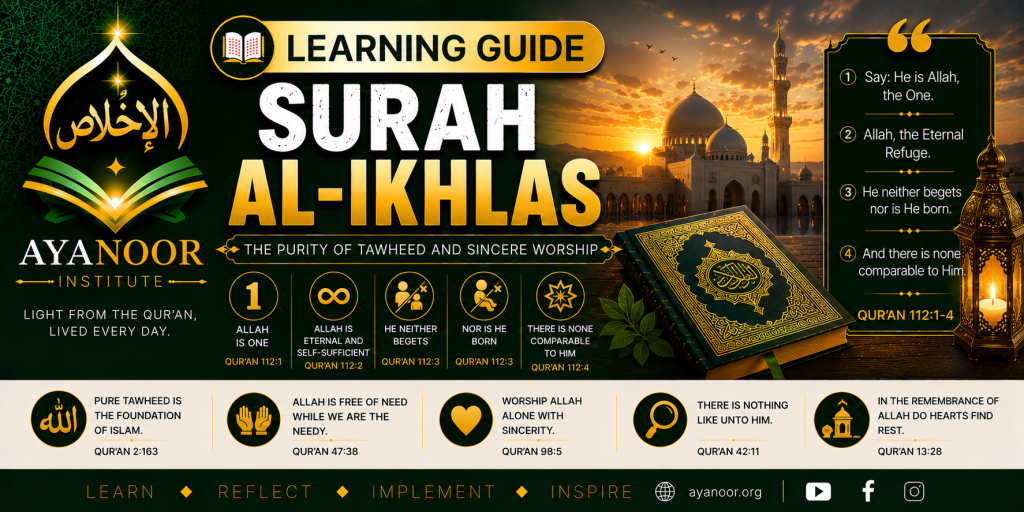
Surah Al-Ikhlas is the 112th chapter of the Qur’an and one of the most beloved and frequently recited surahs in Islam. The word Ikhlas means sincerity, purity, or devotion free from falsehood and association.
This short yet profound surah summarizes the essence of Islamic belief: the absolute Oneness of Allah. It rejects every form of partnership, dependency, or limitation attributed to Allah and establishes pure Tawheed (monotheism).
Surah Al-Ikhlas teaches believers who Allah is — the One, Eternal, Perfect Creator who has no partner, no child, and no equal. It strengthens faith, sincerity in worship, and spiritual clarity.
1. Allah is Absolutely One
The surah begins:
“Say: He is Allah, the One.”
— Qur’an 112:1
Lessons
- Allah is unique and completely One.
- There is no deity worthy of worship except Him.
- True faith begins with recognizing Allah’s Oneness.
Related Qur’anic References
- “Your God is One God.” — Qur’an 2:163
- “There is no deity except Him.” — Qur’an 59:22
2. Allah is Eternal and Self-Sufficient
Allah says:
“Allah, the Eternal Refuge.”
— Qur’an 112:2
The word As-Samad means the One upon whom all creation depends, while He depends on none.
Lessons
- Every human being depends upon Allah.
- Allah is perfect, complete, and free of need.
- Believers should turn to Allah in every situation.
Related Qur’anic References
- “Allah is Free of need, while you are the needy.” — Qur’an 47:38
- “And whoever relies upon Allah — He is sufficient for him.” — Qur’an 65:3
3. Allah Has No Children
Allah says:
“He neither begets.”
— Qur’an 112:3
Lessons
- Allah is beyond human limitations and relationships.
- The Creator is unlike creation.
- Islam teaches pure monotheism free from human attributes.
Related Qur’anic References
- “It is not befitting for Allah to take a son.” — Qur’an 19:35
- “He has not taken a son.” — Qur’an 18:4
4. Allah Was Not Born
Allah says:
“Nor is He born.”
— Qur’an 112:3
Lessons
- Allah is eternal without beginning or end.
- He is not part of creation or subject to time.
- Everything depends on Allah, while He depends on nothing.
Related Qur’anic References
- “He is the First and the Last.” — Qur’an 57:3
- “There is nothing like unto Him.” — Qur’an 42:11
5. Nothing is Comparable to Allah
The surah concludes:
“And there is none comparable to Him.”
— Qur’an 112:4
Lessons
- Allah is unlike anything in creation.
- Human imagination cannot fully comprehend Allah’s greatness.
- Believers worship Allah with humility and awe.
Related Qur’anic References
- “There is nothing like Him.” — Qur’an 42:11
- “Do you know of any equal to Him?” — Qur’an 19:65
6. Sincerity in Worship
The surah is called Al-Ikhlas because it purifies faith and worship.
Lessons
- Worship should be directed only to Allah.
- Sincerity is essential in prayer, charity, and good deeds.
- Tawheed gives purpose and clarity to life.
Related Qur’anic References
- “They were only commanded to worship Allah sincerely.” — Qur’an 98:5
- “Indeed my prayer and sacrifice are for Allah.” — Qur’an 6:162
7. The Great Value of This Surah
Prophet Muhammad ﷺ described Surah Al-Ikhlas as equal to one-third of the Qur’an in meaning because it summarizes the essence of Tawheed.
Lessons
- Understanding Allah is the foundation of Islam.
- Short acts of worship can hold immense spiritual value.
- Repeating and reflecting upon this surah strengthens faith.
Related Qur’anic References
- “So know that there is no deity except Allah.” — Qur’an 47:19
- “Remember Allah often.” — Qur’an 33:41
8. Reliance and Trust in Allah
Knowing Allah as As-Samad increases reliance and peace.
Lessons
- Believers should seek help from Allah first.
- True peace comes through connection with Allah.
- Faith in Allah reduces fear, anxiety, and dependence upon people.
Related Qur’anic References
- “Indeed in the remembrance of Allah do hearts find rest.” — Qur’an 13:28
- “And Allah is sufficient as a Guardian.” — Qur’an 4:81
Key Themes of Surah Al-Ikhlas
1. Pure Monotheism (Tawheed)
Allah alone deserves worship.
2. Allah’s Perfection
Allah is eternal, independent, and complete.
3. No Comparison to Allah
Nothing resembles the Creator.
4. Sincerity in Worship
Faith must remain pure and sincere.
5. Spiritual Reliance
Believers should turn to Allah in every situation.
Reflection Questions
- How strong is our understanding of Tawheed?
- Are our acts of worship truly sincere for Allah?
- Do we rely more upon Allah or upon worldly means?
- How often do we reflect upon Allah’s greatness?
- Does belief in Allah’s Oneness shape our daily life?
Practical Action Points
- Recite Surah Al-Ikhlas regularly with reflection.
- Strengthen sincerity in prayer and worship.
- Increase remembrance of Allah daily.
- Turn to Allah first during difficulties.
- Learn and reflect upon Allah’s names and attributes.
- Avoid pride and dependence upon worldly status.
Conclusion
Surah Al-Ikhlas is one of the most profound chapters of the Qur’an, summarizing the essence of Islamic belief in only four verses. It teaches believers that Allah is One, Eternal, Perfect, and unlike anything in creation.
The surah purifies faith, strengthens sincerity, and reminds humanity that true peace, guidance, and success come only through worshipping Allah alone with complete devotion and trust.