

Introduction
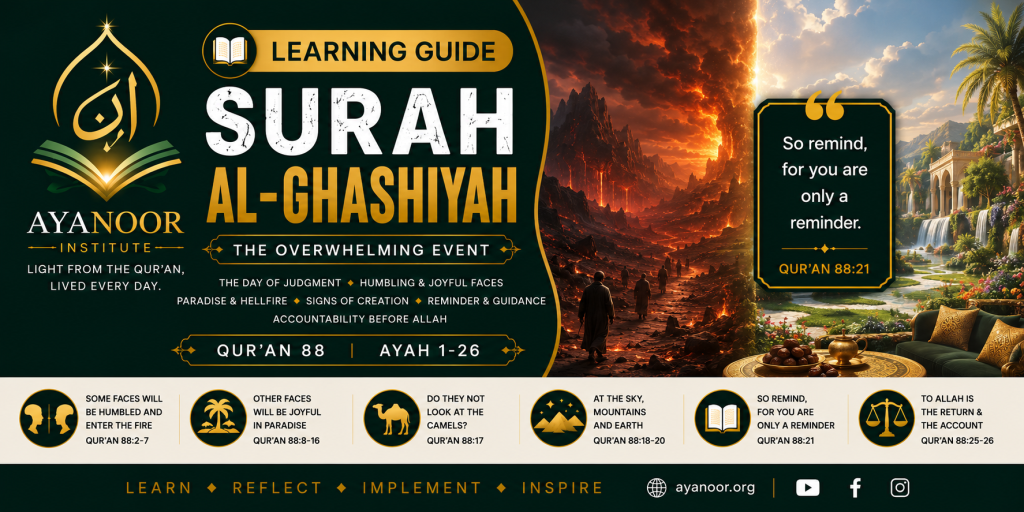
Surah Al-Ghashiyah is the 88th chapter of the Qur’an and was revealed in Makkah. The word Al-Ghashiyah means “The Overwhelming Event,” referring to the Day of Judgment that will overwhelm humanity with its reality and intensity.
This surah contrasts the condition of people in the Hereafter — some humbled and suffering, while others are joyful and rewarded. It also calls humanity to reflect on the signs of Allah in creation and reminds the Prophet ﷺ that his duty is to convey the message, while guidance ultimately belongs to Allah.
The Prophet Muhammad ﷺ frequently recited this surah in Jumu‘ah and Eid prayers because of its profound reminders about the Hereafter and reflection upon creation.
1. The Overwhelming Event — The Day of Judgment
The surah opens:
“Has there reached you the narration of the Overwhelming Event?”
— Qur’an 88:1
This introduction immediately draws attention to the seriousness of the Day of Resurrection.
Lessons
- The Hereafter is a reality, not imagination.
- Human beings should prepare seriously for accountability.
- Reflection on death and resurrection softens the heart.
Related Qur’anic References
- “The Striking Calamity — what is the Striking Calamity?” — Qur’an 101:1-2
- “Every soul shall taste death.” — Qur’an 3:185
2. Faces Humbled in the Hereafter
Allah describes one group:
“Some faces that Day will be humbled.”
— Qur’an 88:2
These are people exhausted from striving in falsehood, arrogance, or disbelief.
Lessons
- Worldly success without faith does not guarantee salvation.
- Pride and rejection of truth lead to regret.
- Actions without sincerity may become worthless.
Related Qur’anic References
- “And We will regard what they have done and make it scattered dust.” — Qur’an 25:23
- “The worldly life is only enjoyment of delusion.” — Qur’an 57:20
3. The Punishment of Hellfire
Allah describes their condition:
“They will enter a blazing Fire.”
— Qur’an 88:4
Their suffering includes boiling water and painful food that neither nourishes nor satisfies.
Lessons
- Hellfire is a real warning from Allah.
- Sin and arrogance carry consequences.
- Allah warns humanity out of mercy before punishment arrives.
Related Qur’anic References
- “Fear the Fire prepared for the disbelievers.” — Qur’an 3:131
- “Indeed, the criminals will be in the punishment of Hell.” — Qur’an 43:74
4. Faces Filled with Joy
Allah then describes another group:
“Other faces, that Day, will show pleasure.”
— Qur’an 88:8
These are believers pleased with their efforts and rewarded by Allah.
Lessons
- True success belongs to faith and righteousness.
- Every sincere effort for Allah is rewarded.
- Eternal peace is greater than temporary worldly comfort.
Related Qur’anic References
- “Indeed, the righteous will be in pleasure.” — Qur’an 82:13
- “Peace be upon you for what you patiently endured.” — Qur’an 13:24
5. The Beauty of Paradise
Allah describes Paradise:
“In an elevated Garden.”
— Qur’an 88:10
Believers will enjoy flowing springs, elevated couches, beautiful cups, cushions, and carpets.
Lessons
- Paradise is a place of comfort, peace, and honor.
- Allah rewards patience and sincerity generously.
- The beauty of Jannah is beyond human imagination.
Related Qur’anic References
- “No soul knows what joy is hidden for them.” — Qur’an 32:17
- “Gardens beneath which rivers flow.” — Qur’an 9:72
6. Reflect on Allah’s Creation
The surah then shifts attention toward nature:
“Do they not look at the camels — how they are created?”
— Qur’an 88:17
Allah also mentions the sky, mountains, and earth.
Lessons
- Creation contains countless signs of Allah’s wisdom.
- Reflection strengthens faith and gratitude.
- Even ordinary things carry extraordinary lessons.
Related Qur’anic References
- “Indeed, in the creation of the heavens and earth are signs.” — Qur’an 3:190
- “And on the earth are signs for those of sure faith.” — Qur’an 51:20
7. The Camel as a Sign
The camel was especially meaningful to the Arabs because of its remarkable design and survival abilities.
Lessons
- Allah created every creature with purpose and balance.
- Nature demonstrates divine intelligence.
- Observing creation should increase humility before Allah.
Related Qur’anic References
- “This is the creation of Allah, so show Me what those besides Him created.” — Qur’an 31:11
- “He perfected everything which He created.” — Qur’an 32:7
8. The Sky, Mountains, and Earth
Allah says:
“And at the sky — how it is raised. And at the mountains — how they are erected. And at the earth — how it is spread out.”
— Qur’an 88:18-20
Lessons
- The universe operates with perfect balance.
- Creation points toward the Creator.
- Reflection on nature strengthens certainty in resurrection and divine power.
Related Qur’anic References
- “And the heaven We constructed with strength.” — Qur’an 51:47
- “And We placed firm mountains upon the earth.” — Qur’an 21:31
9. The Role of the Prophet ﷺ — To Remind
Allah instructs the Prophet ﷺ:
“So remind, for you are only a reminder.”
— Qur’an 88:21
The Prophet’s mission was to convey truth clearly and compassionately.
Lessons
- Guidance belongs to Allah.
- Believers should advise others with wisdom and patience.
- Faith cannot be forced upon people.
Related Qur’anic References
- “There is no compulsion in religion.” — Qur’an 2:256
- “Invite to the way of your Lord with wisdom.” — Qur’an 16:125
10. Allah Will Judge Humanity
The surah concludes:
“Indeed, to Us is their return. Then indeed, upon Us is their account.”
— Qur’an 88:25-26
Every person will return to Allah and be judged fairly.
Lessons
- Accountability before Allah is certain.
- Justice belongs completely to Allah.
- Every action and intention matters.
Related Qur’anic References
- “Indeed to your Lord is the return.” — Qur’an 96:8
- “Whoever does an atom’s weight of good will see it.” — Qur’an 99:7
Key Themes of Surah Al-Ghashiyah
1. The Reality of the Hereafter
The Day of Judgment is certain.
2. Contrast Between Paradise and Hell
Humanity will face different outcomes based on faith and deeds.
3. Reflection on Creation
Nature points toward Allah’s wisdom and power.
4. Reminder and Guidance
The Prophet ﷺ was sent to remind humanity.
5. Divine Accountability
Every person will return to Allah.
Reflection Questions
- How often do we reflect on the Hereafter?
- Are our daily efforts leading us closer to Allah?
- Do we spend time reflecting on Allah’s creation?
- How can we improve sincerity and humility?
- Are we preparing seriously for accountability before Allah?
Practical Action Points
- Reflect regularly on the Day of Judgment.
- Spend time observing nature with gratitude.
- Increase remembrance of Allah and Qur’an recitation.
- Strengthen sincerity in worship and daily life.
- Share reminders gently and wisely with others.
- Prioritize the Hereafter over temporary distractions.
Conclusion
Surah Al-Ghashiyah is a powerful reminder of the reality of the Hereafter, the contrast between eternal success and eternal regret, and the countless signs of Allah present throughout creation.
The surah teaches believers to reflect deeply, remain humble, seek purification, and prepare sincerely for the Day when every soul will return to Allah for complete and perfect accountability.