

Introduction
Surah Al-Fajr is the 89th chapter of the Qur’an and was revealed in Makkah. The word Al-Fajr means “The Dawn,” symbolizing light after darkness, awakening, hope, and the arrival of truth.
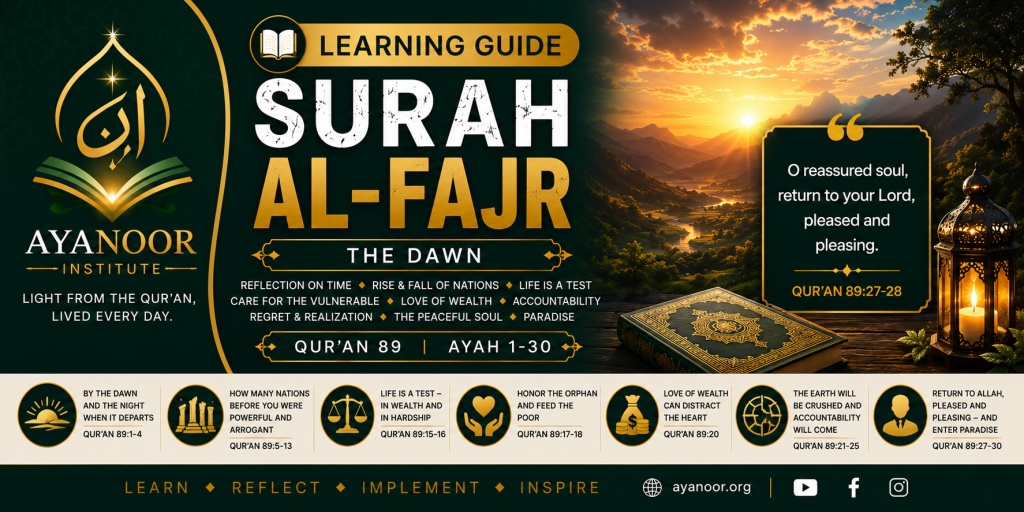
This surah speaks about the rise and fall of powerful nations, the tests of wealth and hardship, care for the vulnerable, the certainty of the Day of Judgment, and the beautiful return of the peaceful soul to Allah.
Surah Al-Fajr is deeply emotional and reflective, calling believers to humility, justice, gratitude, and preparation for the Hereafter.
1. Allah Swears by the Dawn
The surah begins:
“By the dawn.”
— Qur’an 89:1
Allah also swears by the ten nights, the even and odd, and the departing night.
Lessons
- Dawn symbolizes renewal, hope, and guidance.
- Time itself is a sign of Allah’s power.
- Believers should reflect on the blessings hidden in the cycles of life.
Related Qur’anic References
- “And We made the night and day as two signs.” — Qur’an 17:12
- “Indeed in the alternation of night and day are signs.” — Qur’an 3:190
2. The Rise and Fall of Arrogant Nations
Allah reminds humanity about earlier civilizations:
- ‘Aad
- Thamud
- Pharaoh
These nations possessed power, wealth, and impressive structures but became arrogant and oppressive.
“Your Lord poured upon them a scourge of punishment.”
— Qur’an 89:13
Lessons
- Power without righteousness leads to destruction.
- Arrogance blinds people from truth.
- No civilization survives injustice forever.
Related Qur’anic References
- “Indeed Allah does not love the arrogant.” — Qur’an 16:23
- “How many generations We destroyed before them.” — Qur’an 19:74
3. Life is a Test
Allah says:
“As for man, when his Lord tests him and honors him and favors him, he says: ‘My Lord has honored me.’ But when He tests him and restricts his provision, he says: ‘My Lord has humiliated me.’”
— Qur’an 89:15-16
The surah teaches that both wealth and hardship are tests.
Lessons
- Wealth is not always a sign of Allah’s pleasure.
- Difficulty is not always punishment.
- True success lies in faith, patience, and gratitude.
Related Qur’anic References
- “We test you with evil and with good as trial.” — Qur’an 21:35
- “Indeed with hardship comes ease.” — Qur’an 94:5-6
4. Neglecting the Vulnerable
Allah criticizes societies that ignore the weak:
“No! But you do not honor the orphan, nor encourage one another to feed the poor.”
— Qur’an 89:17-18
Lessons
- Compassion is central to Islam.
- A society is judged by how it treats its vulnerable members.
- Faith must produce mercy and social responsibility.
Related Qur’anic References
- “And they give food despite love for it to the needy, the orphan, and the captive.” — Qur’an 76:8
- “Have you seen the one who denies the religion? It is he who repulses the orphan.” — Qur’an 107:1-2
5. Love of Wealth Can Distract the Heart
Allah says:
“And you love wealth with immense love.”
— Qur’an 89:20
The surah warns against becoming consumed by materialism.
Lessons
- Wealth should serve righteousness, not ego.
- Dunya is temporary.
- Greed hardens the heart and weakens spirituality.
Related Qur’anic References
- “Competition in worldly increase distracts you.” — Qur’an 102:1
- “The worldly life is only enjoyment of delusion.” — Qur’an 57:20
6. The Earth Will Be Crushed
Allah describes the Day of Judgment:
“No! When the earth has been leveled, pounded and crushed.”
— Qur’an 89:21
Humanity will finally witness the reality they ignored.
Lessons
- The Day of Judgment is certain.
- Earthly power and possessions will disappear.
- Every soul will stand before Allah alone.
Related Qur’anic References
- “When the earth is shaken with its final earthquake.” — Qur’an 99:1
- “The Day when mankind will stand before the Lord of the worlds.” — Qur’an 83:6
7. Regret on the Day of Judgment
Allah says:
“He will say, ‘Oh, I wish I had sent ahead for my life.’”
— Qur’an 89:24
People who neglected faith and righteousness will regret wasting their worldly life.
Lessons
- Time is one of Allah’s greatest blessings.
- Preparation for the Hereafter should begin now.
- Regret after death will not benefit a person.
Related Qur’anic References
- “Until when death comes to one of them, he says: ‘My Lord, send me back.’” — Qur’an 23:99
- “Every soul shall see what it sent forward.” — Qur’an 81:14
8. The Peaceful Soul
The surah ends beautifully:
“O reassured soul, return to your Lord, pleased and pleasing.”
— Qur’an 89:27-28
This is among the most comforting verses in the Qur’an.
Lessons
- Inner peace comes through faith and remembrance of Allah.
- The believer’s final return is one of honor and mercy.
- Allah invites righteous souls into eternal peace.
Related Qur’anic References
- “Indeed, in the remembrance of Allah do hearts find rest.” — Qur’an 13:28
- “Enter among My servants. Enter My Paradise.” — Qur’an 89:29-30
9. Paradise — The Final Home
Allah says:
“And enter My Paradise.”
— Qur’an 89:30
The righteous are welcomed into eternal joy, security, and closeness to Allah.
Lessons
- Paradise is the ultimate success.
- Every sacrifice for Allah carries eternal reward.
- Patience and sincerity lead to everlasting peace.
Related Qur’anic References
- “Indeed the righteous will be in gardens and bliss.” — Qur’an 52:17
- “No fear will there be upon them, nor will they grieve.” — Qur’an 2:62
Key Themes of Surah Al-Fajr
1. Reflection on Time and Creation
Dawn and the changing cycles of life point toward Allah.
2. The Fall of Arrogant Nations
Power without justice leads to destruction.
3. Wealth and Hardship as Tests
Life’s conditions are trials, not measures of worth.
4. Care for the Vulnerable
Islam emphasizes compassion and social responsibility.
5. Accountability and the Hereafter
Every person will face judgment.
6. The Peaceful Soul
True peace belongs to those connected to Allah.
Reflection Questions
- Do we view both ease and hardship as tests from Allah?
- Are we caring enough for the needy, poor, and vulnerable?
- Is love of wealth distracting us from spirituality?
- How can we cultivate a peaceful soul?
- Are we preparing sincerely for our return to Allah?
Practical Action Points
- Begin mornings with gratitude and remembrance of Allah.
- Reflect on the temporary nature of worldly life.
- Support orphans, the poor, and those in hardship.
- Increase sincerity in worship and character.
- Spend time in Qur’an reflection and dhikr.
- Prioritize the Hereafter over material excess.
Conclusion
Surah Al-Fajr is a profound reminder that worldly power, wealth, and status are temporary, while faith, humility, compassion, and sincerity lead to eternal success.
The surah calls humanity to reflect on history, prepare for accountability, care for the vulnerable, and strive to become among the souls who will one day hear the beautiful invitation:
“Return to your Lord, pleased and pleasing.”