

Introduction
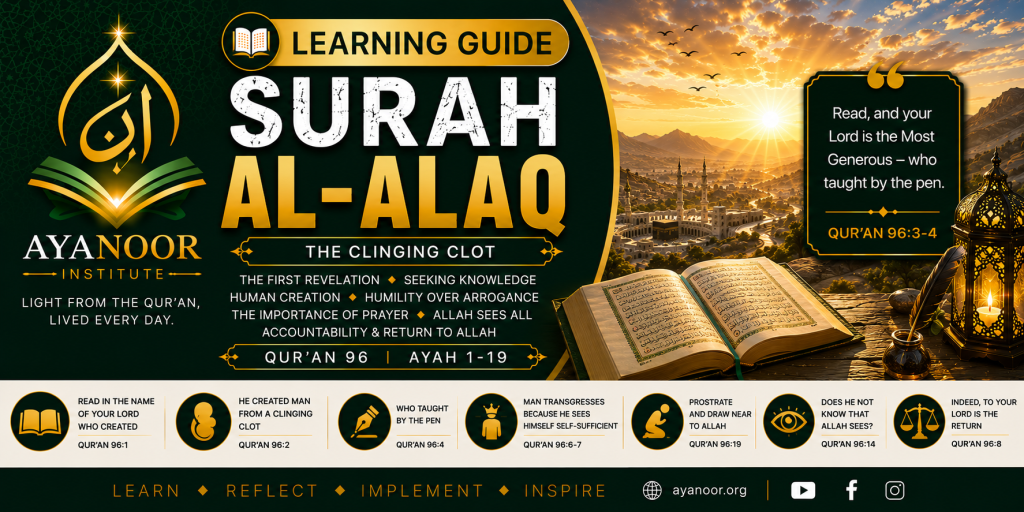
Surah Al-‘Alaq is the 96th chapter of the Qur’an and holds a unique place in Islamic history because its opening verses were the very first revelation given to Prophet Muhammad ﷺ in the Cave of Hira. The word Al-‘Alaq refers to a “clinging clot” or the early stage of human creation.
This surah introduces humanity to the importance of knowledge, reading, learning, humility before Allah, and the danger of arrogance. It reminds believers that Allah is the Creator, the Teacher, and the One to whom everyone will return.
Surah Al-‘Alaq is a foundational chapter about revelation, education, worship, human dignity, and accountability before Allah.
1. The First Command: Read
The surah begins:
“Read in the name of your Lord who created.”
— Qur’an 96:1
The very first revealed command in Islam was not about power or wealth, but knowledge and learning.
Lessons
- Islam values education and reflection.
- Knowledge should be connected to Allah and morality.
- Learning becomes worship when done sincerely.
Related Qur’anic References
- “Say: Are those who know equal to those who do not know?” — Qur’an 39:9
- “My Lord, increase me in knowledge.” — Qur’an 20:114
2. Allah Created Human Beings
Allah says:
“He created man from a clinging clot.”
— Qur’an 96:2
Lessons
- Human beings begin from a humble origin.
- Creation itself is a sign of Allah’s power.
- Humility should accompany knowledge and success.
Related Qur’anic References
- “Did there not pass over man a period of time when he was not a thing worth mentioning?” — Qur’an 76:1
- “From dust He created him.” — Qur’an 3:59
3. Allah is the Teacher
Allah says:
“Read, and your Lord is the Most Generous — who taught by the pen.”
— Qur’an 96:3-4
Lessons
- Knowledge is a mercy from Allah.
- Writing and preservation of knowledge are sacred responsibilities.
- Human civilization grows through learning and teaching.
Related Qur’anic References
- “Who taught man what he did not know.” — Qur’an 96:5
- “Nun. By the pen and what they write.” — Qur’an 68:1
4. Human Beings Become Arrogant
Allah warns:
“No indeed! Man transgresses because he sees himself self-sufficient.”
— Qur’an 96:6-7
Lessons
- Wealth and power can lead to arrogance.
- Forgetting dependence on Allah corrupts the heart.
- Pride is one of the greatest spiritual dangers.
Related Qur’anic References
- “Do not walk upon the earth arrogantly.” — Qur’an 17:37
- “Indeed Allah does not love the arrogant.” — Qur’an 16:23
5. Everyone Returns to Allah
Allah says:
“Indeed, to your Lord is the return.”
— Qur’an 96:8
Lessons
- Human life is temporary.
- Accountability before Allah is certain.
- Awareness of the Hereafter shapes moral behavior.
Related Qur’anic References
- “To Us is their return, then upon Us is their account.” — Qur’an 88:25-26
- “Every soul shall taste death.” — Qur’an 3:185
6. Opposition to Worship and Truth
The surah speaks about those who tried to stop the Prophet ﷺ from praying.
“Have you seen the one who forbids a servant when he prays?”
— Qur’an 96:9-10
Lessons
- Truth often faces resistance.
- Worship strengthens faith and courage.
- Believers should remain steadfast in obedience to Allah.
Related Qur’anic References
- “And seek help through patience and prayer.” — Qur’an 2:45
- “Establish prayer for My remembrance.” — Qur’an 20:14
7. Allah Sees Everything
Allah reminds:
“Does he not know that Allah sees?”
— Qur’an 96:14
Lessons
- Allah is fully aware of every action and intention.
- Secret ظلم (injustice) never escapes divine knowledge.
- Awareness of Allah strengthens honesty and sincerity.
Related Qur’anic References
- “Indeed Allah is ever watchful over you.” — Qur’an 4:1
- “Not a word does he utter except that there is an observer ready.” — Qur’an 50:18
8. The Danger of Persistent Arrogance
Allah warns against the rebellious oppressor:
“No indeed! If he does not stop, We will seize him by the forelock.”
— Qur’an 96:15
Lessons
- Arrogance eventually leads to destruction.
- Human authority is temporary.
- Allah’s justice cannot be escaped.
Related Qur’anic References
- “Your Lord is severe in punishment.” — Qur’an 85:12
- “Allah does not guide the wrongdoing people.” — Qur’an 62:5
9. Do Not Obey Falsehood
Allah commands the Prophet ﷺ:
“Do not obey him. But prostrate and draw near.”
— Qur’an 96:19
Lessons
- Closeness to Allah comes through worship.
- Prayer protects the believer spiritually.
- Prostration symbolizes humility before the Creator.
Related Qur’anic References
- “Bow and prostrate and worship your Lord.” — Qur’an 22:77
- “The closest a servant comes to his Lord is while in prostration.” — Hadith
Key Themes of Surah Al-‘Alaq
1. The Importance of Knowledge
Islam begins with reading, learning, and reflection.
2. Human Humility
Humans come from a humble origin and depend on Allah.
3. Worship and Prayer
Prayer strengthens the soul and brings closeness to Allah.
4. The Danger of Arrogance
Pride and self-sufficiency lead people away from truth.
5. Accountability Before Allah
Every person will return to Allah for judgment.
6. Revelation and Guidance
The Qur’an is a mercy and source of enlightenment.
Reflection Questions
- How seriously are we pursuing beneficial knowledge?
- Does knowledge increase our humility or arrogance?
- Are we maintaining consistency in prayer and worship?
- Do we remember Allah during times of success?
- Are we using our knowledge to benefit others?
Practical Action Points
- Read and reflect on the Qur’an daily.
- Seek knowledge with sincerity and humility.
- Strengthen regular prayer and prostration.
- Avoid arrogance and pride.
- Teach beneficial knowledge to others.
- Remember Allah during success and hardship alike.
Conclusion
Surah Al-‘Alaq marks the beginning of revelation and the beginning of humanity’s spiritual awakening through the Qur’an. It teaches that true knowledge begins with Allah, that human beings must remain humble, and that worship and sincerity are essential for spiritual growth.
The surah reminds believers that education without humility becomes dangerous, while faith, prayer, and remembrance of Allah elevate the human soul and bring true closeness to the Creator.