

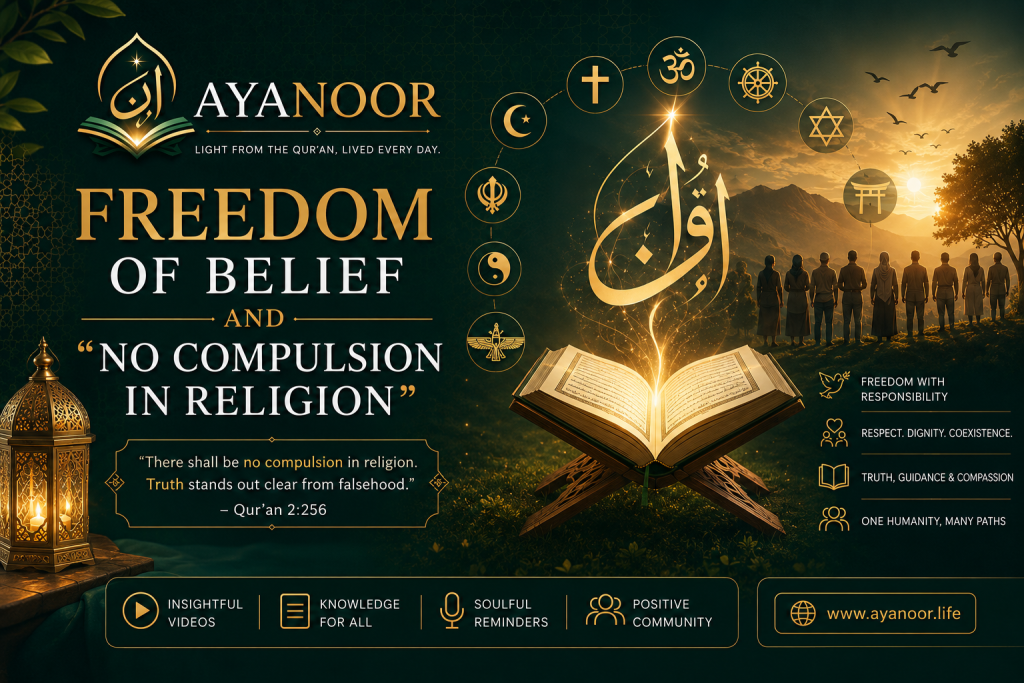
One of the most profound principles found in the Qur’an is the idea that faith cannot be forced upon people. In a world often divided by religion, culture, politics, and identity, Surah Al-Baqarah presents a timeless message about freedom of belief, personal responsibility, and the dignity of human choice.
At the center of this discussion is one of the most widely quoted verses in the Qur’an:
“There shall be no compulsion in religion. Truth stands out clear from falsehood.”
— Qur’an 2:256
This verse is not simply a statement about religion; it is a statement about human nature itself. Allah created human beings with intellect, conscience, emotion, and free will. Faith that is forced through fear, pressure, or manipulation loses its sincerity. True belief must come from understanding, reflection, and personal conviction.
Why the Qur’an Rejects Forced Faith
The Qur’an repeatedly invites people to think, reflect, observe nature, and engage in dialogue. If belief could simply be imposed, there would be no need for reflection, reasoning, or spiritual struggle.
Allah says:
“Will you then compel people until they become believers?”
— Qur’an 10:99
The message is clear: guidance cannot be manufactured through coercion. Human beings are responsible for their choices, and part of the test of life is learning to seek truth willingly.
This principle also teaches humility. Muslims are encouraged to share wisdom with kindness and good character, not through control or domination. The role of believers is to convey truth sincerely while recognizing that guidance ultimately belongs to Allah alone.
Faith and Human Dignity
Freedom of belief is deeply connected to human dignity. When people are denied the right to think, question, or choose, they are stripped of one of the greatest gifts Allah gave humanity: moral responsibility.
In the story of Adam in Surah Al-Baqarah, Allah honored human beings with knowledge and the ability to choose. Even though humanity would make mistakes, Allah still entrusted people with responsibility on Earth.
A forced believer may appear religious externally, but faith without sincerity has little spiritual value. The Qur’an strongly criticizes hypocrisy — people who display belief outwardly while hiding disbelief within their hearts. This demonstrates that Allah values sincerity over appearance.
The Difference Between Invitation and Compulsion
Islam encourages da‘wah — inviting others toward truth — but there is a major difference between invitation and compulsion.
The Qur’an teaches believers to:
- Speak with wisdom
- Engage respectfully
- Listen carefully
- Demonstrate character through actions
- Avoid mockery and hatred
The Prophet Muhammad ﷺ faced rejection, insults, and hostility for many years in Makkah, yet he was repeatedly instructed to remain patient and compassionate. The Qur’an did not command him to force belief upon people. Instead, he was reminded that his responsibility was only to deliver the message clearly.
This lesson is especially important today when religious discussions can quickly become aggressive or political. Surah Al-Baqarah reminds believers that guidance grows best in environments of mercy, understanding, and intellectual honesty.
Freedom of Belief in Families and Communities
One of the most difficult tests for families is learning how to guide without controlling. Many parents genuinely want good for their children but may confuse guidance with domination. This can create fear instead of understanding.
The Qur’anic model encourages conversation, patience, and gradual learning. Faith becomes stronger when young people are allowed to ask questions, reflect deeply, and build a personal connection with Allah.
This principle also applies to society. Healthy communities are not built through fear or pressure but through trust, education, justice, and compassion.
A Universal Message for Humanity
The phrase “No compulsion in religion” speaks not only to Muslims but to humanity as a whole. It establishes a foundation for coexistence, interfaith dialogue, and mutual respect.
People from different religions and backgrounds may disagree on beliefs, but the Qur’an teaches that disagreement should not destroy human dignity. Justice, kindness, and respectful engagement remain essential values.
In a world where religion has sometimes been misused for power, Surah Al-Baqarah calls people back to a higher principle: truth should be embraced through conviction, not fear.
Reflection Questions
- Why do you think sincere faith cannot be forced?
- What is the difference between guiding someone and controlling them?
- How can families encourage faith while still respecting individuality?
- Why does the Qur’an place such importance on human choice?
- How can Muslims engage in interfaith dialogue with wisdom and confidence?
- What happens to societies when people are denied freedom of thought and belief?
Final Reflection
The Qur’an presents faith as a journey of the heart, mind, and soul. Surah Al-Baqarah teaches that belief has meaning only when it is chosen sincerely. Allah gave humanity intellect, conscience, and freedom not by accident, but as part of the test of life itself.
True guidance does not grow through pressure. It grows through truth, mercy, patience, reflection, and the sincere search for Allah.