
Finding Hope, Meaning, and Strength in Modern Life
There are moments in life when everything feels heavy.
A person may smile in public while privately carrying anxiety, financial pressure, loneliness, family tensions, disappointment, or fear about the future. Many people today wake up exhausted before the day even begins. Some feel lost despite having education, careers, followers, or material comfort.
This is why the Quran continues to touch hearts across generations. It speaks to human beings as they truly are — fragile, emotional, hopeful, struggling, imperfect, and constantly searching for meaning.
The Quran does not speak to people from a distance. It speaks to the human heart.
When Life Feels Overwhelming
Every human being experiences moments where life becomes difficult:
- a parent worrying about providing for their family
- a young person struggling with identity and pressure
- someone silently battling depression or anxiety
- a family trying to heal after conflict
- a person carrying guilt from past mistakes
- someone feeling spiritually empty despite worldly success
Allah acknowledges this reality openly in the Quran:
“And We will surely test you with something of fear and hunger and loss of wealth and lives and fruits, but give glad tidings to the patient.”
— Surah Al-Baqarah (2:155)
The Quran reminds us that struggling does not mean we are abandoned by Allah. Difficulty is part of being human.
Sometimes the people closest to Allah are the ones who cried the most, struggled the most, and carried the heaviest responsibilities.
The Loneliness of Modern Life
One of the strange realities of today’s world is that people are constantly connected online, yet many feel deeply alone inside.
People scroll endlessly through perfect images of other people’s lives while quietly wondering:
- “Why am I not happy?”
- “Why do I feel behind?”
- “Why does everyone else seem successful?”
- “Why does my heart still feel empty?”
The Quran gently redirects the human heart away from comparison and back toward inner peace.
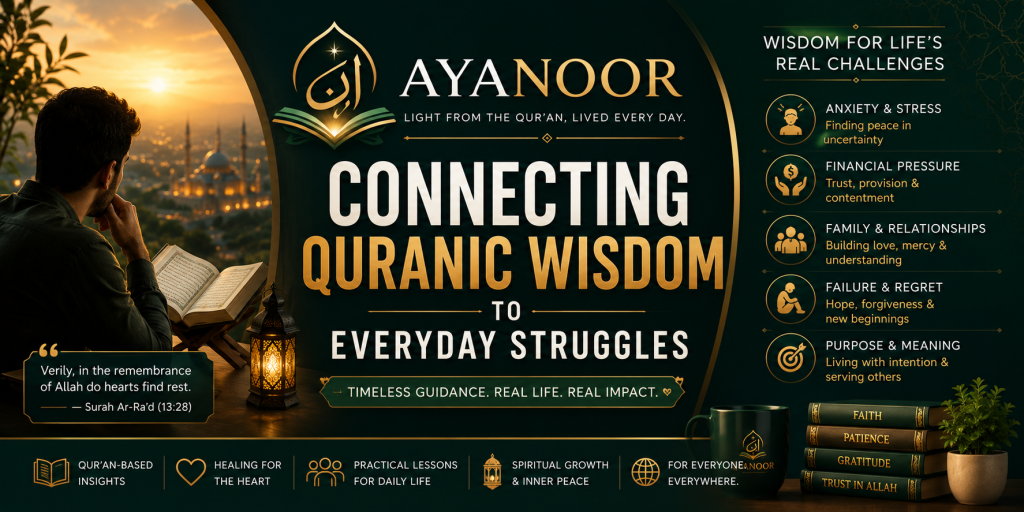
“Verily, in the remembrance of Allah do hearts find rest.”
— Surah Ar-Ra’d (13:28)
Not temporary distraction.
Not endless entertainment.
Not approval from strangers.
Real peace begins when the heart reconnects with its Creator.
When We Feel Like Failures
Many people carry regrets they never speak about.
Some feel ashamed of mistakes from the past. Others believe they have drifted too far away spiritually. Some quietly think:
- “Maybe Allah is disappointed in me.”
- “Maybe I wasted too many years.”
- “Maybe I can never become better.”
But one of the most beautiful things about the Quran is that it never closes the door of hope.
Allah says:
“Do not despair of the mercy of Allah.”
— Surah Az-Zumar (39:53)
The Quran teaches that human beings are not defined only by their worst moments. Growth begins the moment a person sincerely turns back toward goodness.
Even prophets experienced sadness, fear, disappointment, and emotional pain. The Quran does not hide human emotion — it honors it.
Family Struggles and Emotional Pain
Some of the deepest wounds people carry come from family relationships:
- misunderstandings between parents and children
- marriages losing compassion
- siblings drifting apart
- people feeling unseen inside their own homes
The Quran consistently calls human beings back toward mercy.
“And He placed between you affection and mercy.”
— Surah Ar-Rum (30:21)
Modern life often encourages harshness, ego, and emotional reactions. The Quran teaches gentleness, patience, forgiveness, and dignity — especially with the people closest to us.
Sometimes healing begins not with grand speeches, but with:
- listening sincerely
- speaking kindly
- apologizing honestly
- showing compassion again
The Pressure to Constantly Succeed
Modern society teaches people to constantly chase more:
- more money
- more recognition
- more followers
- more status
- more possessions
Yet many people achieve these things and still feel empty.
The Quran warns humanity not to lose itself in endless competition.
“Competition in worldly increase diverts you.”
— Surah At-Takathur (102:1)
The Quran does not tell people to abandon the world. It teaches balance:
work hard, build, achieve, contribute — but do not let worldly success become the measure of your worth.
A person’s value is not determined by income, appearance, or popularity.
Some of the most beloved people to Allah may be unknown to society.
Patience Is Not Weakness
Many people think patience means silently suffering without emotion. But the Quran presents patience as strength.
Patience means:
- continuing despite exhaustion
- remaining kind despite hurt
- holding onto faith during uncertainty
- refusing to become bitter
- trusting Allah even when life feels unclear
Allah says:
“Indeed, Allah is with the patient.”
— Surah Al-Baqarah (2:153)
Some of the strongest people in the world are carrying invisible battles no one knows about.
The Quran Restores Human Dignity
The Quran constantly reminds humanity that every person has dignity regardless of:
- race
- wealth
- nationality
- disability
- social status
“Indeed, the most noble of you in the sight of Allah is the most righteous of you.”
— Surah Al-Hujurat (49:13)
This message remains powerful today because so many people still suffer from discrimination, humiliation, and judgment.
The Quran teaches us to see human beings through the lens of compassion rather than superiority.
The Quran Teaches Us to Slow Down and Reflect
Today’s world moves fast.
People barely have time to process their emotions before rushing into the next distraction. The Quran repeatedly invites people to pause and reflect.
“Do they not reflect upon the Quran?”
— Surah Muhammad (47:24)
Reflection changes people.
Sometimes one sincere moment of reflection can transform an entire life.
A Message Many Hearts Need Today
Perhaps one of the most comforting verses in the Quran is:
“Indeed, with hardship comes ease.”
— Surah Ash-Sharh (94:6)
Not after hardship.
With hardship.
Meaning even in difficult moments, Allah is already creating openings we may not yet see.
Conclusion
The Quran is not only a book to be recited. It is a companion for human struggle.
It comforts the anxious.
It humbles the arrogant.
It softens the angry.
It strengthens the weak.
It guides the lost.
It reminds broken hearts that healing is possible.
Its wisdom continues to matter because human beings continue to search for:
- peace
- meaning
- love
- hope
- belonging
- purpose
And the Quran continues to speak to all of those needs with mercy, balance, and timeless guidance.