

Introduction
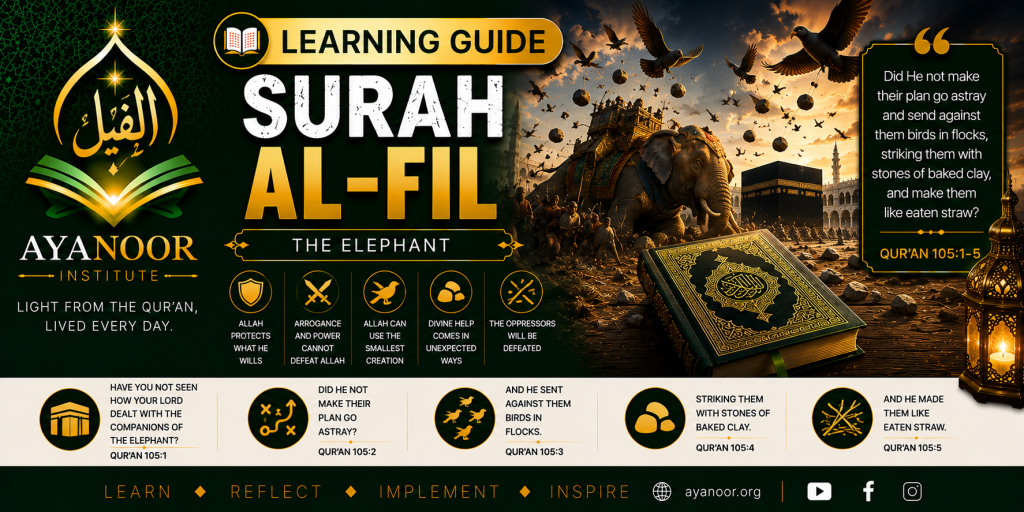
Surah Al-Fil is the 105th chapter of the Qur’an and was revealed in Makkah. The word Al-Fil means “The Elephant.” The surah refers to the famous historical event in which Allah protected the Ka‘bah from the army of Abraha, who marched with elephants intending to destroy the Sacred House in Makkah.
This chapter reminds believers that Allah is the ultimate protector, that worldly power cannot overcome divine will, and that arrogance and oppression eventually fail. Surah Al-Fil also highlights Allah’s care for His sacred places and His ability to defend truth through unexpected means.
The event became a powerful sign for the people of Makkah and is closely connected to the year of the birth of Prophet Muhammad ﷺ.
1. Allah Protected the Sacred House
The surah begins:
“Have you not seen how your Lord dealt with the companions of the elephant?”
— Qur’an 105:1
Lessons
- Allah protects what He wills.
- The Ka‘bah holds a special status in Islam.
- Divine help can arrive even when people feel powerless.
Related Qur’anic References
- “And whoever honors the symbols of Allah — indeed it is from the piety of hearts.” — Qur’an 22:32
- “Indeed the first House established for mankind was that at Bakkah.” — Qur’an 3:96
2. Arrogance and Oppression Fail
Abraha came with a massive army and elephants, believing worldly strength guaranteed victory.
Allah says:
“Did He not make their plan go astray?”
— Qur’an 105:2
Lessons
- Human plans cannot overcome Allah’s decree.
- Pride and oppression eventually collapse.
- Power without humility leads to destruction.
Related Qur’anic References
- “They plan, and Allah plans, and Allah is the best of planners.” — Qur’an 8:30
- “Indeed Allah does not love the arrogant.” — Qur’an 16:23
3. Allah Sent Birds Against the Army
Allah says:
“And He sent against them birds in flocks.”
— Qur’an 105:3
Lessons
- Allah can use even the smallest creation to defeat great powers.
- Victory comes from Allah, not numbers or weapons alone.
- Believers should place trust in Allah during hardships.
Related Qur’anic References
- “And victory is not except from Allah.” — Qur’an 3:126
- “How many small groups have overcome large groups by permission of Allah.” — Qur’an 2:249
4. Stones of Punishment
Allah says:
“Striking them with stones of baked clay.”
— Qur’an 105:4
Lessons
- Allah’s punishment can come unexpectedly.
- ظلم (oppression) and aggression carry consequences.
- The story serves as a warning against arrogance and injustice.
Related Qur’anic References
- “Your Lord is severe in punishment.” — Qur’an 85:12
- “And thus is the seizure of your Lord when He seizes the cities while they are committing wrong.” — Qur’an 11:102
5. The Army Was Destroyed Completely
Allah says:
“And He made them like eaten straw.”
— Qur’an 105:5
The once-powerful army became broken and scattered.
Lessons
- Worldly strength is temporary.
- Allah humbles those who act with arrogance and oppression.
- Real power belongs only to Allah.
Related Qur’anic References
- “To Allah belongs all honor, power, and glory.” — Qur’an 63:8
- “Every soul shall taste death.” — Qur’an 3:185
6. The Importance of the Ka‘bah
Although the surah focuses on the destruction of Abraha’s army, it also reminds believers about the sanctity of the Ka‘bah.
Lessons
- The Ka‘bah is a symbol of worship and unity.
- Sacred places should be respected and honored.
- Islam unites believers around worship of Allah alone.
Related Qur’anic References
- “Purify My House for those who perform Tawaf.” — Qur’an 22:26
- “And proclaim to mankind the pilgrimage.” — Qur’an 22:27
7. Trust in Allah During Difficult Times
The people of Makkah were unable to defend themselves against the army, yet Allah protected them.
Lessons
- Believers should trust Allah even when situations appear impossible.
- Reliance upon Allah brings strength and peace.
- Allah’s help can come from unexpected directions.
Related Qur’anic References
- “And whoever relies upon Allah — He is sufficient for him.” — Qur’an 65:3
- “Indeed Allah is with the believers.” — Qur’an 8:19
8. Signs for Humanity
The story of the elephant became a lasting sign remembered across generations.
Lessons
- Historical events in the Qur’an contain spiritual lessons.
- Allah’s signs strengthen faith and reflection.
- Believers should study history with wisdom and humility.
Related Qur’anic References
- “Indeed in their stories are lessons for people of understanding.” — Qur’an 12:111
- “Travel through the land and observe.” — Qur’an 29:20
Key Themes of Surah Al-Fil
1. Allah is the Ultimate Protector
No force can overcome Allah’s will.
2. Arrogance Leads to Destruction
Oppression and pride eventually fail.
3. The Sanctity of the Ka‘bah
Allah honored and protected His Sacred House.
4. Victory Comes from Allah
True strength belongs to Allah alone.
5. Trust and Reliance Upon Allah
Believers should remain hopeful during difficulties.
Reflection Questions
- Do we truly trust Allah during difficult situations?
- How do pride and arrogance affect individuals and societies?
- Are we respecting the sacred symbols and teachings of Islam?
- What lessons can we learn from historical events in the Qur’an?
- Do we rely too much on worldly strength instead of Allah?
Practical Action Points
- Strengthen reliance upon Allah through prayer and du‘a.
- Avoid arrogance in success and power.
- Reflect on Qur’anic stories regularly.
- Respect sacred places and acts of worship.
- Stand against oppression and injustice.
- Remember that Allah’s help can come unexpectedly.
Conclusion
Surah Al-Fil is a powerful reminder that Allah alone controls power, victory, and protection. The destruction of Abraha’s mighty army showed that arrogance and oppression cannot stand against the will of Allah.
The surah teaches believers to trust Allah, remain humble, honor the sacred symbols of Islam, and recognize that true strength comes not from worldly might, but from sincere faith and reliance upon the Creator.