

Introduction
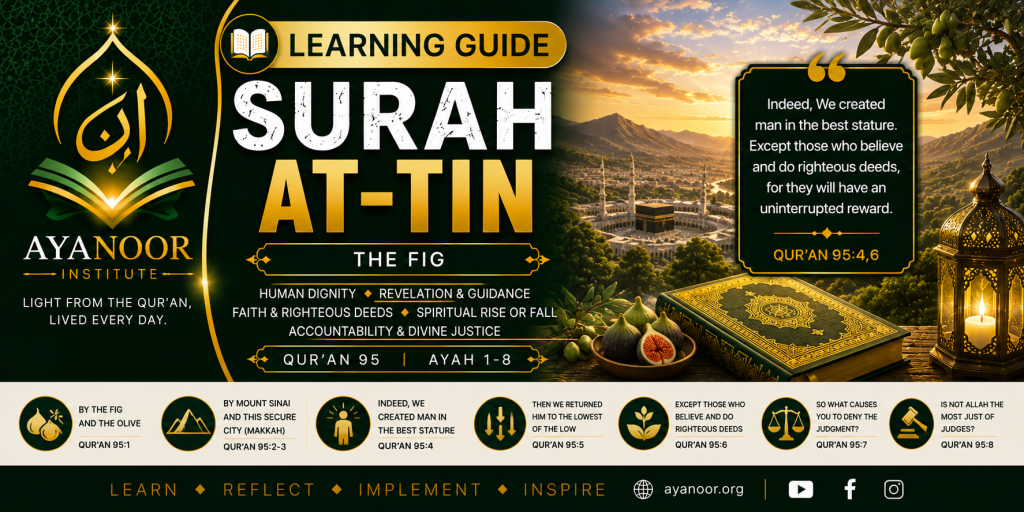
Surah At-Tin is the 95th chapter of the Qur’an and was revealed in Makkah. The word At-Tin means “The Fig.” Allah begins the surah by swearing by the fig, the olive, Mount Sinai, and the secure city of Makkah — all symbols connected with revelation, blessings, and prophetic guidance.
This short but powerful surah focuses on the dignity of human beings, the importance of faith and righteous action, and the reality of accountability before Allah. It teaches that Allah created humanity in the best form, but people can fall spiritually when they ignore divine guidance.
Surah At-Tin reminds believers that true honor comes through faith, morality, and living according to Allah’s guidance.
1. Allah Swears by Sacred Symbols
The surah begins:
“By the fig and the olive.”
— Qur’an 95:1
Allah also swears by Mount Sinai and the secure city of Makkah.
Lessons
- These places and symbols are connected with prophets and revelation.
- Allah draws attention to signs that carry spiritual meaning.
- Revelation is humanity’s source of guidance and honor.
Related Qur’anic References
- “And the olive and the palm trees.” — Qur’an 80:29
- “And We called him from the side of Mount Tur.” — Qur’an 19:52
2. Human Beings Were Created in the Best Form
Allah says:
“Indeed, We created man in the best stature.”
— Qur’an 95:4
Human beings were given intellect, morality, emotions, and the ability to choose between right and wrong.
Lessons
- Humanity has been honored by Allah.
- Every person has spiritual potential and dignity.
- Human life has purpose and responsibility.
Related Qur’anic References
- “We have certainly honored the children of Adam.” — Qur’an 17:70
- “He fashioned you and perfected your forms.” — Qur’an 40:64
3. Humans Can Fall Spiritually
Allah warns:
“Then We returned him to the lowest of the low.”
— Qur’an 95:5
When people reject guidance and follow corruption, they lose their spiritual dignity.
Lessons
- Ignoring Allah’s guidance harms the soul.
- Moral decline can be worse than physical weakness.
- Human greatness depends on faith and righteousness.
Related Qur’anic References
- “Indeed the worst of creatures in Allah’s sight are those who disbelieve.” — Qur’an 8:55
- “No! Rather, their hearts are stained because of what they used to earn.” — Qur’an 83:14
4. Faith and Good Deeds Bring Lasting Reward
Allah says:
“Except those who believe and do righteous deeds, for they will have an uninterrupted reward.”
— Qur’an 95:6
Lessons
- Faith must be combined with action.
- Righteous deeds protect and elevate the soul.
- Allah rewards sincerity and perseverance eternally.
Related Qur’anic References
- “Indeed those who believe and do righteous deeds will have gardens beneath which rivers flow.” — Qur’an 18:107
- “Allah does not let the reward of good doers go to waste.” — Qur’an 9:120
5. Accountability Before Allah
Allah asks:
“So what causes you to deny the Judgment after this?”
— Qur’an 95:7
The surah reminds humanity that resurrection and accountability are realities.
Lessons
- Human life is not meaningless.
- Every action carries consequences.
- Awareness of Judgment encourages responsibility and justice.
Related Qur’anic References
- “Whoever does an atom’s weight of good will see it.” — Qur’an 99:7
- “To Us is their return, then upon Us is their account.” — Qur’an 88:25-26
6. Allah is the Most Just Judge
The surah concludes:
“Is not Allah the most just of judges?”
— Qur’an 95:8
Lessons
- Allah’s judgment is perfect and fair.
- No ظلم (injustice) escapes Allah’s knowledge.
- Believers should trust Allah’s wisdom and justice.
Related Qur’anic References
- “Indeed Allah does not wrong anyone even by an atom’s weight.” — Qur’an 4:40
- “Your Lord wrongs no one.” — Qur’an 18:49
Key Themes of Surah At-Tin
1. The Honor of Human Creation
Allah created humanity with dignity and purpose.
2. The Need for Revelation
Guidance protects human beings spiritually.
3. Spiritual Rise or Decline
People can elevate or corrupt themselves through choices.
4. Faith and Righteous Deeds
True success lies in belief and good character.
5. Accountability and Divine Justice
Every soul will return to Allah for judgment.
Reflection Questions
- Are we living according to the dignity Allah gave humanity?
- What habits strengthen or weaken our souls?
- Are faith and righteous deeds visible in our daily lives?
- How often do we reflect on accountability before Allah?
- Are we using our abilities for good and service?
Practical Action Points
- Reflect daily on Allah’s blessings and purpose in life.
- Strengthen both faith and good deeds together.
- Avoid habits that corrupt the heart and character.
- Treat others with dignity and justice.
- Read and reflect on the Qur’an regularly.
- Live with awareness of accountability before Allah.
Conclusion
Surah At-Tin is a profound reminder that Allah created human beings with honor, dignity, and immense spiritual potential. Yet true greatness depends on faith, righteous action, and remaining connected to divine guidance.
The surah teaches that while humans can rise spiritually through belief and good deeds, they can also fall through corruption and neglect of Allah’s guidance. Ultimately, every soul will stand before Allah — the Most Just of judges — and be rewarded according to its choices and actions.