

Introduction
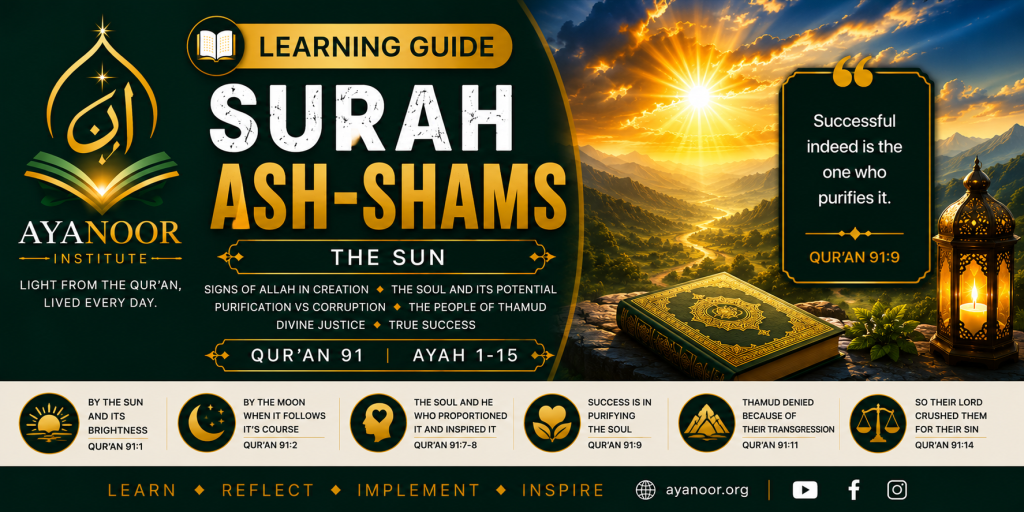
Surah Ash-Shams is the 91st chapter of the Qur’an and was revealed in Makkah. The word Ash-Shams means “The Sun.” The surah begins with a series of powerful oaths by the sun, moon, day, night, sky, earth, and the human soul, drawing attention to the harmony and balance Allah placed throughout creation.
The central message of this surah is the purification of the soul. Allah teaches that true success belongs to the one who purifies the heart and soul, while failure belongs to the one who corrupts it. The surah also reminds humanity through the story of the people of Thamud, who were destroyed because of arrogance and rebellion against Allah.
Surah Ash-Shams is a deeply reflective chapter about self-purification, morality, accountability, and the struggle between righteousness and sin.
1. Allah Swears by the Sun and Its Brightness
The surah opens:
“By the sun and its brightness.”
— Qur’an 91:1
Allah continues with oaths by the moon, the day, the night, the sky, and the earth.
Lessons
- The universe reflects divine order and precision.
- Creation points toward Allah’s wisdom and power.
- The balance in nature mirrors the balance needed within the human soul.
Related Qur’anic References
- “Indeed, in the creation of the heavens and the earth are signs.” — Qur’an 3:190
- “And the sun runs on its fixed course.” — Qur’an 36:38
2. The Human Soul and Its Moral Awareness
Allah says:
“And by the soul and He who proportioned it, and inspired it with its wickedness and its righteousness.”
— Qur’an 91:7-8
Allah created human beings with awareness of right and wrong.
Lessons
- Humans possess conscience and moral responsibility.
- The soul naturally recognizes truth and falsehood.
- Every person chooses which path to follow.
Related Qur’anic References
- “Indeed, We guided him to the path.” — Qur’an 76:3
- “And We showed him the two ways.” — Qur’an 90:10
3. True Success is Purification of the Soul
One of the most powerful verses in the Qur’an:
“Successful indeed is the one who purifies it.”
— Qur’an 91:9
Purification includes faith, sincerity, repentance, good character, remembrance of Allah, and controlling sinful desires.
Lessons
- Spiritual purification is the foundation of true success.
- External success means little without inner righteousness.
- Islam focuses on transforming the heart and character.
Related Qur’anic References
- “He has succeeded who purifies himself.” — Qur’an 87:14
- “Indeed, in the remembrance of Allah do hearts find rest.” — Qur’an 13:28
4. Failure Comes Through Corruption of the Soul
Allah warns:
“And failed is the one who corrupts it.”
— Qur’an 91:10
Neglecting the soul leads to spiritual darkness and destruction.
Lessons
- Sin gradually hardens the heart.
- Ignoring conscience weakens spiritual awareness.
- Arrogance and repeated wrongdoing corrupt the soul.
Related Qur’anic References
- “No! Rather, the stain has covered their hearts because of what they used to earn.” — Qur’an 83:14
- “Then their hearts became hardened.” — Qur’an 57:16
5. The People of Thamud Rejected Truth
Allah mentions the nation of Thamud:
“Thamud denied because of their transgression.”
— Qur’an 91:11
They arrogantly rejected Prophet Salih (AS) despite clear signs from Allah.
Lessons
- Arrogance prevents people from accepting truth.
- Rejecting divine guidance leads to destruction.
- Communities collapse when corruption becomes widespread.
Related Qur’anic References
- “And to Thamud We sent their brother Salih.” — Qur’an 11:61
- “So they hamstrung the she-camel and rebelled.” — Qur’an 7:77
6. The She-Camel as a Sign from Allah
Allah provided the miraculous she-camel as a test for Thamud.
“This is the she-camel of Allah and her drinking time.”
— Qur’an 91:13
Instead of respecting Allah’s sign, they harmed it.
Lessons
- Allah gives signs and opportunities for guidance.
- Disrespecting sacred trusts leads to consequences.
- Human beings are tested through obedience.
Related Qur’anic References
- “And We gave Thamud the she-camel as a visible sign.” — Qur’an 17:59
- “Do not harm the she-camel of Allah.” — Qur’an 11:64
7. Sin Can Spread Through Society
Allah says:
“When the most wicked among them rose up.”
— Qur’an 91:12
One rebellious individual led others toward destruction.
Lessons
- Corruption spreads when evil is normalized.
- Communities are influenced by leadership and social behavior.
- Believers should stand against wrongdoing.
Related Qur’anic References
- “Help one another in righteousness and piety.” — Qur’an 5:2
- “Fear a trial which will not strike only the wrongdoers among you.” — Qur’an 8:25
8. Allah’s Justice is Certain
Allah says:
“So their Lord crushed them for their sin and leveled them.”
— Qur’an 91:14
Allah’s justice eventually reaches those who persist in oppression and rebellion.
Lessons
- Allah is patient, but injustice has consequences.
- No nation or individual escapes accountability forever.
- Divine justice is perfect and fair.
Related Qur’anic References
- “Indeed, your Lord is ever watchful.” — Qur’an 89:14
- “Allah is not unaware of what the wrongdoers do.” — Qur’an 14:42
9. Allah Fears No Consequence
The surah ends:
“And He does not fear the consequence thereof.”
— Qur’an 91:15
Allah’s judgment is absolute and perfect.
Lessons
- Allah’s authority is complete.
- Human power is temporary and limited.
- Ultimate control belongs only to Allah.
Related Qur’anic References
- “He is not questioned about what He does.” — Qur’an 21:23
- “To Allah belongs the dominion of the heavens and the earth.” — Qur’an 57:2
Key Themes of Surah Ash-Shams
1. Reflection on Creation
The sun, moon, day, and night reflect Allah’s perfection.
2. Purification of the Soul
True success lies in spiritual purification.
3. Moral Responsibility
Humans can choose righteousness or corruption.
4. The Danger of Arrogance
Rejecting truth destroys individuals and nations.
5. Accountability and Divine Justice
Every action carries consequences before Allah.
Reflection Questions
- What steps are we taking to purify our hearts and souls?
- Are worldly distractions weakening our spirituality?
- How do we respond when truth challenges our ego?
- Are we strengthening good habits or sinful habits?
- What lessons can we learn from the destruction of past nations?
Practical Action Points
- Increase daily remembrance (dhikr) and Qur’an reflection.
- Repent sincerely and regularly seek forgiveness.
- Avoid habits that harden the heart.
- Surround yourself with righteous influences.
- Practice honesty, humility, and compassion.
- Reflect on Allah’s signs in creation every day.
Conclusion
Surah Ash-Shams is a profound chapter about the inner struggle of the human soul. Through the signs of creation and the lessons from past nations, Allah teaches that real success is not material wealth or worldly status, but the purification of the heart through faith, sincerity, and obedience.
The surah reminds believers that every soul is capable of both righteousness and corruption — and that eternal success belongs to those who purify themselves and remain connected to Allah.