

Introduction
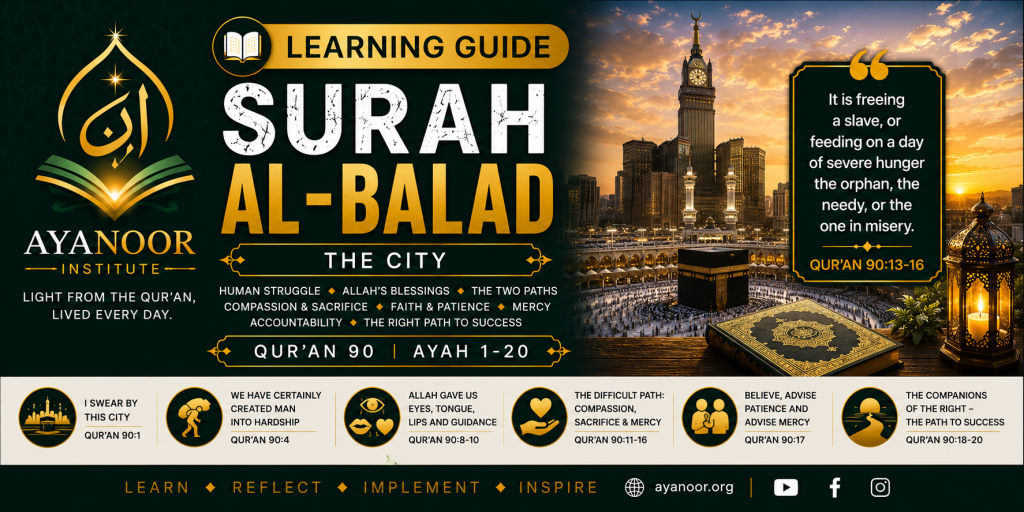
Surah Al-Balad is the 90th chapter of the Qur’an and was revealed in Makkah. The word Al-Balad means “The City,” referring to the sacred city of Makkah — the birthplace of the Prophet Muhammad ﷺ and a center of spiritual history.
This surah highlights the struggles of human life, the blessings Allah has given humanity, the importance of compassion and sacrifice, and the path toward true righteousness. It teaches that real success is not found in pride or wealth alone, but in faith, patience, mercy, and serving others.
Surah Al-Balad is a profound reminder that life itself is a test and that believers must strive through hardship toward goodness and obedience to Allah.
1. Allah Swears by the Sacred City
The surah begins:
“I swear by this city.”
— Qur’an 90:1
Allah honors the sacred city of Makkah and the presence of the Prophet ﷺ within it.
Lessons
- Sacred places carry spiritual significance.
- Makkah is honored because of revelation and worship.
- Allah reminds humanity of spiritual roots and divine guidance.
Related Qur’anic References
- “Indeed, the first House established for mankind was that at Bakkah.” — Qur’an 3:96
- “And this secure city.” — Qur’an 95:3
2. Human Life is Full of Struggle
Allah says:
“We have certainly created man into hardship.”
— Qur’an 90:4
Life contains trials, responsibilities, emotional struggles, and tests of faith.
Lessons
- Hardship is part of the human experience.
- Believers should not lose hope during difficulties.
- Patience and trust in Allah transform struggle into growth.
Related Qur’anic References
- “Indeed with hardship comes ease.” — Qur’an 94:5-6
- “Allah does not burden a soul beyond its capacity.” — Qur’an 2:286
3. Wealth and Pride Can Mislead
Allah describes people who boast about spending wealth arrogantly:
“He says, ‘I have spent abundant wealth.’”
— Qur’an 90:6
Some people think wealth gives them superiority or independence from Allah.
Lessons
- Wealth is a trust, not a guarantee of honor.
- Arrogance blinds people from accountability.
- True value comes through faith and righteousness.
Related Qur’anic References
- “Indeed the most noble of you in the sight of Allah is the most righteous.” — Qur’an 49:13
- “Competition in worldly increase distracts you.” — Qur’an 102:1
4. Allah Gave Humanity Great Blessings
Allah reminds humanity:
“Have We not made for him two eyes, and a tongue and two lips?”
— Qur’an 90:8-9
Allah highlights the blessings of sight, speech, understanding, and guidance.
Lessons
- Every human being carries immense blessings.
- Gratitude should lead to humility and worship.
- Human abilities should be used for truth and goodness.
Related Qur’anic References
- “And if you tried to count Allah’s blessings, you could not enumerate them.” — Qur’an 16:18
- “It is He who produced for you hearing and vision and hearts.” — Qur’an 67:23
5. Allah Showed Humanity the Two Paths
Allah says:
“And We showed him the two ways.”
— Qur’an 90:10
Human beings are given the choice between righteousness and wrongdoing.
Lessons
- Humans possess moral responsibility.
- Guidance has been clearly shown through revelation.
- Every choice carries consequences.
Related Qur’anic References
- “We guided him to the path, whether he be grateful or ungrateful.” — Qur’an 76:3
- “Whoever does good, it is for himself.” — Qur’an 41:46
6. The Difficult Path — True Righteousness
Allah says:
“But he has not attempted the difficult path.”
— Qur’an 90:11
The “difficult path” refers to acts of sacrifice, compassion, and moral courage.
Lessons
- Goodness often requires effort and sacrifice.
- Real righteousness is more than words.
- Faith should appear through action and compassion.
Related Qur’anic References
- “Righteousness is not that you turn your faces east or west…” — Qur’an 2:177
- “And strive for Allah with the striving due to Him.” — Qur’an 22:78
7. Freeing People and Helping the Vulnerable
Allah explains the difficult path:
“It is freeing a slave, or feeding on a day of severe hunger an orphan near of kin or a needy person in misery.”
— Qur’an 90:13-16
Islam encourages social justice, mercy, and helping those in hardship.
Lessons
- Compassion is central to faith.
- Islam promotes dignity and liberation.
- Caring for others purifies the heart.
Related Qur’anic References
- “And they give food despite love for it to the needy, the orphan, and the captive.” — Qur’an 76:8
- “Have you seen the one who denies the religion? It is he who repulses the orphan.” — Qur’an 107:1-2
8. Faith, Patience, and Mercy
Allah says:
“And then being among those who believed and advised one another to patience and advised one another to mercy.”
— Qur’an 90:17
Faith must be accompanied by patience and mercy toward others.
Lessons
- Believers support each other spiritually and emotionally.
- Mercy is a defining quality of Islam.
- Patience strengthens communities and hearts.
Related Qur’anic References
- “Indeed Allah is with the patient.” — Qur’an 2:153
- “And We have not sent you except as a mercy to the worlds.” — Qur’an 21:107
9. The People of the Right
Allah describes the righteous:
“Those are the companions of the right.”
— Qur’an 90:18
These are believers who succeed through faith, compassion, and righteous deeds.
Lessons
- Success belongs to sincere believers.
- True honor comes through obedience to Allah.
- Paradise is the reward for faith and perseverance.
Related Qur’anic References
- “The companions of the right — what are the companions of the right?” — Qur’an 56:27
- “Indeed the righteous will be in gardens and bliss.” — Qur’an 52:17
10. The People of the Left
Allah warns about those who reject truth:
“But those who disbelieved in Our signs — they are the companions of the left.”
— Qur’an 90:19
Lessons
- Rejection of truth carries consequences.
- Guidance should not be ignored.
- Accountability before Allah is certain.
Related Qur’anic References
- “Whoever does an atom’s weight of evil will see it.” — Qur’an 99:8
- “Every soul is held in pledge for what it earned.” — Qur’an 74:38
Key Themes of Surah Al-Balad
1. Human Life is a Test
Struggle and hardship are part of life.
2. Gratitude for Allah’s Blessings
Human abilities are gifts from Allah.
3. Moral Choice and Responsibility
Allah showed humanity the path of good and evil.
4. Compassion and Social Justice
Helping others is central to righteousness.
5. Faith, Patience, and Mercy
Believers strengthen one another through kindness.
6. Accountability in the Hereafter
Every soul will face the results of its choices.
Reflection Questions
- How do we respond to hardship and difficulty?
- Are we grateful for Allah’s blessings?
- Are we helping vulnerable people around us?
- How can we increase patience and mercy in daily life?
- Are our actions reflecting true faith?
Practical Action Points
- Help someone in hardship regularly.
- Practice gratitude for Allah’s blessings every day.
- Increase patience during difficulties.
- Speak kindly and show mercy to others.
- Support charitable and humanitarian efforts.
- Reflect on how faith should appear in daily behavior.
Conclusion
Surah Al-Balad teaches that life is a journey of struggle, moral choices, compassion, and accountability. Allah reminds humanity that true success is not found through pride or wealth, but through faith, patience, sacrifice, mercy, and sincere service to others.
The surah calls believers to take the “difficult path” — the path of righteousness, compassion, and obedience — which ultimately leads to eternal success and closeness to Allah.