

Introduction
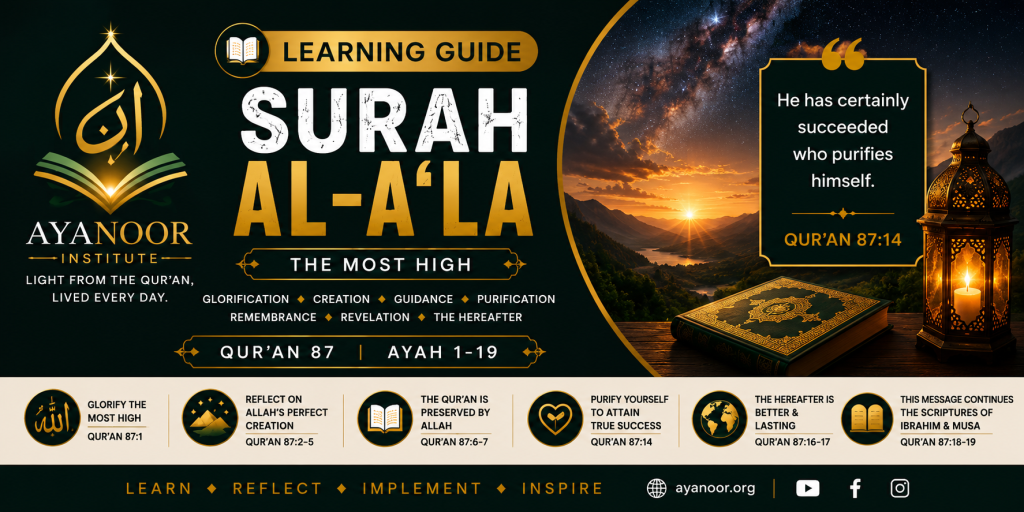
Surah Al-A‘la is the 87th chapter of the Qur’an and was revealed in Makkah. The name Al-A‘la means “The Most High,” referring to Allah’s supreme greatness, perfection, and authority over all creation.
This beautiful surah emphasizes glorifying Allah, reflecting on creation, divine guidance, purification of the soul, remembrance, revelation, and the eternal success of those who seek Allah sincerely. It also reminds humanity that the Hereafter is far better and everlasting than the temporary attractions of worldly life.
The Prophet Muhammad ﷺ frequently recited this surah in prayers such as Jumu‘ah, Eid, and Witr, highlighting its importance and powerful message.
1. Glorify the Name of Your Lord, The Most High
The surah begins:
“Glorify the name of your Lord, the Most High.”
— Qur’an 87:1
This verse calls believers to honor, praise, and remember Allah with humility and awe.
Lessons
- Allah is perfect above all نقص (imperfection).
- Glorification of Allah strengthens faith and gratitude.
- Worship begins with recognizing Allah’s greatness.
Related Qur’anic References
- “So glorify the praises of your Lord.” — Qur’an 56:74
- “To Allah belongs the highest example.” — Qur’an 16:60
2. Allah Created and Perfectly Proportioned Everything
Allah says:
“Who created and proportioned.”
— Qur’an 87:2
Allah created the universe with balance, wisdom, and precision.
Lessons
- Creation reflects divine intelligence and mercy.
- Every creature has purpose and design.
- Reflecting on nature increases certainty in Allah.
Related Qur’anic References
- “Indeed, We created everything with precise measure.” — Qur’an 54:49
- “He perfected everything which He created.” — Qur’an 32:7
3. Allah Guides Creation
Allah says:
“And Who destined and then guided.”
— Qur’an 87:3
Allah guides all creation — from animals following instinct to humans receiving revelation and conscience.
Lessons
- Guidance is one of Allah’s greatest blessings.
- Human beings need divine guidance for true success.
- The Qur’an is a mercy and roadmap for life.
Related Qur’anic References
- “Indeed this Qur’an guides to that which is most upright.” — Qur’an 17:9
- “Our Lord is He who gave each thing its form and then guided it.” — Qur’an 20:50
4. Life, Growth, and Decline
Allah describes vegetation growing and later drying out:
“And who brings out the pasture and then makes it black stubble.”
— Qur’an 87:4-5
This reflects the temporary nature of worldly life.
Lessons
- Dunya constantly changes and fades.
- Human life also passes through stages.
- Eternal success belongs to the Hereafter.
Related Qur’anic References
- “The life of this world is but amusement and diversion.” — Qur’an 57:20
- “Every soul shall taste death.” — Qur’an 3:185
5. Allah Preserved the Qur’an
Allah comforts the Prophet ﷺ:
“We will make you recite, and you will not forget.”
— Qur’an 87:6
Allah protected the Qur’an through revelation and preservation.
Lessons
- The Qur’an is divinely protected.
- Allah supports those carrying His message.
- Memorization and recitation are honored acts.
Related Qur’anic References
- “Indeed We revealed the Reminder, and surely We will preserve it.” — Qur’an 15:9
- “Falsehood cannot approach it.” — Qur’an 41:42
6. Remind, For Reminder Benefits Believers
Allah says:
“So remind, if the reminder benefits.”
— Qur’an 87:9
The Qur’an encourages believers to continue advising, teaching, and reminding others gently.
Lessons
- People constantly need reminders.
- Guidance softens hearts willing to listen.
- Teaching truth is an act of mercy.
Related Qur’anic References
- “And remind, for indeed the reminder benefits the believers.” — Qur’an 51:55
- “Invite to the way of your Lord with wisdom.” — Qur’an 16:125
7. The Humble Accept Guidance
Allah says:
“He who fears Allah will remember.”
— Qur’an 87:10
People with humility and sincerity benefit most from revelation.
Lessons
- A soft heart accepts truth more easily.
- Arrogance blocks guidance.
- Taqwa opens the door to understanding.
Related Qur’anic References
- “This is guidance for the God-conscious.” — Qur’an 2:2
- “Indeed the most noble of you in the sight of Allah is the most righteous.” — Qur’an 49:13
8. The Miserable Reject Guidance
Allah contrasts believers with those who reject truth:
“But the wretched one will avoid it.”
— Qur’an 87:11
These people turn away from remembrance despite clear signs.
Lessons
- Repeated rejection hardens the heart.
- Guidance requires sincerity and humility.
- Ignoring truth leads to spiritual loss.
Related Qur’anic References
- “Then their hearts became hardened.” — Qur’an 57:16
- “Indeed, the worst of creatures are those who do not reason.” — Qur’an 8:22
9. Success Belongs to Those Who Purify Themselves
One of the central messages of the surah:
“He has certainly succeeded who purifies himself.”
— Qur’an 87:14
Purification includes faith, worship, character, sincerity, and cleansing the heart from arrogance and sin.
Lessons
- Real success is spiritual, not merely material.
- Self-purification requires effort and consistency.
- Dhikr and salah help cleanse the heart.
Related Qur’anic References
- “Successful indeed is the one who purifies it.” — Qur’an 91:9
- “Indeed prayer prevents immorality and wrongdoing.” — Qur’an 29:45
10. The Hereafter is Better and Everlasting
Allah says:
“But you prefer the worldly life, while the Hereafter is better and more lasting.”
— Qur’an 87:16-17
This verse reminds believers to maintain perspective and prioritize eternal success.
Lessons
- Dunya is temporary.
- The Hereafter is eternal and more valuable.
- Balance is needed between worldly responsibilities and spiritual goals.
Related Qur’anic References
- “What is with Allah is better and more lasting.” — Qur’an 42:36
- “Seek through what Allah has given you the home of the Hereafter.” — Qur’an 28:77
11. The Message Continues Previous Scriptures
The surah concludes:
“Indeed, this is in the former scriptures — the scriptures of Ibrahim and Musa.”
— Qur’an 87:18-19
The core message of monotheism, purification, and accountability has always been part of divine revelation.
Lessons
- Islam continues the message of earlier prophets.
- Truth remains consistent across revelation.
- Humanity has long been called toward worship and righteousness.
Related Qur’anic References
- “He has ordained for you the same religion He ordained for Noah.” — Qur’an 42:13
- “Indeed this nation of yours is one nation.” — Qur’an 21:92
Key Themes of Surah Al-A‘la
1. Glorification of Allah
Allah is the Most High and perfect.
2. Reflection on Creation
Nature reflects divine wisdom and balance.
3. Guidance and Revelation
Allah guides humanity through revelation.
4. Purification of the Soul
True success comes through spiritual purification.
5. Reminder and Reflection
Believers benefit from reminders and remembrance.
6. The Hereafter Over Dunya
Eternal success is greater than temporary pleasure.
Reflection Questions
- How often do we glorify and remember Allah?
- Are we reflecting deeply on Allah’s creation?
- What steps are we taking to purify our hearts?
- Are worldly distractions affecting our spiritual priorities?
- How connected are we to the Qur’an and remembrance?
Practical Action Points
- Increase daily dhikr and glorification of Allah.
- Reflect regularly on nature and creation.
- Read and memorize portions of the Qur’an.
- Prioritize sincerity and purification of character.
- Balance worldly life with preparation for the Hereafter.
- Give reminders gently and wisely to others.
Conclusion
Surah Al-A‘la is a deeply uplifting chapter that reminds believers of Allah’s greatness, the beauty of creation, the importance of remembrance, and the path toward true success through purification and faith.
The surah teaches that while worldly life is temporary, the Hereafter is everlasting — and those who remember Allah, seek purification, and follow divine guidance will attain lasting peace and success.