

Introduction
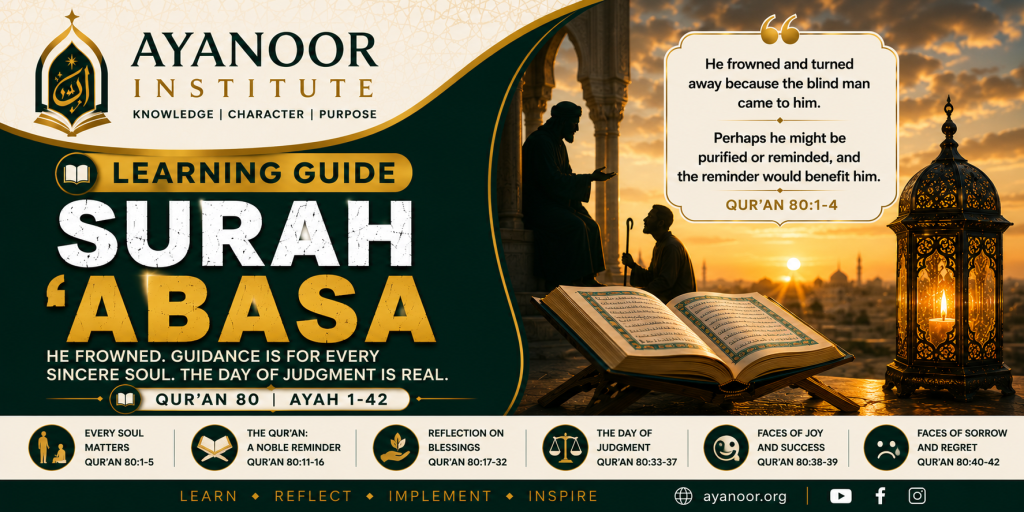
Surah ‘Abasa is the 80th chapter of the Qur’an and was revealed in Makkah. The name ‘Abasa means “He Frowned.” The surah begins with a moment in which Prophet Muhammad ﷺ was gently corrected by Allah after turning away from a blind companion, Abdullah ibn Umm Maktum رضي الله عنه, while speaking to influential leaders of Quraysh.
This surah teaches profound lessons about humility, sincerity, equality, gratitude, revelation, and the reality of the Hereafter.
1. Every Soul Matters Before Allah
The surah begins:
“He frowned and turned away because the blind man came to him.”
— Qur’an 80:1-2
The Prophet ﷺ was deeply concerned about guiding the powerful leaders of Makkah, but Allah reminded him that sincere seekers are more valuable than worldly status.
Lessons
- Human worth is not based on wealth, status, or influence.
- Sincere hearts are honored by Allah.
- Believers should treat all people with dignity and respect.
Related Qur’anic References
- “Indeed, the most noble of you in the sight of Allah is the most righteous.” — Qur’an 49:13
- “Do not turn your cheek in contempt toward people.” — Qur’an 31:18
2. The Importance of Sincere Guidance
Allah says regarding the blind companion:
“Perhaps he might be purified or reminded, and the reminder would benefit him.”
— Qur’an 80:3-4
This shows that sincere people seeking guidance deserve attention and care.
Lessons
- Guidance should be offered sincerely and compassionately.
- A humble seeker may be closer to Allah than a powerful leader.
- Dawah is about sincerity, not numbers or influence.
Related Qur’anic References
- “Indeed, you do not guide whom you love, but Allah guides whom He wills.” — Qur’an 28:56
- “Invite to the way of your Lord with wisdom.” — Qur’an 16:125
3. The Qur’an is a Noble Reminder
Allah describes the Qur’an:
“No indeed! These verses are a reminder.”
— Qur’an 80:11
The revelation is described as noble, pure, and carried by honorable angels.
Lessons
- The Qur’an is a divine gift and reminder.
- Believers should approach the Qur’an with reverence.
- Guidance requires reflection and humility.
Related Qur’anic References
- “Indeed this Qur’an guides to that which is most upright.” — Qur’an 17:9
- “A blessed Book We revealed to you so they may reflect upon its verses.” — Qur’an 38:29
4. Human Ingratitude Despite Allah’s Blessings
Allah says:
“Cursed is man; how ungrateful he is.”
— Qur’an 80:17
The surah reminds humanity of its creation from a tiny drop and the countless blessings Allah provides.
Lessons
- Human beings often forget their dependence on Allah.
- Gratitude should shape how we live.
- Reflecting on blessings strengthens faith.
Related Qur’anic References
- “If you are grateful, I will surely increase you.” — Qur’an 14:7
- “And He gave you from all you asked of Him.” — Qur’an 14:34
5. Reflection on Food and Provision
Allah asks humanity to consider its food:
“Then let mankind look at his food.”
— Qur’an 80:24
The surah describes:
- Rain sent from the sky
- Earth split open
- Crops and fruits growing
- Sustenance for humans and animals
Lessons
- Provision is a mercy from Allah.
- Everyday blessings are signs of divine care.
- Food should inspire gratitude, not wastefulness.
Related Qur’anic References
- “It is He who sends down rain from the sky.” — Qur’an 16:10
- “Eat from the good things We have provided for you.” — Qur’an 2:172
6. The Reality of the Day of Judgment
The surah then shifts toward the Hereafter:
“But when there comes the Deafening Blast.”
— Qur’an 80:33
On that Day, people will flee even from close family members because of the intensity of accountability.
Lessons
- The Hereafter is a serious reality.
- Every soul will stand individually before Allah.
- Worldly relationships cannot replace personal faith and deeds.
Related Qur’anic References
- “Every soul shall taste death.” — Qur’an 3:185
- “The Day when neither wealth nor children will benefit.” — Qur’an 26:88
7. Faces of Joy and Faces of Sorrow
Allah describes two groups on the Day of Judgment:
The Believers
“Faces that Day will be bright, laughing and rejoicing.”
— Qur’an 80:38-39
The Rejecters
“And faces that Day will have upon them dust.”
— Qur’an 80:40
Lessons
- Inner faith eventually becomes outward honor.
- True success belongs to those who obey Allah sincerely.
- The Hereafter reveals the reality hidden in this world.
Related Qur’anic References
- “Indeed, the righteous will be in pleasure.” — Qur’an 82:13
- “As for those whose faces become bright, they will be in the mercy of Allah.” — Qur’an 3:107
Key Themes of Surah ‘Abasa
1. Equality and Dignity
Every sincere soul matters before Allah.
2. Humility in Dawah
Guidance should be offered with compassion and sincerity.
3. The Qur’an as Reminder
The Qur’an is noble guidance for humanity.
4. Gratitude for Blessings
Human beings should reflect on Allah’s provisions.
5. Accountability in the Hereafter
Every person will answer for their deeds.
6. The Temporary Nature of Worldly Status
True honor comes through righteousness, not power or wealth.
Reflection Questions
- Do we judge people based on status rather than sincerity?
- How much importance do we give to the Qur’an in daily life?
- Are we grateful for Allah’s everyday blessings?
- How can we improve compassion and humility toward others?
- Are we preparing sincerely for the Hereafter?
Practical Action Points
- Treat every person with dignity and respect.
- Spend time reflecting on the Qur’an daily.
- Practice gratitude for food, health, and provision.
- Avoid arrogance or favoritism based on wealth or status.
- Increase sincerity in helping and guiding others.
- Reflect regularly on the Hereafter.
Conclusion
Surah ‘Abasa is a powerful reminder that Allah values sincerity, humility, and righteousness above worldly status. Through the gentle correction of the Prophet ﷺ, the surah teaches believers to honor every sincere seeker and to avoid judging people based on wealth or influence.
It also calls humanity to reflect on creation, provision, gratitude, and the coming Day of Judgment — a Day when true success will belong to those whose hearts were sincere before Allah.