

Introduction
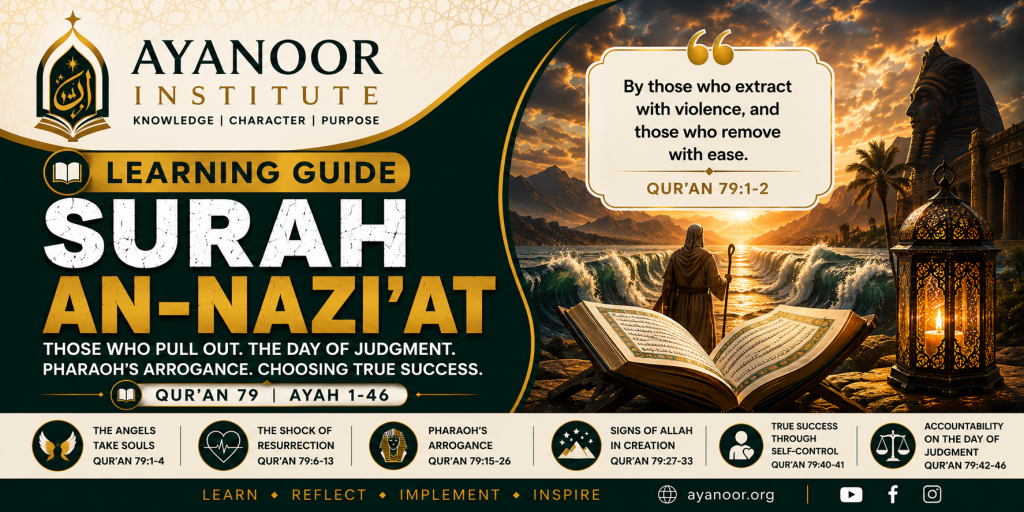
Surah An-Nazi’at is the 79th chapter of the Qur’an and was revealed in Makkah. The name An-Nazi’at means “Those Who Pull Out”, referring to the angels who remove souls at death by Allah’s command.
This surah focuses on the reality of death, resurrection, accountability, the Day of Judgment, and the consequences of arrogance. It also presents the story of Prophet Musa (Moses) عليه السلام and Pharaoh as a timeless lesson about truth, power, and humility.
1. The Reality of Death and the Angels
The surah begins with a series of oaths related to angels carrying out Allah’s commands:
“By those who extract with violence, and those who remove with ease.”
— Qur’an 79:1-2
These verses are commonly understood to refer to angels taking souls at death.
Lessons
- Death is a certainty for every soul.
- The transition from this world to the next is real.
- Life should be lived with awareness of accountability.
Related Qur’anic References
- “Every soul shall taste death.” — Qur’an 3:185
- “The Angel of Death who has been entrusted with you will take you.” — Qur’an 32:11
2. The Shock of Resurrection
Allah describes the terrifying events of the Last Day:
“Hearts that Day will tremble.”
— Qur’an 79:8
People who denied resurrection will finally realize the truth.
Lessons
- The Day of Judgment will be overwhelming.
- Human beings often become careless when they forget the Hereafter.
- Faith in the unseen shapes how believers live today.
Related Qur’anic References
- “The Trumpet will be blown.” — Qur’an 39:68
- “The Day when people will stand before the Lord of the worlds.” — Qur’an 83:6
3. The Arrogance of Pharaoh
One of the major themes of the surah is the story of Pharaoh.
Allah commanded Prophet Musa عليه السلام:
“Go to Pharaoh; indeed, he has transgressed.”
— Qur’an 79:17
Pharaoh became arrogant, oppressed people, and even claimed divinity.
“He said, ‘I am your highest lord.’”
— Qur’an 79:24
Lessons
- Arrogance destroys individuals and societies.
- Power without humility leads to corruption.
- Allah supports truth even against the strongest oppressors.
Related Qur’anic References
- “Indeed, Pharaoh exalted himself in the land.” — Qur’an 28:4
- “Allah does not love the arrogant.” — Qur’an 16:23
4. The Gentle Approach of Prophet Musa عليه السلام
Allah instructed Musa عليه السلام to speak gently even to Pharaoh:
“Speak to him with gentle speech that perhaps he may remember or fear Allah.”
— Qur’an 20:44
Lessons
- Truth should be conveyed with wisdom and dignity.
- Good character strengthens dawah (inviting toward Allah).
- Even difficult people deserve respectful communication.
Related Qur’anic References
- “Invite to the way of your Lord with wisdom and good instruction.” — Qur’an 16:125
- “Repel evil with what is better.” — Qur’an 41:34
5. Allah’s Power in Creation
The surah invites humanity to reflect on creation:
“Are you a more difficult creation or is the heaven? Allah constructed it.”
— Qur’an 79:27
Allah mentions:
- The sky
- The earth
- Night and day
- Water and vegetation
- Mountains
Lessons
- Creation itself is proof of Allah’s power.
- The One who created the universe can easily resurrect humanity.
- Reflection on nature strengthens faith.
Related Qur’anic References
- “Indeed, in the creation of the heavens and earth are signs.” — Qur’an 3:190
- “And We made from water every living thing.” — Qur’an 21:30
6. The Temporary Nature of This World
Allah says:
“But as for the one who transgressed and preferred the life of this world.”
— Qur’an 79:37-38
The surah warns against becoming consumed by worldly desires while neglecting the Hereafter.
Lessons
- Dunya (worldly life) is temporary.
- Material success without faith is incomplete.
- Eternal life should shape our priorities.
Related Qur’anic References
- “The worldly life is only enjoyment of delusion.” — Qur’an 57:20
- “Seek through what Allah has given you the home of the Hereafter.” — Qur’an 28:77
7. Success Through Self-Control
Allah contrasts worldly obsession with spiritual discipline:
“But as for the one who feared standing before his Lord and restrained the soul from desires.”
— Qur’an 79:40
Lessons
- Spiritual success requires self-control.
- The soul must be trained with discipline and remembrance of Allah.
- True freedom comes from controlling harmful desires.
Related Qur’anic References
- “Successful indeed is the one who purifies it.” — Qur’an 91:9
- “The soul constantly commands toward evil except whom my Lord has mercy upon.” — Qur’an 12:53
8. The Reality of the Hereafter
Allah describes how quickly worldly life will seem to have passed:
“It will seem as though they had remained only an evening or a morning.”
— Qur’an 79:46
Lessons
- Life passes quickly.
- The Hereafter is the true and lasting reality.
- Believers should prepare before time runs out.
Related Qur’anic References
- “The life of this world is but amusement and diversion.” — Qur’an 29:64
- “The Hour is coming; there is no doubt about it.” — Qur’an 40:59
Key Themes of Surah An-Nazi’at
1. The Reality of Death
Every soul will leave this world.
2. Resurrection and Judgment
Humanity will be brought back for accountability.
3. Arrogance vs. Humility
Pharaoh serves as a warning against pride and oppression.
4. Reflection on Creation
Nature points toward Allah’s power and wisdom.
5. Self-Discipline
Controlling desires leads to success.
6. The Temporary Nature of Dunya
Eternal life is more important than temporary pleasures.
Reflection Questions
- How often do we remember death and the Hereafter?
- Are worldly distractions affecting our relationship with Allah?
- Do we communicate truth with wisdom and gentleness?
- What desires do we struggle to control?
- Are we learning humility from the story of Pharaoh?
Practical Action Points
- Reflect regularly on the Hereafter.
- Strengthen daily prayer and Qur’an recitation.
- Practice humility in speech and behavior.
- Control harmful desires and habits.
- Spend time reflecting on Allah’s creation.
- Increase sincerity and accountability in daily life.
Conclusion
Surah An-Nazi’at is a profound reminder that death, resurrection, and accountability are unavoidable realities. Through powerful imagery and the story of Pharaoh, the surah teaches that arrogance leads to destruction while humility, discipline, and faith lead to eternal success.
It reminds believers that worldly life is brief and that true honor comes from fearing Allah, controlling the soul’s desires, and preparing sincerely for the eternal Hereafter.