

Introduction
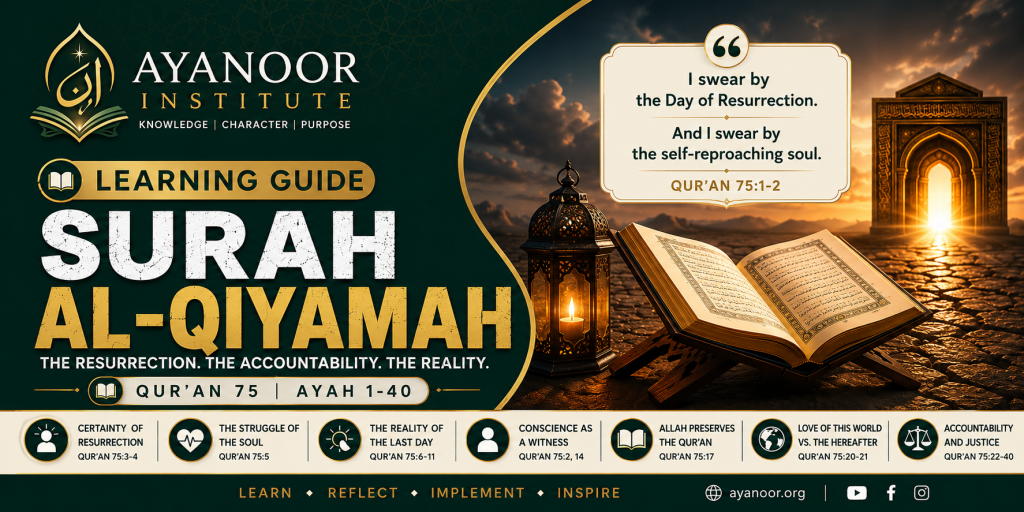
Surah Al-Qiyamah is the 75th chapter of the Qur’an and was revealed in Makkah. The word Al-Qiyamah means “The Resurrection” or “The Day of Standing.” The surah powerfully describes the certainty of life after death, human accountability, the reality of the Day of Judgment, and the inner struggle of the human soul.
This surah calls humanity to reflect deeply on death, resurrection, conscience, and our ultimate return to Allah.
1. The Certainty of Resurrection
Allah begins the surah with a solemn oath:
“I swear by the Day of Resurrection.”
— Qur’an 75:1
Allah then challenges those who deny life after death:
“Does man think that We will not assemble his bones?”
— Qur’an 75:3
Allah reminds humanity that resurrection is not difficult for Him.
“Yes indeed; We are able even to proportion his fingertips.”
— Qur’an 75:4
Lessons
- Resurrection is a certainty, not a metaphor.
- Allah’s power over creation is absolute.
- Even the smallest details of human creation are preserved by Allah.
Related Qur’anic References
- “As We began the first creation, We will repeat it.” — Qur’an 21:104
- “And He gives life to the dead.” — Qur’an 30:50
2. The Human Tendency to Delay Repentance
Allah explains one reason people deny accountability:
“But man desires to continue in sin.”
— Qur’an 75:5
People often avoid thinking about Judgment because they want unrestricted freedom without consequences.
Lessons
- Ignoring accountability can lead to moral decline.
- Constant repentance keeps the heart alive.
- The soul naturally drifts unless guided by revelation.
Related Qur’anic References
- “Do not follow desire, lest it lead you astray.” — Qur’an 38:26
- “Indeed the soul constantly commands to evil except whom my Lord has mercy upon.” — Qur’an 12:53
3. The Fear and Chaos of the Last Day
The surah vividly describes cosmic upheaval:
“When the sight is dazzled, and the moon darkens, and the sun and moon are joined.”
— Qur’an 75:7-9
Humanity will realize the seriousness of the Hereafter.
“Man will say on that Day, ‘Where is the escape?’”
— Qur’an 75:10
Lessons
- Worldly power and wealth will not save anyone.
- The Day of Judgment will expose reality completely.
- True security lies only with Allah.
Related Qur’anic References
- “Every soul shall taste death.” — Qur’an 3:185
- “The Day when neither wealth nor children will benefit.” — Qur’an 26:88
4. Human Conscience is a Witness
Allah swears by another important reality:
“And I swear by the self-reproaching soul.”
— Qur’an 75:2
This refers to the conscience that feels guilt after wrongdoing.
Lessons
- Allah placed moral awareness within human beings.
- Guilt can become a path toward repentance.
- A believer should regularly evaluate their actions.
Related Qur’anic References
- “Rather, man against himself will be a witness.” — Qur’an 75:14
- “Successful indeed is the one who purifies the soul.” — Qur’an 91:9
5. Allah Preserved the Qur’an
During revelation, Prophet Muhammad ﷺ would repeat verses quickly out of concern for preserving them. Allah reassured him:
“Indeed upon Us is its collection and its recitation.”
— Qur’an 75:17
Allah Himself guaranteed the preservation of the Qur’an.
Lessons
- The Qur’an is divinely protected.
- Revelation came with precision and care.
- Believers should listen, reflect, and follow the Qur’an patiently.
Related Qur’anic References
- “Indeed We have sent down the Reminder, and surely We will guard it.” — Qur’an 15:9
- “A blessed Book We revealed to you so they may reflect upon its verses.” — Qur’an 38:29
6. Love of This World vs. the Hereafter
Allah describes the spiritual problem of many people:
“But you love the immediate world and leave the Hereafter.”
— Qur’an 75:20-21
Temporary pleasures often distract people from eternal realities.
Lessons
- Islam does not forbid worldly life, but warns against obsession with it.
- A balanced believer prepares for both worlds.
- Priorities reveal the condition of the heart.
Related Qur’anic References
- “The worldly life is nothing but enjoyment of delusion.” — Qur’an 57:20
- “Seek through what Allah has given you the home of the Hereafter.” — Qur’an 28:77
7. Faces on the Day of Judgment
Allah contrasts two groups:
The Righteous
“Faces that Day will be radiant, looking at their Lord.”
— Qur’an 75:22-23
The Wicked
“And faces that Day will be gloomy.”
— Qur’an 75:24
Lessons
- Inner faith eventually becomes visible outwardly.
- Eternal success belongs to those who obey Allah sincerely.
- The Hereafter is the true measure of victory.
Related Qur’anic References
- “For them are glad tidings in worldly life and the Hereafter.” — Qur’an 10:64
- “Some faces that Day will be bright, laughing and rejoicing.” — Qur’an 80:38-39
8. The Reality of Death
The surah powerfully describes the final moments of life:
“No! When the soul reaches the collar bones.”
— Qur’an 75:26
At death, worldly control disappears completely.
Lessons
- Death is unavoidable.
- Human beings are weak despite worldly pride.
- Preparing for death gives life meaning and direction.
Related Qur’anic References
- “Wherever you may be, death will overtake you.” — Qur’an 4:78
- “Every soul shall taste death.” — Qur’an 29:57
9. Human Creation as Proof of Allah’s Power
Allah reminds humanity of its humble beginning:
“Was he not a drop of fluid emitted?”
— Qur’an 75:37
If Allah created humans once, resurrection is even easier.
Lessons
- Human beings should remain humble.
- Creation itself is evidence of Allah’s existence and power.
- Reflection on our origins increases gratitude.
Related Qur’anic References
- “Did We not create you from a humble fluid?” — Qur’an 77:20
- “And among His signs is that He created you from dust.” — Qur’an 30:20
Key Themes of Surah Al-Qiyamah
1. Certainty of Resurrection
Life after death is guaranteed.
2. Accountability
Every person will answer for their deeds.
3. The Role of Conscience
The soul recognizes truth internally.
4. Preservation of the Qur’an
Allah Himself protects revelation.
5. Temporary Nature of This World
Worldly life is short compared to eternity.
6. Death as a Reminder
Awareness of death purifies priorities.
Reflection Questions
- How often do we reflect on the Hereafter?
- What distractions keep us attached to temporary worldly pleasures?
- Is our conscience becoming softer or harder?
- How can we prepare spiritually for death?
- Are we living according to the guidance of the Qur’an?
Practical Action Points
- Reflect regularly on the Hereafter.
- Strengthen daily Qur’an recitation and understanding.
- Repent sincerely and consistently.
- Avoid becoming consumed by materialism.
- Perform acts of worship with awareness and humility.
- Remember death as a motivation for positive change.
Conclusion
Surah Al-Qiyamah is a profound reminder that human life is not meaningless. Allah created humanity with purpose, conscience, and accountability. The surah urges believers to rise above temporary distractions and prepare for the eternal meeting with their Lord.
It teaches that resurrection is certain, death is unavoidable, and true success belongs to those who live with faith, sincerity, and awareness of the Hereafter.