

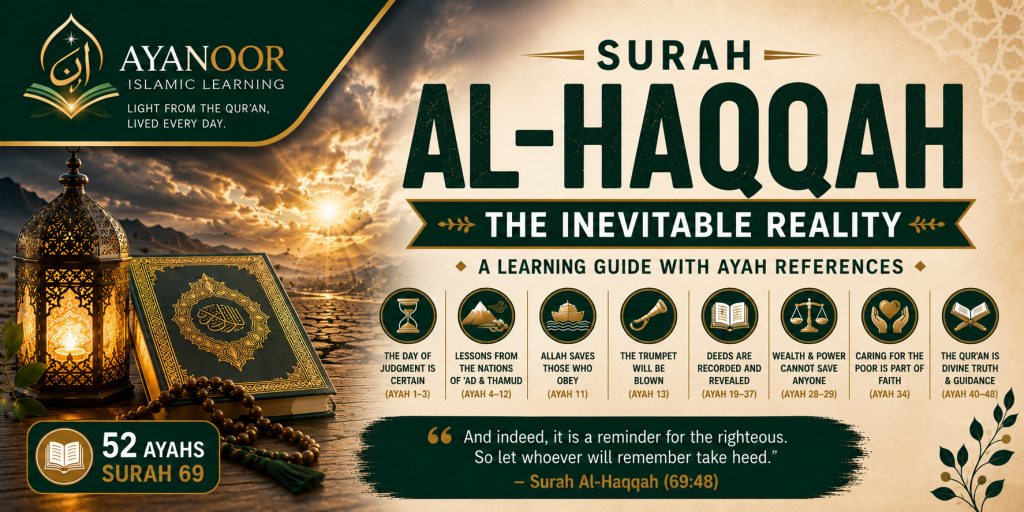
The Surah Al-Haqqah is the 69th chapter of the Qur’an, consisting of 52 ayahs. The word Al-Haqqah means “The Inevitable Reality” or “The Certain Truth,” referring to the Day of Judgment — a reality that cannot be denied or escaped.
The Surah powerfully describes the certainty of the Hereafter, the destruction of past nations who rejected truth, the accountability of every human being, and the absolute truthfulness of the Qur’an and the message of the Prophet Muhammad ﷺ.
1. The Day of Judgment Is a Certain Reality
The Surah opens dramatically:
“The Inevitable Reality! What is the Inevitable Reality? And what can make you know what the Inevitable Reality is?”
— Ayahs 1–3
Lessons
- The Day of Judgment is not imagination or myth.
- Every human being will face accountability.
- The Qur’an repeatedly awakens humanity from heedlessness.
Reflection
People often live as though life is endless and consequences are distant. The Surah reminds believers that the Hereafter is certain and unavoidable.
2. Learn From the Destruction of Past Nations
The Surah recalls nations that rejected divine guidance.
The People of Thamud and ‘Ad
“As for Thamud, they were destroyed by the overpowering blast.”
— Ayah 5
“And as for ‘Ad, they were destroyed by a furious violent wind.”
— Ayah 6
Lessons
- Arrogance and denial lead societies toward destruction.
- Power and civilization cannot protect people from Allah’s judgment.
- History contains lessons for future generations.
Reflection
The Qur’an repeatedly encourages believers to study history and recognize how injustice, pride, and corruption destroy communities.
3. The Flood of Prophet Nuh (Noah) عليه السلام
“Indeed, when the water overflowed, We carried you in the sailing ship.”
— Ayah 11
Lessons
- Allah saves those who remain faithful.
- Obedience brings protection even during overwhelming hardship.
- The stories of the Prophets are reminders for humanity.
Reflection
The ark of Nuh symbolizes faith, trust, and survival through obedience to Allah.
4. The Trumpet Will Announce the Final Hour
“Then when the Trumpet is blown with one blast…”
— Ayah 13
Lessons
- The universe itself will be transformed.
- Human power and worldly systems will collapse.
- The Hereafter marks the beginning of eternal reality.
Reflection
The Surah shifts focus away from temporary worldly distractions toward eternal accountability.
5. The Earth and Mountains Will Collapse
“And the earth and the mountains are lifted and crushed with one blow.”
— Ayah 14
Lessons
- Even the strongest parts of creation are powerless before Allah.
- The material world is temporary.
- Human beings should not become arrogant because of worldly achievements.
Reflection
The Surah humbles humanity by reminding us how fragile worldly life truly is.
6. The Records of Deeds Will Be Given
One of the most emotional parts of the Surah describes people receiving their books of deeds.
Those Receiving Their Book in the Right Hand
“Here, read my record!”
— Ayah 19
Lessons
- Righteous deeds lead to joy and success.
- Faith and sincerity are rewarded.
- Believers should live preparing for this moment.
Reflection
The successful person is not merely wealthy or famous, but someone whose deeds please Allah.
Those Receiving Their Book in the Left Hand
“Oh, I wish I had not been given my record…”
— Ayah 25
Lessons
- Regret in the Hereafter will not change reality.
- Neglecting faith and morality has consequences.
- Temporary worldly pleasures cannot save a person from accountability.
Reflection
The Surah encourages believers to correct themselves before regret becomes permanent.
7. Wealth and Power Cannot Save Anyone
The doomed person says:
“My wealth has not benefited me.”
— Ayah 28
“My authority has gone away from me.”
— Ayah 29
Lessons
- Status, wealth, and influence are temporary.
- True success belongs to faith and righteousness.
- Material possessions cannot replace spiritual preparation.
Reflection
Many people spend their lives chasing worldly status while neglecting eternal success.
8. Feeding the Poor and Caring for Society Matter
The Surah criticizes those who neglected the needy.
“Nor did he encourage the feeding of the poor.”
— Ayah 34
Lessons
- Social responsibility is part of faith.
- Compassion toward the vulnerable matters deeply.
- Wealth should be used responsibly and generously.
Reflection
Islam connects worship with caring for humanity and building compassionate societies.
9. The Qur’an Is Divine Revelation
The Surah strongly defends the authenticity of the Qur’an.
“And indeed, it is the word of a noble Messenger.”
— Ayah 40
And Allah says:
“And it is not the word of a poet…”
— Ayah 41
Lessons
- The Qur’an is divine revelation, not human invention.
- The message of Islam is based on truth and guidance.
- Revelation provides clarity in a confused world.
Reflection
The Qur’an transforms hearts, societies, and civilizations through truth and wisdom.
10. The Prophet ﷺ Did Not Invent the Message
Allah powerfully declares:
“And if he had made up about Us some false sayings…”
— Ayah 44
Lessons
- The Prophet ﷺ conveyed revelation faithfully.
- Divine revelation cannot be altered or manipulated.
- Truthfulness is central to prophethood.
Reflection
The Surah reassures believers about the authenticity and trustworthiness of the Qur’an.
11. The Qur’an Is a Reminder for the God-Conscious
The Surah concludes:
“And indeed, it is a reminder for the righteous.”
— Ayah 48
Lessons
- The Qur’an benefits hearts that are open and sincere.
- Guidance requires humility and reflection.
- Taqwa strengthens spiritual understanding.
Reflection
The Qur’an is not merely meant to be recited — it is meant to transform lives.
Major Themes of Surah Al-Haqqah
| Theme | Ayah Reference |
| The certainty of the Day of Judgment | 1–3 |
| Destruction of past nations | 4–12 |
| The blowing of the Trumpet | 13 |
| Collapse of the universe | 14–18 |
| Receiving the books of deeds | 19–37 |
| Wealth cannot save anyone | 28–29 |
| Caring for the poor | 34 |
| Truthfulness of the Qur’an | 40–43 |
| Authenticity of the Prophet ﷺ | 44–47 |
| Qur’an as a reminder | 48 |
Practical Lessons for Daily Life
Personal Growth
- Live with awareness of accountability.
- Focus on sincere deeds over worldly image.
- Practice gratitude and humility.
Family & Society
- Support the poor and vulnerable.
- Build communities based on compassion and justice.
- Learn from history and avoid arrogance.
Spiritual Development
- Reflect on the Hereafter regularly.
- Strengthen connection with the Qur’an.
- Prepare for the Day when deeds will be revealed.
Self-Reflection Questions
- Am I preparing for eternal accountability?
- What kind of record am I building?
- Do I prioritize worldly success over spiritual success?
- How do I treat the vulnerable and needy?
- Do I reflect seriously on the Qur’an’s message?
Final Reflection
The Quran powerfully awakens the heart by reminding humanity that the Day of Judgment is a certain and unavoidable reality. The Surah contrasts temporary worldly life with eternal consequences and calls believers toward humility, accountability, compassion, and sincere faith.
It teaches that:
- Every action matters
- Wealth and status will fade
- Truth will become fully clear
- The Qur’an is divine guidance
- Eternal success belongs to those who live with faith and righteousness
The Surah encourages believers to live consciously, prepare sincerely for the Hereafter, and remain firmly connected to Allah and His revelation.
Leave a Reply