
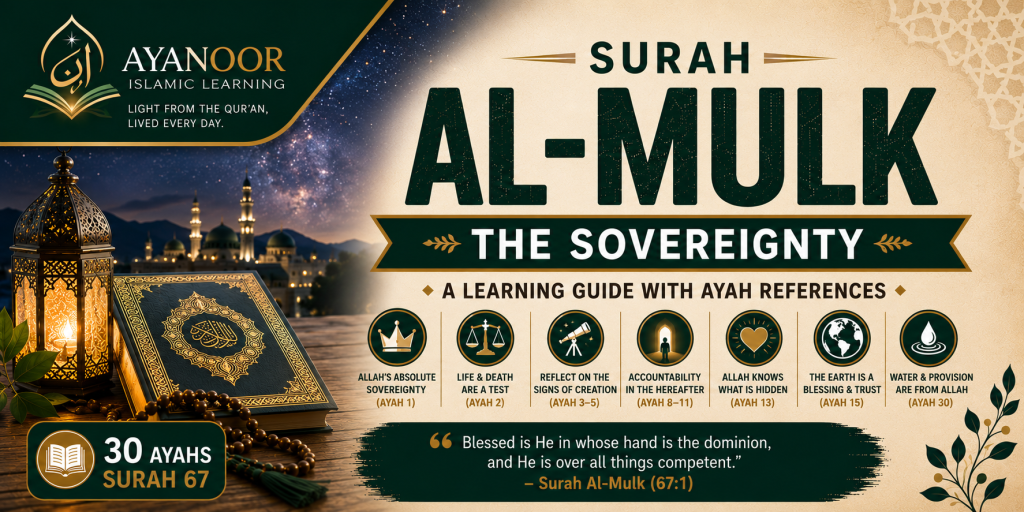
Surah Al-Mulk is the 67th chapter of the Qur’an, consisting of 30 ayahs. The word Al-Mulk means “The Kingdom” or “The Sovereignty,” emphasizing Allah’s complete authority, control, and ownership over all creation.
The Surah calls humanity to reflect deeply on life, death, creation, accountability, and the signs of Allah throughout the universe. It teaches believers to live with humility, awareness, gratitude, and preparation for the Hereafter.
⸻
1. Allah Owns All Power and Sovereignty
The Surah opens with a powerful declaration:
“Blessed is He in whose hand is the dominion, and He is over all things competent.”
— Ayah 1
Lessons
- Allah has absolute control over everything.
- Human power is temporary and limited.
- True security comes from trusting Allah.
Reflection
People often seek control through:
- Wealth
- Influence
- Status
- Technology
But the Surah reminds believers that ultimate authority belongs only to Allah.
⸻
2. Life and Death Are Tests
“He who created death and life to test you as to which of you is best in deeds…”
— Ayah 2
Lessons
- Life is a temporary test, not a permanent destination.
- Success is measured by quality of deeds, sincerity, and faith.
- Death is part of Allah’s divine plan.
Reflection
The Surah shifts the believer’s focus from:
- “How long did I live?”
to: - “How well did I live?”
⸻
3. Reflect on the Perfection of Creation
Allah repeatedly invites humanity to observe the skies.
“You do not see in the creation of the Most Merciful any inconsistency…”
— Ayah 3
And:
“Then return your vision twice again. Your vision will return humbled while it is fatigued.”
— Ayah 4
Lessons
- Creation reflects Allah’s precision and wisdom.
- Reflection strengthens faith.
- The universe operates in balance and order.
Reflection
The Qur’an encourages scientific reflection and spiritual contemplation together. The skies, stars, oceans, and natural systems are signs pointing toward the Creator.
⸻
4. The Stars Are Signs and Protection
“And We have certainly beautified the nearest heaven with lamps…”
— Ayah 5
Lessons
- The universe is both functional and beautiful.
- Beauty itself is a sign of Allah’s artistry.
- Creation serves multiple purposes beyond human understanding.
Reflection
The Surah encourages believers to appreciate:
- Beauty
- Harmony
- Design
- Balance in creation
as reminders of Allah’s greatness.
⸻
5. Accountability in the Hereafter
The Surah vividly describes the consequences for those who reject truth.
“Whenever a group is thrown into it, its keepers will ask them, ‘Did no warner come to you?’”
— Ayah 8
Lessons
- Human beings are accountable for their choices.
- Guidance was sent clearly through revelation and prophets.
- Ignoring truth carries consequences.
Reflection
The Qur’an consistently reminds believers that actions matter and life has purpose beyond worldly enjoyment.
⸻
6. Listening and Thinking Are Essential
The people of Hell regret ignoring guidance.
“And they will say, ‘If only we had listened or reasoned, we would not be among the companions of the Blaze.’”
— Ayah 10
Lessons
- Islam encourages reflection and reasoning.
- Blind arrogance leads people away from truth.
- Listening sincerely is part of wisdom.
Reflection
The Surah encourages believers to:
- Reflect deeply
- Seek knowledge
- Think critically
- Remain humble before truth
⸻
7. Allah Knows What Is Hidden
“And conceal your speech or publicize it; indeed, He is Knowing of that within the hearts.”
— Ayah 13
Lessons
- Allah knows thoughts, intentions, and hidden emotions.
- Sincerity matters deeply in Islam.
- Nothing is hidden from Allah.
Reflection
This awareness encourages believers to purify:
- Intentions
- Character
- Speech
- Private behavior
not just outward actions.
⸻
8. The Earth Is a Blessing and Trust
“It is He who made the earth manageable for you, so walk among its slopes and eat of His provision…”
— Ayah 15
Lessons
- The earth is a gift from Allah.
- Humans should use resources responsibly.
- Provision ultimately comes from Allah.
Reflection
Believers are encouraged to balance:
- Effort and trust
- Productivity and gratitude
- Progress and responsibility
⸻
9. Human Security Is Fragile
The Surah repeatedly asks humanity to reflect on how vulnerable people truly are.
“Or who is it that could provide for you if He withheld His provision?”
— Ayah 21
Lessons
- Human beings are deeply dependent on Allah.
- Wealth and systems cannot guarantee security.
- Gratitude should replace arrogance.
Reflection
Modern societies often feel self-sufficient, but the Surah reminds believers how quickly circumstances can change.
⸻
10. The Blindness of the Heart
Allah compares someone walking correctly with someone stumbling blindly.
“Then is one who walks fallen on his face better guided or one who walks upright on a straight path?”
— Ayah 22
Lessons
- Guidance gives clarity and balance.
- Spiritual blindness causes confusion and misdirection.
- Revelation illuminates life’s path.
Reflection
The Qur’an provides believers with:
- Moral direction
- Spiritual purpose
- Ethical guidance
- Inner stability
⸻
11. Gratitude for Human Abilities
“Say, ‘It is He who produced you and made for you hearing and vision and hearts; little are you grateful.’”
— Ayah 23
Lessons
- Human senses and intellect are blessings.
- Gratitude should lead to obedience and reflection.
- Many blessings are taken for granted.
Reflection
The Surah encourages believers to appreciate:
- Hearing
- Sight
- Intelligence
- Emotions
- Life itself
as gifts from Allah.
⸻
12. The Surah Ends With a Powerful Reminder About Water
The Surah concludes with a profound question:
“Say, ‘Have you considered: if your water was to become sunken into the earth, then who could bring you flowing water?’”
— Ayah 30
Lessons
- Basic necessities are blessings from Allah.
- Human beings are more dependent than they realize.
- Gratitude and humility are essential.
Reflection
Water — something often overlooked — becomes a sign of Allah’s mercy and human dependence.
⸻
Major Themes of Surah Al-Mulk
| Theme | Ayah Reference |
| Allah’s sovereignty | 1 |
| Life and death as tests | 2 |
| Reflection on creation | 3–5 |
| Accountability in the Hereafter | 6–11 |
| Thinking and reasoning | 10 |
| Allah’s knowledge of hearts | 13 |
| Earth and provision | 15 |
| Human dependence on Allah | 21 |
| Guidance versus blindness | 22 |
| Gratitude for blessings | 23 |
| Water as a sign of mercy | 30 |
⸻
Practical Lessons for Daily Life
Spiritual Growth
- Reflect on creation regularly.
- Strengthen awareness of Allah’s presence.
- Prepare sincerely for the Hereafter.
Personal Development
- Practice gratitude daily.
- Use intellect and reasoning responsibly.
- Purify intentions and private actions.
Society & Environment
- Respect the earth and its resources.
- Avoid arrogance and self-sufficiency.
- Recognize human dependence upon Allah.
⸻
Self-Reflection Questions
- Do I reflect deeply on Allah’s creation?
- Am I living with awareness of accountability?
- How grateful am I for everyday blessings?
- Do I use my knowledge and abilities wisely?
- Am I preparing for eternal life or only worldly success?
⸻
Final Reflection
The Quran reminds believers that Allah alone owns all power, life, death, and provision. The Surah awakens the heart through reflection on creation, accountability, and human dependence upon Allah.
It teaches believers to:
- Live thoughtfully
- Reflect deeply
- Remain humble
- Prepare for the Hereafter
- Appreciate Allah’s countless blessings
Through its powerful imagery and repeated calls to reflection, the Surah transforms ordinary experiences — the sky, the earth, water, life, and death — into reminders of Allah’s greatness and mercy.
Leave a Reply