

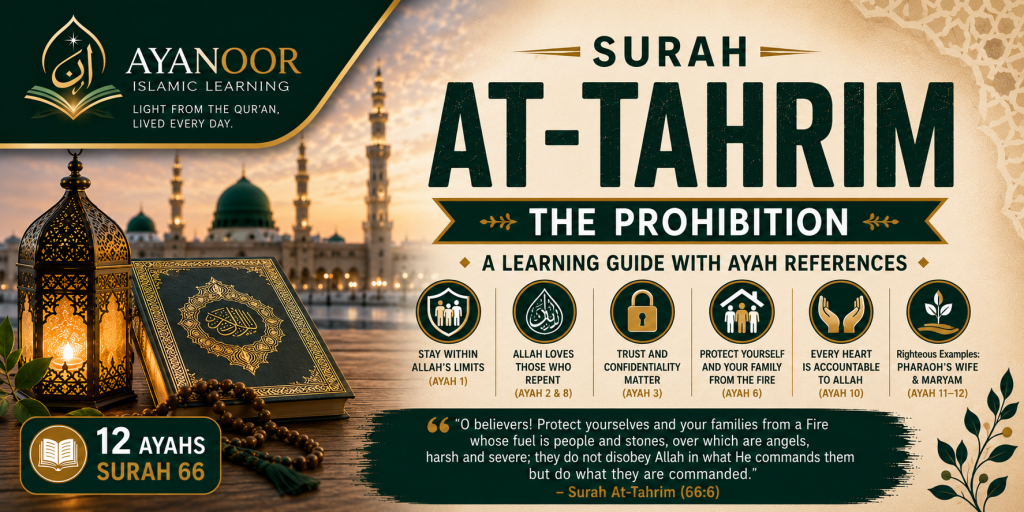
Surah At-Tahrim is the 66th chapter of the Qur’an, consisting of 12 ayahs. The Surah focuses on personal integrity, family responsibility, sincere repentance, trust, loyalty, and the importance of protecting faith within the home and society.
Although the Surah begins with an incident involving the Prophet Muhammad ﷺ and his household, its lessons are universal for all believers. It teaches balance between personal relationships and obedience to Allah while emphasizing spiritual accountability for every individual.
1. Do Not Make Forbidden What Allah Has Made Lawful
The Surah opens with Allah addressing the Prophet ﷺ:
“O Prophet! Why do you prohibit what Allah has made lawful for you, seeking to please your wives?”
— Ayah 1
Lessons
- Pleasing people should never lead to compromising divine guidance.
- Islam encourages balance and moderation.
- Even sincere intentions must remain within Allah’s boundaries.
Reflection
People sometimes:
- Suppress truth to avoid conflict
- Compromise principles for approval
- Make life unnecessarily difficult
The Surah reminds believers that Allah’s guidance should remain the highest standard.
2. Allah Encourages Repentance and Mercy
“Allah has already ordained for you the dissolution of your oaths…”
— Ayah 2
Lessons
- Islam provides practical solutions when mistakes happen.
- Allah’s mercy remains open through repentance.
- Believers should not remain trapped in guilt after sincere repentance.
Reflection
Human beings make mistakes, but Islam emphasizes correction, growth, and returning to Allah with sincerity.
3. Trust and Confidentiality Matter
The Surah describes a private matter that was disclosed within the Prophet’s household.
“And when the Prophet confided a matter to one of his wives…”
— Ayah 3
Lessons
- Trust is sacred in relationships.
- Betraying confidences damages families and communities.
- Communication should be handled with honesty and wisdom.
Reflection
Healthy relationships require:
- Trust
- Respect
- Emotional maturity
- Responsible communication
4. Believers Must Support Truth and Righteousness
Allah warns against alliances that weaken faith and obedience.
“If you both turn in repentance to Allah, then your hearts have inclined…”
— Ayah 4
Lessons
- Relationships should strengthen faith, not weaken it.
- Sincere repentance restores spiritual balance.
- Emotional closeness should not justify wrongdoing.
Reflection
A healthy family environment encourages:
- Worship
- Good character
- Honesty
- Accountability
- Spiritual growth
5. Protect Yourself and Your Family Spiritually
One of the most powerful teachings in the Surah is:
“O believers! Protect yourselves and your families from a Fire whose fuel is people and stones…”
— Ayah 6
Lessons
- Spiritual leadership begins within the home.
- Parents and families share responsibility for moral guidance.
- Faith must be nurtured intentionally.
Reflection
Protecting families includes:
- Teaching Qur’an and values
- Encouraging prayer
- Building healthy environments
- Guarding against harmful influences
6. Sincere Repentance Cleanses the Heart
“O believers! Turn to Allah in sincere repentance…”
— Ayah 8
Lessons
- Tawbah (repentance) must be sincere and heartfelt.
- Allah loves those who return to Him honestly.
- Repentance brings spiritual renewal and hope.
Reflection
True repentance includes:
- Regret for wrongdoing
- Seeking forgiveness
- Correcting behavior
- Intention not to repeat the mistake
7. Every Person Is Responsible for Their Own Faith
The Surah gives examples of righteous and unrighteous individuals.
Allah mentions:
- The wives of Prophets Nuh and Lut as examples of disbelief despite being close to righteous men.
- The wife of Pharaoh as an example of faith despite living with oppression.
- Maryam (Mary) عليها السلام as an example of purity and devotion.
“Allah presents an example of those who believed: the wife of Pharaoh…”
— Ayah 11
“And Mary, the daughter of ‘Imran…”
— Ayah 12
Lessons
- Faith is a personal responsibility.
- Family background alone does not guarantee righteousness.
- A believer can remain spiritually strong even in difficult environments.
Reflection
The Surah teaches believers not to rely solely on:
- Family status
- Community identity
- Religious labels
True faith requires personal sincerity and commitment.
8. The Wife of Pharaoh: A Model of Faith Under Pressure
The wife of Pharaoh made a beautiful dua:
“My Lord, build for me near You a house in Paradise…”
— Ayah 11
Lessons
- True faith can survive oppression and hardship.
- Spiritual strength matters more than worldly comfort.
- Believers should prioritize closeness to Allah above worldly status.
Reflection
The wife of Pharaoh lived in luxury but chose faith over power and comfort. Her example teaches courage, sincerity, and spiritual independence.
9. Maryam (Mary) as a Symbol of Purity and Faith
Allah honors Maryam عليها السلام for her devotion and purity.
“And Mary, the daughter of ‘Imran, who guarded her chastity…”
— Ayah 12
Lessons
- Purity, sincerity, and worship are honored by Allah.
- Spiritual excellence is achievable through faith and devotion.
- Women hold honored positions in the Qur’an as examples for humanity.
Reflection
Maryam’s story teaches believers:
- Patience during trials
- Trust in Allah
- Strength through worship
- Dignity and faithfulness
Major Themes of Surah At-Tahrim
| Theme | Ayah Reference |
| Staying within Allah’s limits | 1 |
| Repentance and mercy | 2 |
| Trust and confidentiality | 3 |
| Supporting righteousness | 4–5 |
| Protecting families spiritually | 6 |
| Sincere repentance | 8 |
| Personal accountability in faith | 10–12 |
| Example of Pharaoh’s wife | 11 |
| Example of Maryam | 12 |
Practical Lessons for Daily Life
Personal Growth
- Avoid compromising principles to please others.
- Make sincere repentance a regular habit.
- Guard your speech and trustworthiness.
Family & Relationships
- Build spiritually healthy homes.
- Encourage prayer, honesty, and good character.
- Protect family relationships through trust and wisdom.
Spiritual Development
- Strengthen personal accountability before Allah.
- Remember that faith requires action and sincerity.
- Learn from the righteous examples in the Qur’an.
Self-Reflection Questions
- Do I compromise truth to please others?
- Am I trustworthy with private matters?
- How am I protecting my family spiritually?
- Is my repentance sincere and consistent?
- Am I taking personal responsibility for my faith?
Final Reflection
The Quran teaches believers that true faith requires sincerity, accountability, repentance, and moral courage. The Surah reminds humanity that relationships, family ties, and social pressures should never overpower obedience to Allah.
Its examples of the wife of Pharaoh and Maryam عليها السلام show that true honor comes through faith, purity, and closeness to Allah — not through status, wealth, or surroundings.
The Surah calls believers to:
- Protect their homes spiritually
- Build relationships based on trust and righteousness
- Repent sincerely
- Remain loyal to truth
- Strengthen their connection with Allah in every situation
Leave a Reply