

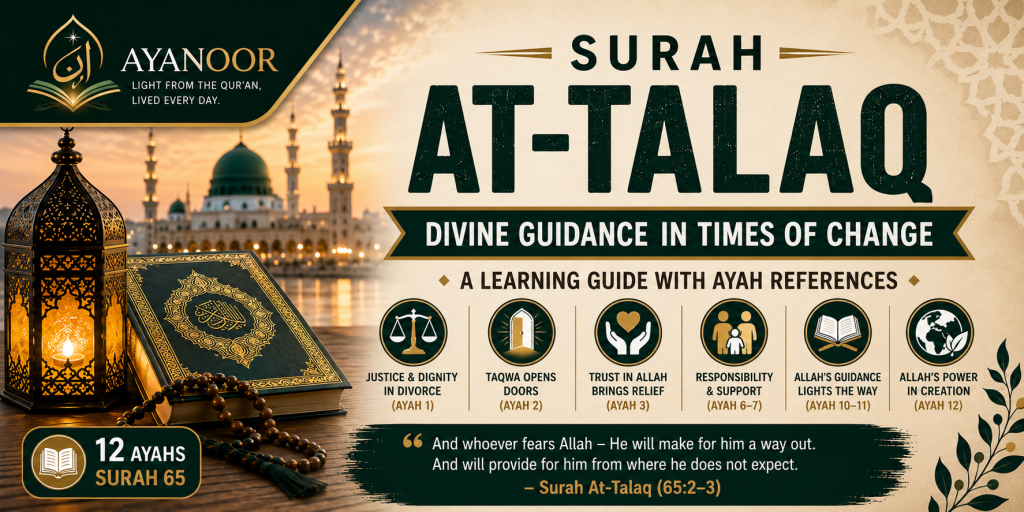
Surah At-Talaq is the 65th chapter of the Qur’an, consisting of 12 ayahs. The Surah provides guidance regarding divorce, family responsibilities, justice, patience, trust in Allah, and maintaining dignity and compassion during difficult transitions in life.
Although the Surah discusses divorce laws, its message extends far beyond legal rulings. It teaches believers how to act with taqwa (God-consciousness), fairness, mercy, and trust in Allah during emotionally challenging situations.
1. Divorce Must Be Handled With Justice and Respect
The Surah begins with detailed guidance about divorce procedures.
“O Prophet! When you divorce women, divorce them for their waiting period and keep count of the waiting period…”
— Ayah 1
Lessons
- Islam discourages impulsive and emotionally harmful separations.
- Even during conflict, dignity and fairness must remain.
- Divorce should follow clear ethical and spiritual principles.
Reflection
The Surah teaches believers that relationships should never be destroyed through:
- Anger
- Revenge
- Humiliation
- Injustice
Even separation must be handled responsibly and compassionately.
2. Do Not Oppress or Expel One Another
“Do not turn them out of their homes, nor should they leave…”
— Ayah 1
Lessons
- Emotional and financial abuse are discouraged.
- Stability and protection are important during the waiting period.
- Islam safeguards the dignity and rights of both parties.
Reflection
The Qur’an emphasizes humanity and mercy even in painful circumstances. Families should avoid turning personal conflict into cruelty.
3. Taqwa (God-Consciousness) Opens Doors
One of the most famous teachings of the Surah is repeated several times:
“And whoever fears Allah — He will make for him a way out.”
— Ayah 2
And:
“And He will provide for him from where he does not expect…”
— Ayah 3
Lessons
- Taqwa brings guidance, relief, and unexpected solutions.
- Allah helps those who remain conscious of Him during hardship.
- Faith transforms difficult situations into opportunities for growth.
Reflection
These verses apply not only to divorce but to every challenge in life:
- Financial stress
- Family conflict
- Emotional hardship
- Uncertainty about the future
The Surah teaches believers to rely upon Allah while taking responsible action.
4. Trust in Allah Brings Strength
“And whoever relies upon Allah — then He is sufficient for him.”
— Ayah 3
Lessons
- Tawakkul (trust in Allah) does not mean passivity.
- Believers should take practical steps while placing their hearts in Allah’s care.
- Allah’s wisdom is greater than human plans.
Reflection
When life becomes uncertain, people often become overwhelmed with fear. The Surah reminds believers that Allah remains fully aware and fully in control.
5. Islam Protects Financial Rights and Responsibilities
The Surah discusses financial support and fair treatment after separation.
“Lodge them where you dwell, according to your means…”
— Ayah 6
And:
“Let the wealthy spend according to his wealth, and the one whose provision is restricted should spend from what Allah has given him…”
— Ayah 7
Lessons
- Financial responsibility remains important after separation.
- Justice should reflect both compassion and practicality.
- Wealth should never become a tool for oppression.
Reflection
Islam encourages fairness and balance:
- No neglect
- No exploitation
- No unnecessary hardship
Family systems should be built upon mercy and responsibility.
6. Allah Does Not Burden Beyond Capacity
“Allah does not burden a soul beyond what He has given it…”
— Ayah 7
Lessons
- Allah understands every individual’s circumstances.
- Difficulties are matched with divine wisdom and capacity.
- Believers should avoid unrealistic expectations of themselves and others.
Reflection
During hardship, believers should remember:
- Healing takes time
- Patience is part of faith
- Allah knows hidden struggles
7. Learn From the Fate of Past Nations
The Surah warns humanity by reminding them about previous communities that ignored Allah’s guidance.
“And how many a city rebelled against the command of its Lord and His messengers…”
— Ayah 8
Lessons
- Societies decline when justice and morality collapse.
- Ignoring divine guidance leads to consequences.
- Accountability exists for both individuals and communities.
Reflection
The Qur’an consistently encourages believers to reflect on history and learn from the rise and fall of civilizations.
8. Allah Sent Revelation as Light and Guidance
“Allah has certainly sent down to you a reminder — a Messenger reciting to you the clear verses of Allah…”
— Ayahs 10–11
Lessons
- The Qur’an is guidance during confusion and hardship.
- Revelation brings people from darkness into light.
- Spiritual guidance is essential for healthy families and societies.
Reflection
Modern societies often focus heavily on laws and systems while neglecting spiritual and moral foundations. The Surah reminds believers that true balance requires divine guidance.
9. Reflect on Allah’s Power in Creation
The Surah ends by reminding believers of Allah’s complete authority and knowledge.
“Allah is the One who created seven heavens and of the earth the like of them…”
— Ayah 12
Lessons
- Allah’s power extends across all creation.
- Human struggles exist within Allah’s vast wisdom and control.
- Reflection on creation strengthens trust and humility.
Reflection
Even personal hardships become easier to bear when believers recognize Allah’s greatness, wisdom, and mercy.
Major Themes of Surah At-Talaq
| Theme | Ayah Reference |
| Justice in divorce | 1 |
| Protecting dignity and rights | 1–2 |
| Taqwa brings solutions | 2 |
| Trust in Allah | 3 |
| Financial fairness and responsibility | 6–7 |
| Allah does not burden beyond capacity | 7 |
| Lessons from past nations | 8–9 |
| Revelation as guidance | 10–11 |
| Allah’s power in creation | 12 |
Practical Lessons for Daily Life
Family & Relationships
- Handle conflict with dignity and fairness.
- Avoid emotional cruelty during disagreements.
- Practice patience, forgiveness, and responsibility.
Personal Growth
- Develop taqwa during difficult moments.
- Trust Allah even when the future feels uncertain.
- Balance emotions with wisdom and self-control.
Spiritual Life
- Turn to the Qur’an during hardship.
- Increase reliance upon Allah through prayer and remembrance.
- Reflect on Allah’s wisdom in every situation.
Self-Reflection Questions
- How do I behave during conflict or stress?
- Do I trust Allah during uncertainty?
- Am I fair and compassionate toward others?
- Do I let emotions overpower wisdom?
- How can I strengthen taqwa in daily life?
Final Reflection
The Quran teaches believers that even in painful situations, Islam calls for dignity, justice, mercy, and trust in Allah. The Surah transforms moments of conflict into opportunities for spiritual growth, patience, and self-accountability.
Its repeated reminders about taqwa and reliance upon Allah provide comfort to every believer facing uncertainty or hardship.
The Surah teaches that:
- Allah opens doors during difficulty
- Patience leads to relief
- Compassion strengthens families
- Justice protects society
- True peace comes through trust in Allah and obedience to His guidance
Leave a Reply