

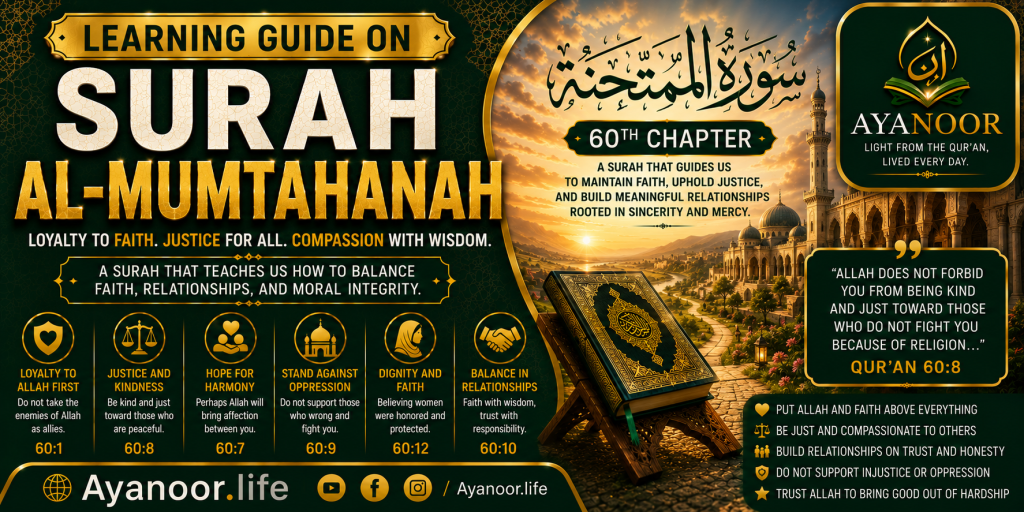
A Learning Guide on Loyalty, Justice, Relationships, Faith, and Moral Balance
Surah Al-Mumtahanah (“The Woman to Be Examined”) is the 60th chapter of the Qur’an and is a deeply practical Surah focused on:
- loyalty to faith,
- balancing emotions with principles,
- justice toward others,
- dealing with difficult relationships,
- and maintaining moral integrity during social and political tension.
The Surah was revealed during a sensitive period when Muslims faced hostility and persecution from the Quraysh of Makkah. It teaches believers how to:
- remain principled without becoming unjust,
- maintain faith without hatred,
- and uphold morality even during conflict.
One of the Surah’s most beautiful teachings is that Islam does not command hatred toward all non-Muslims, but rather distinguishes between:
- those who oppress and attack,
- and those who live peacefully and fairly.
Surah Al-Mumtahanah teaches believers to balance:
- faith with compassion,
- loyalty with justice,
- and emotional relationships with spiritual principles.
1. Faith Should Come Before Compromising Principles
The Surah begins by warning believers not to compromise faith out of emotional attachment or fear.
“O you who believe, do not take My enemies and your enemies as allies…”
— Qur’an 60:1
This verse addressed situations where some individuals allowed personal ties to weaken loyalty to truth and justice.
Reflection
The Surah teaches believers that:
- relationships matter,
- but principles matter more.
Faith requires moral clarity even when emotions become difficult.
People sometimes compromise:
- truth,
- ethics,
- or integrity
for: - approval,
- social acceptance,
- or worldly comfort.
Surah Al-Mumtahanah teaches believers to remain principled with wisdom and balance.
2. Prophet Ibrahim عليه السلام Is Presented as a Model of Faith
Allah presents Prophet Ibrahim عليه السلام as an example of sincerity and moral courage.
“There has already been for you an excellent example in Ibrahim…”
— Qur’an 60:4
Ibrahim remained loyal to Allah even when facing rejection from his own people.
Reflection
True faith sometimes requires:
- standing firm respectfully,
- maintaining principles peacefully,
- and remaining sincere despite pressure.
The Surah teaches believers to combine:
- strength in faith,
- with wisdom and good character.
3. Islam Encourages Justice and Kindness Toward Peaceful People
One of the most important verses in the Surah states:
“Allah does not forbid you from being kind and just toward those who do not fight you because of religion…”
— Qur’an 60:8
Reflection
This verse establishes a foundational Islamic principle:
- justice,
- kindness,
- fairness,
- and good treatment
are encouraged toward people who live peacefully.
Islam does not teach blind hostility toward others.
The Surah distinguishes clearly between:
- oppression and peaceful coexistence,
- aggression and fairness.
This verse encourages believers to build relationships based upon:
- justice,
- compassion,
- dignity,
- and ethical conduct.
4. Oppression and Aggression Should Not Be Supported
Allah warns against supporting those who:
- persecute believers,
- expel people unjustly,
- or actively fight truth.
“Allah only forbids you from those who fight you because of religion…”
— Qur’an 60:9
Reflection
The Surah teaches balance:
- believers should remain compassionate and fair,
- but should not support oppression or injustice.
This principle applies universally:
- stand against ظلم (oppression),
- even when emotionally difficult.
5. Believers Must Be Careful About Trust and Confidential Matters
Part of the Surah addresses sensitive political and social trust during conflict.
Reflection
The Surah teaches:
- responsibility,
- discretion,
- and trustworthiness.
Strong communities require:
- honesty,
- reliability,
- and protection of sensitive matters.
Carelessness in speech or communication can harm individuals and societies.
6. Allah Can Transform Hostility into Love
One of the most hopeful verses in the Surah states:
“Perhaps Allah will place affection between you and those whom you consider enemies…”
— Qur’an 60:7
Reflection
Relationships and circumstances can change dramatically through:
- guidance,
- mercy,
- wisdom,
- and forgiveness.
The Qur’an encourages believers not to become consumed by hatred or bitterness.
Allah has the power to:
- soften hearts,
- heal divisions,
- and transform enemies into allies.
7. Women’s Dignity and Faith Were Protected
The Surah discusses believing women who migrated from Makkah and emphasizes their protection and dignity.
Reflection
Islam values:
- women’s faith,
- moral agency,
- and personal dignity.
The Surah demonstrates that women were recognized as independent moral individuals responsible before Allah.
8. Faith Requires Both Emotional and Moral Discipline
Surah Al-Mumtahanah repeatedly teaches believers to balance:
- emotions,
- loyalty,
- relationships,
- and principles.
Reflection
Human beings naturally form emotional attachments, but the Qur’an teaches that:
- emotions should not override justice,
- nor weaken commitment to truth and morality.
True faith requires emotional maturity.
9. Believers Should Live with Hope and Wisdom
The Surah repeatedly combines:
- caution,
- wisdom,
- mercy,
- and hope.
Reflection
Islam is not a religion of emotional extremism.
Surah Al-Mumtahanah teaches believers to:
- think carefully,
- act justly,
- remain compassionate,
- and trust Allah’s wisdom.
Practical Lessons from Surah Al-Mumtahanah
Personal Lessons
- Stay principled during pressure
- Balance emotions with morality
- Remain fair and compassionate
- Avoid supporting oppression
- Build trustworthiness and integrity
Family Lessons
- Build homes rooted in faith and justice
- Encourage emotional maturity
- Maintain healthy boundaries with wisdom
- Teach children fairness and respect
Community Lessons
- Justice must apply universally
- Peaceful coexistence is encouraged
- Oppression should never be supported
- Communities require trust and honesty
Spiritual Lessons
- Loyalty to Allah comes first
- Faith requires wisdom and balance
- Allah can soften hearts and heal divisions
- True believers remain principled and compassionate
Important Ayahs for Reflection
Loyalty to Faith
“Do not take My enemies and your enemies as allies…”
— Qur’an 60:1
Example of Ibrahim
“There has already been for you an excellent example in Ibrahim…”
— Qur’an 60:4
Hope for Reconciliation
“Perhaps Allah will place affection between you…”
— Qur’an 60:7
Kindness and Justice
“Allah does not forbid you from being kind and just…”
— Qur’an 60:8
Avoid Supporting Oppression
“Allah only forbids you from those who fight you…”
— Qur’an 60:9
Questions for Reflection
- Do I compromise principles because of emotional pressure?
- Am I fair and compassionate toward others?
- How do I balance relationships with moral responsibility?
- Do I stand against injustice consistently?
- Am I trustworthy with sensitive matters?
- Do I believe Allah can heal broken relationships and hearts?
Conclusion
Surah Al-Mumtahanah is a profound guide about:
- loyalty,
- justice,
- emotional balance,
- trust,
- and moral integrity.
The Surah teaches believers that:
- faith requires principles,
- justice must remain universal,
- and compassion should exist alongside moral clarity.
It reminds humanity that:
- oppression should never be supported,
- peaceful coexistence is encouraged,
- and Allah can transform hostility into reconciliation and mercy.
Above all, Surah Al-Mumtahanah calls believers to become people who live with:
- wisdom,
- sincerity,
- fairness,
- emotional maturity,
- and unwavering loyalty to truth and Allah.