

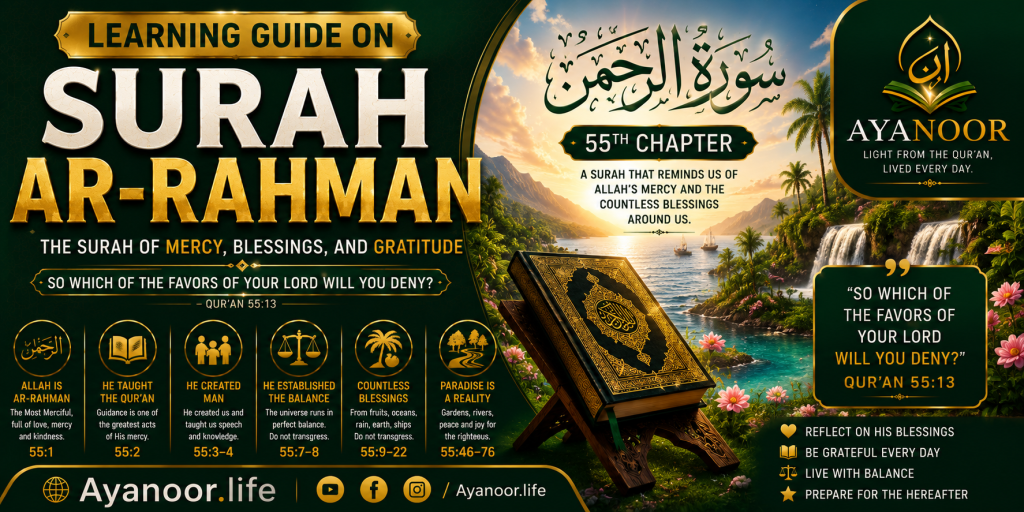
A Learning Guide on Mercy, Balance, Gratitude, Creation, and the Blessings of Allah
Surah Ar-Rahman is the 55th chapter of the Qur’an and is one of the most beautiful and emotionally powerful Surahs in the entire Qur’an. It is often called:
“The Surah of Mercy”
because it begins with one of Allah’s greatest names:
“Ar-Rahman” — The Most Merciful
— Qur’an 55:1
The Surah continuously reminds humanity and jinn about:
- Allah’s mercy,
- the blessings of creation,
- the balance of the universe,
- the reality of accountability,
- and the beauty of Paradise.
Throughout the Surah, Allah repeatedly asks:
“So which of the favors of your Lord will you deny?”
— Repeated throughout Surah Ar-Rahman
This repeated verse becomes the heartbeat of the Surah — awakening gratitude, reflection, and humility.
1. Allah’s Mercy Comes Before Everything
The Surah begins simply and powerfully:
“The Most Merciful.”
— Qur’an 55:1
Immediately after mentioning His mercy, Allah says:
“He taught the Qur’an.”
— Qur’an 55:2
This teaches that one of Allah’s greatest acts of mercy is guidance itself.
Reflection
People often think mercy only means:
- wealth,
- comfort,
- or protection from hardship.
But the Qur’an teaches that true mercy includes:
- guidance,
- wisdom,
- purpose,
- forgiveness,
- and spiritual awakening.
The Qur’an itself is a mercy for humanity.
2. Human Beings Were Created with the Ability to Learn and Communicate
Allah says:
“He created man.”
— Qur’an 55:3
“He taught him speech.”
— Qur’an 55:4
Reflection
The ability to:
- communicate,
- express emotions,
- think,
- and understand
is itself a remarkable blessing.
Language allows humanity to:
- build relationships,
- transfer knowledge,
- teach generations,
- and worship Allah consciously.
Many blessings become invisible simply because they are constant.
Surah Ar-Rahman teaches believers to notice what they usually overlook.
3. The Universe Operates with Perfect Balance
Allah says:
“And the sky He raised and established the balance.”
— Qur’an 55:7
“So do not transgress within the balance.”
— Qur’an 55:8
Reflection
Allah created:
- ecosystems,
- seasons,
- oceans,
- planets,
- and human life
with incredible precision and balance.
The Surah teaches humanity not to disturb this balance through:
- injustice,
- greed,
- corruption,
- exploitation,
- and excess.
This applies both spiritually and socially.
Healthy lives require balance between:
- work and worship,
- ambition and humility,
- strength and mercy,
- dunya and akhirah.
4. Nature Is Filled with Signs and Blessings
The Surah beautifully mentions:
- fruits,
- palm trees,
- grains,
- herbs,
- pearls,
- oceans,
- ships,
- and stars.
“And the earth He laid out for the creatures.”
— Qur’an 55:10
Reflection
Surah Ar-Rahman invites believers to observe nature not merely as scenery, but as signs of Allah’s care and generosity.
Every element of creation points toward:
- wisdom,
- provision,
- beauty,
- and mercy.
The Qur’an teaches gratitude through observation.
5. Human Beings and Jinn Are Both Accountable
The Surah repeatedly addresses both:
- mankind,
- and jinn.
Allah reminds all creation that worldly life is temporary.
“Everyone upon the earth will perish.”
— Qur’an 55:26
“And there will remain the Face of your Lord…”
— Qur’an 55:27
Reflection
People often become attached to:
- wealth,
- beauty,
- status,
- and temporary success.
But Surah Ar-Rahman teaches that everything worldly eventually fades except Allah.
This develops:
- humility,
- perspective,
- and sincerity.
6. Accountability Before Allah Is Certain
The Surah describes scenes of the Day of Judgment and reminds humanity that every person will stand before Allah.
Reflection
The repeated reminders of accountability are balanced with reminders of mercy.
Islam creates balance between:
- hope,
- fear,
- gratitude,
- and responsibility.
7. Paradise Is Described with Beauty and Peace
One of the most beautiful parts of Surah Ar-Rahman is the description of Paradise.
Allah describes:
- flowing rivers,
- gardens,
- fruits,
- shade,
- peace,
- and joy.
“For whoever fears standing before his Lord are two gardens.”
— Qur’an 55:46
Reflection
The descriptions of Paradise are not merely about luxury — they symbolize:
- peace,
- fulfillment,
- emotional comfort,
- and eternal security.
The Surah teaches believers to strive for eternal success rather than temporary worldly distraction.
8. Gratitude Is a Central Theme of the Surah
The repeated verse:
“So which of the favors of your Lord will you deny?”
— Repeated throughout Surah Ar-Rahman
appears over and over again to awaken gratitude.
Reflection
Human beings often focus more on:
- what they lack,
- their hardships,
- or comparisons with others,
while forgetting countless blessings already surrounding them.
Surah Ar-Rahman trains the heart to notice:
- mercy,
- beauty,
- provision,
- guidance,
- relationships,
- and spiritual gifts.
Gratitude transforms perspective.
9. Allah Is Constantly Managing Creation
Allah says:
“Every day He is bringing about a matter.”
— Qur’an 55:29
Reflection
Allah continuously:
- provides,
- forgives,
- guides,
- creates,
- heals,
- and controls all affairs.
Nothing escapes His knowledge or care.
This verse gives believers:
- hope during hardship,
- calmness during uncertainty,
- and trust during difficult times.
Practical Lessons from Surah Ar-Rahman
Personal Lessons
- Develop gratitude daily
- Reflect upon Allah’s blessings
- Live with balance and humility
- Remember the temporary nature of worldly life
- Seek closeness to Allah sincerely
Family Lessons
- Build homes upon mercy and gratitude
- Teach children to notice blessings
- Encourage balanced living
- Create peaceful and compassionate relationships
Community Lessons
- Justice maintains balance
- Excess and greed destroy harmony
- Gratitude strengthens societies
- Mercy should guide relationships
Spiritual Lessons
- The Qur’an is a mercy
- Allah’s signs surround us constantly
- Accountability is certain
- Paradise is the reward of sincerity
- Gratitude softens and awakens the heart
Important Ayahs for Reflection
Allah’s Mercy
“The Most Merciful.”
— Qur’an 55:1
Teaching the Qur’an
“He taught the Qur’an.”
— Qur’an 55:2
Balance in Creation
“And established the balance.”
— Qur’an 55:7
Temporary Nature of Life
“Everyone upon the earth will perish.”
— Qur’an 55:26
Gardens of Paradise
“For whoever fears standing before his Lord are two gardens.”
— Qur’an 55:46
Gratitude
“So which of the favors of your Lord will you deny?”
— Repeated throughout the Surah
Questions for Reflection
- How often do I consciously reflect upon Allah’s blessings?
- Am I living with balance in my life?
- Do I focus more on blessings or on complaints?
- How connected am I to the Qur’an as a mercy from Allah?
- Am I preparing for eternal life or only temporary worldly success?
- What blessings have I stopped noticing because they became routine?
Conclusion
Surah Ar-Rahman is one of the Qur’an’s greatest reminders about:
- mercy,
- gratitude,
- balance,
- beauty,
- and divine generosity.
The Surah teaches believers that:
- Allah’s blessings surround humanity constantly,
- creation itself reflects mercy and wisdom,
- and true success belongs to those who live with gratitude and awareness of Allah.
It awakens the heart by repeatedly asking:
“So which of the favors of your Lord will you deny?”
Above all, Surah Ar-Rahman calls believers to become people of:
- gratitude,
- reflection,
- humility,
- balance,
- and sincere love for Allah and His countless blessings.