

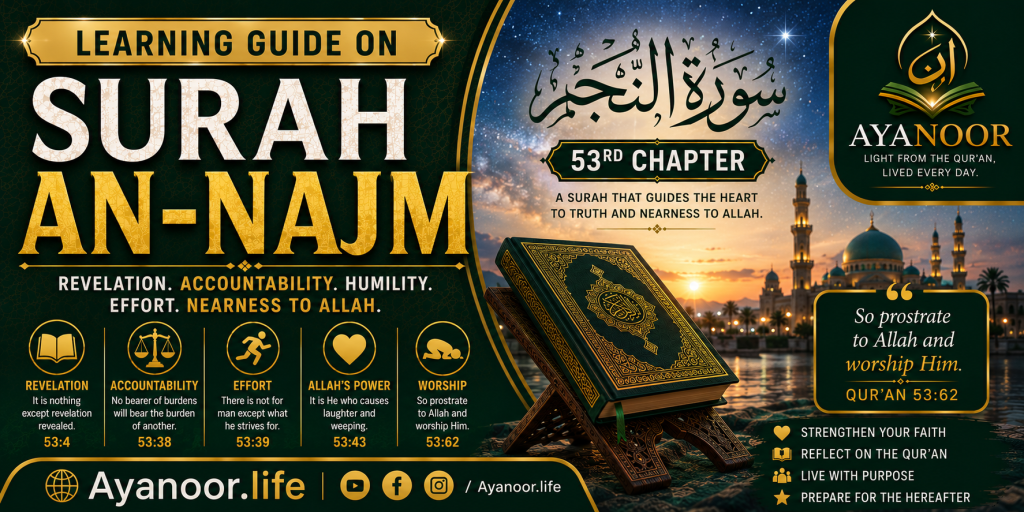
A Learning Guide on Revelation, Truth, Accountability, Humility, and Nearness to Allah
Surah An-Najm (“The Star”) is the 53rd chapter of the Qur’an and is one of the most emotionally powerful Makkan Surahs. It focuses on:
- the truth of divine revelation,
- the authenticity of Prophet Muhammad ﷺ,
- human accountability,
- humility before Allah,
- and the importance of sincere worship.
The Surah powerfully defends the truthfulness of the Prophet ﷺ while calling humanity to reflect upon:
- creation,
- revelation,
- personal responsibility,
- and the temporary nature of worldly life.
It ends with a direct command to humanity:
“So prostrate to Allah and worship Him.”
— Qur’an 53:62
This Surah awakens the heart through:
- deep reflection,
- emotional intensity,
- and reminders about ultimate reality.
1. Prophet Muhammad ﷺ Spoke by Divine Revelation
The Surah begins with Allah swearing by the star:
“By the star when it descends.”
— Qur’an 53:1
Allah then defends the integrity of Prophet Muhammad ﷺ:
“Your companion has neither strayed nor erred.”
— Qur’an 53:2
“Nor does he speak from his own desire.”
— Qur’an 53:3
“It is nothing except revelation revealed.”
— Qur’an 53:4
Reflection
The Surah teaches that Islam is not based on:
- personal opinion,
- imagination,
- or human invention,
but upon divine revelation from Allah.
This strengthens the believer’s trust in:
- the Qur’an,
- prophetic guidance,
- and divine wisdom.
2. Revelation Requires Humility and Reflection
The Surah describes the greatness of revelation and the spiritual experience of the Prophet ﷺ.
It reminds believers that guidance requires:
- humility,
- sincerity,
- and openness of heart.
Reflection
Modern society often places human desire above divine guidance.
People may:
- reshape morality around trends,
- follow emotions blindly,
- or prioritize personal preference over truth.
Surah An-Najm teaches believers to align themselves with divine guidance rather than temporary desires.
3. Human Beings Must Avoid Following Assumptions Blindly
Allah criticizes people who follow assumptions without knowledge.
“They follow nothing except assumption and what their souls desire…”
— Qur’an 53:23
Reflection
Today many opinions spread through:
- social media,
- speculation,
- emotional reactions,
- and misinformation.
The Surah teaches believers:
- seek truth sincerely,
- verify knowledge,
- and avoid blindly following desires or assumptions.
Faith should be grounded in:
- reflection,
- sincerity,
- and wisdom.
4. Every Human Being Is Responsible for Their Own Actions
One of the most important principles in the Qur’an appears in this Surah:
“And that no bearer of burdens will bear the burden of another.”
— Qur’an 53:38
The Surah continues:
“And that there is not for man except what he strives for.”
— Qur’an 53:39
Reflection
The Qur’an teaches personal accountability.
Every individual is responsible for:
- choices,
- intentions,
- effort,
- and actions.
People often:
- blame others,
- blame society,
- or avoid responsibility.
But Surah An-Najm teaches that growth begins when people accept accountability sincerely.
5. Effort Matters Greatly Before Allah
Allah emphasizes the value of sincere effort.
“And that his effort will be seen.”
— Qur’an 53:40
Reflection
The believer should never think:
- good efforts are wasted,
- hidden sacrifices go unnoticed,
- or sincere struggles lack value.
Allah sees:
- private worship,
- emotional struggles,
- patience,
- honesty,
- and acts of kindness that others may never notice.
This verse brings comfort and motivation.
6. Allah Controls Life, Death, and Provision
The Surah reminds humanity that ultimate control belongs to Allah.
“And that it is He who causes laughter and weeping.”
— Qur’an 53:43
“And that it is He who gives death and gives life.”
— Qur’an 53:44
Reflection
People often believe they control everything through:
- wealth,
- status,
- power,
- or planning.
But Surah An-Najm reminds believers that:
- life itself is dependent upon Allah,
- emotions are within His knowledge,
- and human beings remain dependent upon Him at every moment.
This develops:
- humility,
- gratitude,
- and reliance upon Allah.
7. Earlier Nations Were Destroyed Because of Arrogance
The Surah mentions past nations such as:
- the people of Nuh,
- ‘Ad,
- and Thamud.
These nations were destroyed because of:
- arrogance,
- corruption,
- denial of truth,
- and moral rebellion.
Reflection
History repeatedly shows that civilizations collapse when:
- arrogance replaces humility,
- corruption replaces justice,
- and desires replace morality.
The Qur’an teaches believers to learn from history instead of repeating its mistakes.
8. Nearness to Allah Requires Sincerity
The Surah repeatedly calls believers toward sincerity in worship.
It condemns superficial spirituality and reminds humanity that Allah sees the heart.
Reflection
True faith is not:
- appearance alone,
- slogans,
- or public image.
Real faith transforms:
- behavior,
- character,
- speech,
- priorities,
- and relationships.
The believer’s goal is closeness to Allah through sincerity.
9. The Surah Ends with Humility and Worship
The ending of Surah An-Najm is deeply emotional.
Allah asks:
“Then at this statement do you wonder?”
— Qur’an 53:59
“And you laugh and do not weep?”
— Qur’an 53:60
The Surah concludes:
“So prostrate to Allah and worship Him.”
— Qur’an 53:62
Reflection
The proper response to divine truth is not arrogance or distraction — it is humility, reflection, and worship.
The first Muslims reportedly fell into prostration when hearing this Surah because of its emotional power and truth.
Practical Lessons from Surah An-Najm
Personal Lessons
- Seek truth sincerely
- Accept personal responsibility
- Avoid blind assumptions
- Stay humble before Allah
- Value sincere effort
Family Lessons
- Build homes upon honesty and accountability
- Encourage sincere worship
- Teach responsibility and effort
- Avoid arrogance and selfishness
Community Lessons
- Truth must be based upon knowledge
- Societies collapse through arrogance
- Accountability strengthens communities
- Humility creates justice and compassion
Spiritual Lessons
- Revelation is divine guidance
- Allah sees every effort
- Human beings depend completely upon Allah
- Worship softens and awakens the heart
Important Ayahs for Reflection
Revelation from Allah
“Nor does he speak from his own desire.”
— Qur’an 53:3
Personal Responsibility
“No bearer of burdens will bear the burden of another.”
— Qur’an 53:38
Value of Effort
“There is not for man except what he strives for.”
— Qur’an 53:39
Allah Controls Life
“It is He who causes laughter and weeping.”
— Qur’an 53:43
Worship and Prostration
“So prostrate to Allah and worship Him.”
— Qur’an 53:62
Questions for Reflection
- Am I following truth or simply following desires?
- Do I take responsibility for my actions sincerely?
- How much effort am I making to grow spiritually?
- Do I approach revelation with humility?
- Is my worship transforming my character?
- Am I becoming closer to Allah through sincerity?
Conclusion
Surah An-Najm is a powerful reminder about:
- revelation,
- accountability,
- humility,
- sincere effort,
- and closeness to Allah.
The Surah teaches believers that:
- divine guidance is truth,
- every person is accountable,
- assumptions can mislead,
- and sincere effort matters deeply before Allah.
It reminds humanity that:
- worldly pride fades,
- Allah controls all affairs,
- and true honor lies in worship, sincerity, and submission to Him.
Above all, Surah An-Najm calls believers to humble themselves before divine truth and to live lives rooted in reflection, responsibility, worship, and nearness to Allah.
Leave a Reply