

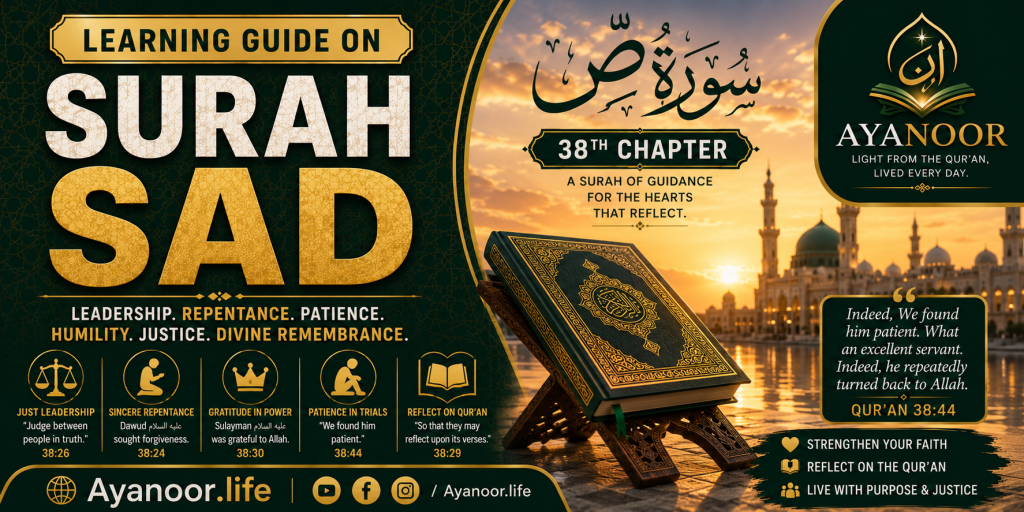
A Learning Guide on Leadership, Repentance, Patience, Humility, and Divine Responsibility
Surah Sad is the 38th chapter of the Qur’an and is one of the most profound chapters concerning:
- leadership,
- moral responsibility,
- spiritual humility,
- repentance,
- and steadfastness during trials.
The Surah highlights the lives of several prophets including:
- Dawud (David) عليه السلام,
- Sulayman (Solomon) عليه السلام,
- Ayyub (Job) عليه السلام,
- and Prophet Muhammad ﷺ.
Through their stories, Allah teaches believers that:
- power is a test,
- leadership requires justice,
- hardships refine the soul,
- and sincere repentance brings people closer to Allah.
Surah Sad repeatedly reminds humanity that:
- worldly success without humility can become dangerous,
- while sincere faith transforms hardship into spiritual growth.
1. The Qur’an Is a Reminder for Humanity
The Surah begins by emphasizing the greatness of the Qur’an:
“By the Qur’an containing reminder…”
— Qur’an 38:1
Allah explains that many reject truth not because of lack of evidence, but because of:
- arrogance,
- pride,
- and attachment to worldly status.
“But those who disbelieve are in pride and division.”
— Qur’an 38:2
Reflection
Modern society often values:
- image,
- power,
- popularity,
- and material success
more than humility and truth.
Surah Sad reminds believers that guidance requires:
- openness,
- sincerity,
- and willingness to reflect honestly.
2. Arrogance Was the Downfall of Iblis
One of the central lessons in Surah Sad is the story of Iblis refusing to bow before Adam عليه السلام.
“He said: I am better than him…”
— Qur’an 38:76
Iblis allowed arrogance to overpower obedience.
Reflection
Arrogance remains one of humanity’s greatest spiritual dangers.
People may become arrogant because of:
- wealth,
- knowledge,
- race,
- status,
- beauty,
- or power.
The Surah teaches that arrogance blinds people from truth and destroys spiritual growth.
3. Leadership Requires Justice and Accountability
Allah speaks about Prophet Dawud عليه السلام and reminds him:
“O Dawud, indeed We have made you a successor upon the earth, so judge between people in truth…”
— Qur’an 38:26
Leadership in Islam is not merely authority — it is responsibility.
The verse continues:
“And do not follow desire, lest it lead you away from the path of Allah.”
— Qur’an 38:26
Reflection
Whether someone leads:
- a family,
- business,
- organization,
- or nation,
leadership requires: - fairness,
- integrity,
- humility,
- and self-control.
Many societies suffer when leaders prioritize:
- ego,
- greed,
- or personal desire over justice.
4. Sincere Repentance Elevates a Person
Surah Sad beautifully shows that even righteous people seek forgiveness and return to Allah sincerely.
After realizing a mistake in judgment, Dawud عليه السلام immediately repented.
“And Dawud realized that We had tested him, so he sought forgiveness from his Lord…”
— Qur’an 38:24
Reflection
The Qur’an teaches that greatness is not perfection — it is the willingness to:
- admit mistakes,
- correct oneself,
- and return to Allah humbly.
A sincere believer does not become arrogant after success nor hopeless after failure.
5. Blessings Should Bring Gratitude, Not Distraction
Allah granted Sulayman عليه السلام:
- power,
- wealth,
- wisdom,
- and control over many resources.
Yet Sulayman remained devoted to Allah.
“Indeed, he was one who repeatedly turned back to Allah.”
— Qur’an 38:30
Reflection
Modern people often become distracted by:
- business,
- entertainment,
- ambition,
- and worldly achievements.
Surah Sad teaches believers that blessings should strengthen spirituality rather than weaken it.
Success should produce:
- gratitude,
- humility,
- and responsibility.
6. Hardship Can Purify the Soul
The story of Prophet Ayyub عليه السلام is one of the Qur’an’s greatest examples of patience.
He experienced:
- illness,
- loss,
- emotional suffering,
- and hardship.
Yet he remained patient and connected to Allah.
“Indeed, We found him patient. What an excellent servant. Indeed, he repeatedly turned back to Allah.”
— Qur’an 38:44
Reflection
Many people today struggle emotionally because hardship feels meaningless.
Surah Sad teaches that trials can:
- purify the heart,
- strengthen faith,
- build empathy,
- and deepen spiritual maturity.
Patience does not mean lack of pain — it means refusing to lose faith during pain.
7. The Hereafter Is More Important Than Worldly Pride
The Surah repeatedly reminds humanity about the reality of the Hereafter.
Allah contrasts:
- temporary worldly arrogance,
- with eternal accountability.
“This is a reminder. And indeed, for the righteous is a good place of return.”
— Qur’an 38:49
Reflection
People often become consumed by:
- reputation,
- luxury,
- status,
- and temporary success.
But Surah Sad redirects focus toward:
- eternal values,
- sincerity,
- worship,
- and accountability before Allah.
8. The Qur’an Was Revealed for Reflection
Toward the end of the Surah, Allah explains the purpose of revelation:
“This is a blessed Book which We have revealed to you so that they may reflect upon its verses…”
— Qur’an 38:29
The Qur’an was revealed not only for recitation, but for:
- reflection,
- understanding,
- and transformation.
Reflection
A believer should continually ask:
- How is the Qur’an changing my behavior?
- Is it increasing humility?
- Is it improving character?
- Is it shaping priorities?
9. Prophet Muhammad ﷺ Was Told to Remain Patient
The Surah repeatedly comforted Prophet Muhammad ﷺ during rejection and opposition.
“Be patient over what they say…”
— Qur’an 38:17
Reflection
People pursuing truth often face:
- criticism,
- misunderstanding,
- rejection,
- and emotional exhaustion.
Surah Sad teaches believers:
- remain patient,
- stay principled,
- and trust Allah’s wisdom.
Practical Lessons from Surah Sad
Personal Lessons
- Control arrogance
- Stay humble during success
- Repent sincerely after mistakes
- Reflect deeply on the Qur’an
- Remain patient during hardship
Family Lessons
- Lead with justice and compassion
- Teach accountability with mercy
- Encourage gratitude within the home
- Build emotional resilience
Community Lessons
- Leadership is a trust
- Justice strengthens societies
- Arrogance destroys communities
- Compassion and humility create unity
Spiritual Lessons
- Allah values sincerity and repentance
- Hardship can elevate the soul
- Blessings are tests
- The Hereafter is the ultimate reality
Important Ayahs for Reflection
Leadership and Justice
“Judge between people in truth…”
— Qur’an 38:26
The Qur’an for Reflection
“So that they may reflect upon its verses…”
— Qur’an 38:29
Patience of Ayyub
“Indeed, We found him patient…”
— Qur’an 38:44
Arrogance of Iblis
“I am better than him…”
— Qur’an 38:76
Patience During Criticism
“Be patient over what they say…”
— Qur’an 38:17
Questions for Reflection
- Do success and blessings increase my humility or arrogance?
- How do I respond after making mistakes?
- Am I leading others with fairness and compassion?
- How patient am I during hardship?
- Do I reflect deeply upon the Qur’an?
- Am I prioritizing worldly image over eternal values?
Conclusion
Surah Sad is a powerful reminder that:
- leadership is responsibility,
- success is a test,
- hardship is purification,
- and repentance is a path back to Allah.
The Surah teaches believers through the examples of the prophets that true greatness lies not in power or status, but in:
- humility,
- sincerity,
- patience,
- justice,
- and constant return to Allah.
It reminds humanity that:
- arrogance destroys,
- gratitude elevates,
- patience strengthens,
- and reflection awakens the heart.
Above all, Surah Sad calls believers to live with humility before Allah while carrying responsibility, character, and justice in every aspect of life.
Leave a Reply